
A washing machine typically fades into the background of everyday life. Clothes are loaded, a button is pressed, and the machine quietly performs its job. When the motor stops working, that familiar routine is interrupted. The washer may remain full of water, produce a humming sound without spinning, or sit completely silent.
The motor functions as the mechanical core of a washing machine. It drives the drum movement that agitates clothing and spins out water during the final stage of the cycle. When this component fails or struggles to start, the entire appliance becomes ineffective.
Understanding why a washing machine motor stops working requires looking beyond a single cause. Several mechanical and electrical systems operate together inside a washer. A malfunction in one area can prevent the motor from functioning, even when the motor itself has not actually failed.
Taking a closer look at how these systems interact often makes troubleshooting more manageable and helps avoid unnecessary repairs
In this article
The Role of the Motor Inside a Washing Machine
The motor converts electrical energy into mechanical motion. In simple terms, it transforms electricity into rotation. That rotation transfers through belts, couplings, or direct-drive systems that turn the drum.
During a normal wash cycle, the motor performs several functions:
- Rotating the drum slowly during the agitation phase
- Reversing direction to move clothing through water
- Increasing speed for the spin cycle
- Working with the control board to regulate cycle timing
Modern washing machines depend on precise communication between electronic controls and mechanical components. The control board sends signals that instruct the motor when to start, how fast to spin, and when to stop.
Because of this coordination, a motor problem does not always originate within the motor itself. In some situations, the motor remains fully functional but cannot operate because of a sensor malfunction, wiring problem, or safety mechanism.
Recognizing this relationship helps explain why diagnosing washer problems can sometimes feel confusing. A silent drum may result from several different underlying issues
What Happens When the Motor Stops Working
When the motor fails to operate, the washer often shows a few recognizable patterns of behavior.
In some machines, the washer fills with water but never begins agitation. The cycle appears to start normally, yet the drum remains motionless. In other cases, the motor produces a humming sound while the drum refuses to move.
Common situations include:
- The washer fills with water but does not begin washing
- The machine hums while the drum remains still
- The drum moves briefly and then stops mid-cycle
- The washer drains water but does not spin
- The appliance becomes completely silent
Each pattern can point toward a different part of the system. A humming sound often indicates that electrical power is reaching the motor, but something is preventing it from turning. A completely silent washer may suggest a control issue or power interruption.
These small clues frequently provide more useful information than an error code displayed on the control panel
Mechanical Problems That Commonly Stop the Motor
Mechanical components surrounding the motor experience constant motion and stress. Over time, normal wear can interrupt the transfer of movement from the motor to the drum.
One of the most common issues involves the drive belt. Many washing machines use a rubber belt that connects the motor to the drum pulley. If the belt stretches, slips, or breaks, the motor may continue running while the drum remains stationary.
Another component that sometimes fails is the motor coupling. In certain washer designs, a small plastic or rubber connector links the motor shaft to the transmission system. Repeated overloading can cause this connector to crack or break.
Carbon brushes represent another point of mechanical wear. These small conductive components maintain electrical contact inside certain types of motors. Over time, friction gradually wears them down until the motor can no longer receive a stable electrical connection.
A worn brush does not always lead to immediate failure. Instead, the washer may behave inconsistently—starting normally during one cycle and refusing to spin during the next.
Mechanical wear rarely occurs suddenly. In most cases, machines show subtle warning signs before the motor stops completely
Electrical and Control System Issues
Mechanical wear explains many washer problems, but electrical systems also play a crucial role in motor operation.
The control board acts as the appliance’s central processing unit. It receives signals from sensors and determines how the machine should behave during each stage of the cycle. If the board fails to send the appropriate signal, the motor will not receive instructions to start.
A damaged wiring harness can create similar symptoms. The vibration produced during wash cycles can gradually loosen connections over time. If a wire becomes disconnected or damaged, electrical power may not reach the motor even though the washer appears to be operating normally.
Capacitors are another important component in many washing machine motors. These small devices store electrical energy and release it in a way that helps the motor begin rotating. When a capacitor weakens or fails, the motor may produce a humming sound but struggle to start turning.
The lid switch is another component that is often overlooked. Many washers include a safety feature that prevents the drum from spinning when the lid or door is open. If the switch becomes faulty, the washer may incorrectly assume the lid is open and refuse to start the motor.
Electrical issues can sometimes resemble serious motor failures, which is why careful testing is often necessary before replacing major components.
Situations That Can Stop the Motor Without Any Broken Parts
Not every motor problem involves damaged components. In some cases, the washer simply cannot operate under certain conditions.
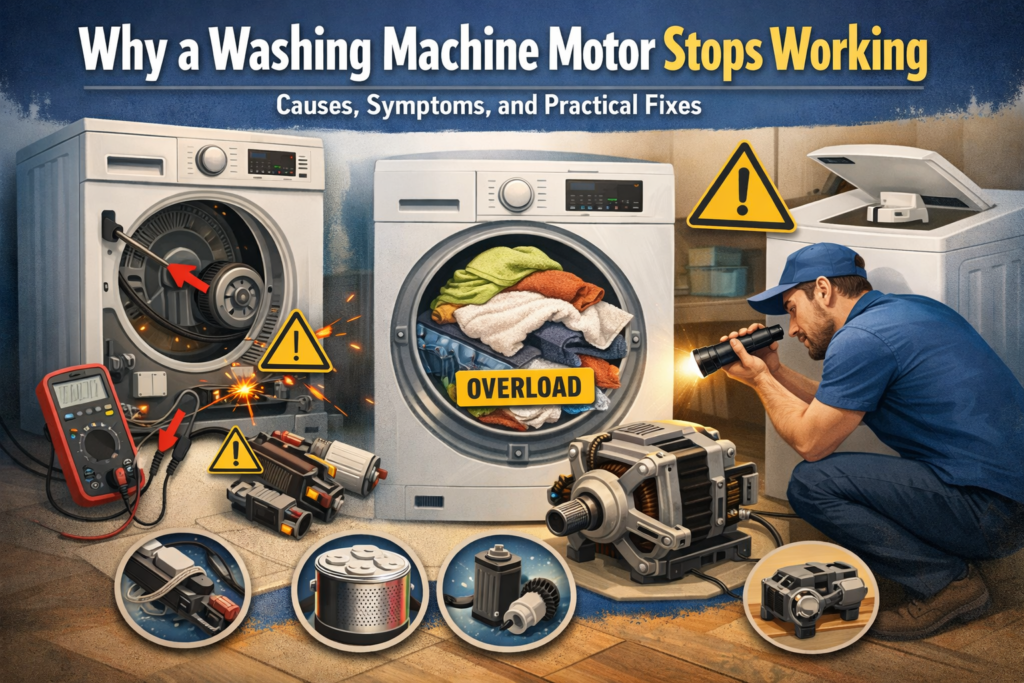
An overloaded drum is one of the most common causes. Heavy items such as blankets or comforters place significant strain on the motor. When the load becomes too heavy or uneven, many machines automatically stop the motor to prevent internal damage.
Imbalanced loads can produce a similar result. If clothing shifts to one side of the drum, the washer may detect excessive vibration and cancel the spin cycle.
Drainage problems can also interfere with motor operation. Most washers will not begin spinning until the water has drained completely. If the drain hose becomes blocked or kinked, the washer may appear stuck in the wash cycle even though the motor itself is functioning properly.
These issues often resolve quickly once the underlying condition is corrected.
Two everyday situations illustrate how easily this can occur.
A homeowner might load several thick towels into the washer before leaving for work. When they return, the machine is filled with wet laundry and the drum has barely moved. The issue is not a faulty motor but the excessive weight of the load.
In another situation, someone may notice their washer humming quietly during the spin cycle. After redistributing a heavy blanket that had shifted to one side of the drum, the machine resumes normal operation.
In many cases, small adjustments restore normal function immediately.
What a Washing Machine Motor Cannot Realistically Do
Marketing language surrounding appliances sometimes creates unrealistic expectations. A washing machine motor is durable, but it cannot overcome every obstacle placed inside the drum.
No motor is designed to handle unlimited weight. Consistently overloading the washer places strain on belts, couplings, bearings, and internal mounts. Over time, this stress reduces the lifespan of the entire appliance.
A motor also cannot compensate for blocked drainage or faulty electronics. When sensors detect unsafe operating conditions, modern washers intentionally stop the motor to protect internal components.
Some repair advertisements suggest that replacing the motor will automatically restore a malfunctioning washer. In reality, the motor is only one part of a larger system. Installing a new motor without addressing underlying problems can result in repeated failures.
Recognizing these limitations helps set realistic expectations when diagnosing washer problems.
Safety, Maintenance, and Repair Considerations
Working with appliances requires caution. Washing machines combine water, electricity, and heavy mechanical parts within a compact structure.
Before inspecting any internal components, the machine should always be unplugged from the electrical outlet. Disconnecting the power supply reduces the risk of electrical shock and prevents the washer from starting unexpectedly.
Routine maintenance can significantly reduce motor-related problems. A few simple habits can make a noticeable difference:
- Avoid consistently overloading the drum
- Ensure the washer remains level on the floor
- Check the drain hose periodically for blockages
- Listen for unusual grinding or scraping sounds
These simple checks can reveal early signs of mechanical wear before serious damage develops.
When electrical testing becomes necessary, professional technicians often use multimeters to measure voltage and electrical continuity. These tools help determine whether electricity is reaching the motor and whether internal circuits remain intact.
Attempting complex electrical repairs without proper training can introduce safety risks. In many cases, consulting an experienced technician remains the safest approach.
What Research and Appliance Design Continue to Explore
Washing machine technology continues to evolve. Engineers are constantly developing new motor designs aimed at improving efficiency, durability, and noise control.
Direct-drive systems provide one example. These designs eliminate belts entirely by connecting the motor directly to the drum. Fewer moving parts reduce the likelihood of mechanical wear.
Brushless motors represent another important development. By removing carbon brushes, manufacturers reduce internal friction and extend motor lifespan. These motors also tend to operate more quietly and require less maintenance.
Research in appliance engineering continues to examine how electronic controls interact with mechanical components. Improved sensors and updated software may allow washers to detect imbalances earlier and protect motors from unnecessary strain.
As washing machine technology progresses, the boundary between mechanical repair and electronic diagnostics continues to shift.
A Quiet Moment When the Washer Stops
A broken washing machine often highlights how much modern routines depend on simple appliances. The motor hidden beneath the drum rarely attracts attention until it stops turning.
When the washer becomes silent, the problem may stem from worn parts, electronic controls, or something as simple as an uneven load. Careful observation usually provides the first clues.
Understanding how the motor interacts with the rest of the machine turns troubleshooting from guesswork into a more logical process.
Sometimes the solution involves replacing a small component. In other cases, it may be as simple as redistributing a heavy load and restarting the cycle.
Occasionally, the quiet drum simply reminds us how many unseen mechanisms quietly support everyday life
FAQs
Why is my washing machine motor not working?
A washing machine motor may stop working due to several reasons, including a broken drive belt, worn carbon brushes, a faulty lid switch, electrical wiring problems, or a damaged motor capacitor. In some cases, the washer may also stop operating because of an overloaded or unbalanced laundry load.
How do I know if my washing machine motor is broken?
Signs of a failing washer motor include a humming sound without drum movement, a washer that fills with water but does not spin, slow or inconsistent drum movement, or a completely silent machine during the wash cycle. These symptoms can indicate either motor failure or issues in related components.
Can a washing machine run if the drive belt is broken?
No. If the drive belt is broken or has slipped off the pulley system, the motor may still run but the drum will not spin. Replacing or repositioning the belt is usually necessary to restore normal washer operation.
Why does my washing machine hum but not spin?
A humming sound usually means electricity is reaching the motor but the drum cannot move. This can happen because of a faulty motor capacitor, a jammed drum, a worn motor coupling, or an overloaded washer preventing the motor from turning.
Is it worth repairing a washing machine motor?
Repairing a washing machine motor can be worthwhile if the appliance is relatively new and the repair cost is reasonable. Sometimes the issue involves smaller components such as the belt, capacitor, or carbon brushes rather than the motor itself, making the repair more affordable.
How can I prevent washing machine motor problems?
You can reduce the risk of motor problems by avoiding overloading the washer, balancing laundry loads properly, keeping the machine level on the floor, checking the drain hose regularly, and addressing unusual noises or vibration early before they lead to more serious mechanical damage