
A washing machine that fills and then immediately drains is usually reacting to a setup or sensing issue rather than a serious mechanical fault. In many situations, the appliance is actually working as intended, protecting itself from overflow, incorrect water levels, or unstable operating conditions. Understanding how water flow, internal pressure systems, and sensors interact during a wash cycle can help explain why a washing machine fills then immediately drains without completing the process.
If your washing machine fills then immediately drains, the most common cause is a siphoning issue, incorrect drain hose placement, or a faulty water level sensor. In most cases, adjusting the hose height or checking basic components can resolve the problem quickly without major repairs.
Quick Troubleshooting Checklist
- Check if the drain hose is too low or inserted too deep
- Make sure there is an air gap to prevent siphoning
- Inspect water inlet valve and filters
- Verify proper water pressure in your home
- Reset the washing machine for 5–10 minutes
Table of Contents
How the Washing Process Works When a Washing Machine Fills Then Immediately Drains
A modern washing machine follows a controlled sequence designed to ensure proper cleaning and safe operation. Water enters through the inlet valve and rises to a level monitored by a pressure or water-level sensor. Once the correct level is reached, the drum begins agitation or tumbling, and only after the wash phase completes does the machine activate the drain pump to remove water.
This process depends on precise coordination between timing mechanisms, pressure readings, and electronic controls. If any part of this system sends an unexpected signal, the washer may interrupt the cycle to prevent potential issues. When a washing machine fills then immediately drains, it typically indicates that the system detects a mismatch in expected conditions, even if everything appears normal externally.
It is important to understand that the washer does not drain randomly. Instead, it responds to internal feedback, interpreting certain signals as incomplete filling, overfilling risk, or operational faults that require immediate correction
Common Signs of This Problem
If your washing machine fills then immediately drains, you may notice specific patterns during operation.
- Water drains while the machine is still filling
- Washer stops before starting agitation
- Cycle pauses or resets automatically
- Clothes remain wet but unwashed
The Hidden Role of Gravity and Water Flow
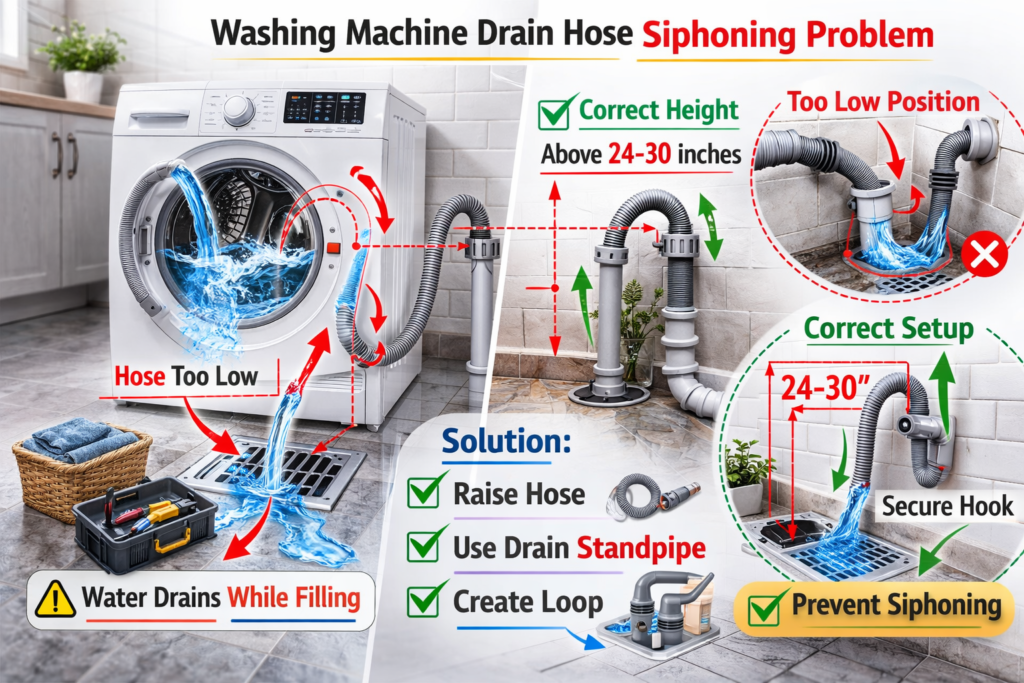
One of the most common causes of this issue is unrelated to electronics and instead involves basic water physics. Gravity plays a significant role in how water moves through the washer and its drainage system. If the drain hose is positioned too low or inserted too deeply into the standpipe, water may begin flowing out of the machine as it fills. This creates a siphoning effect, where water is continuously pulled out before the tub can reach the required level. As a result, the washer keeps filling but never stabilizes at the correct water level.
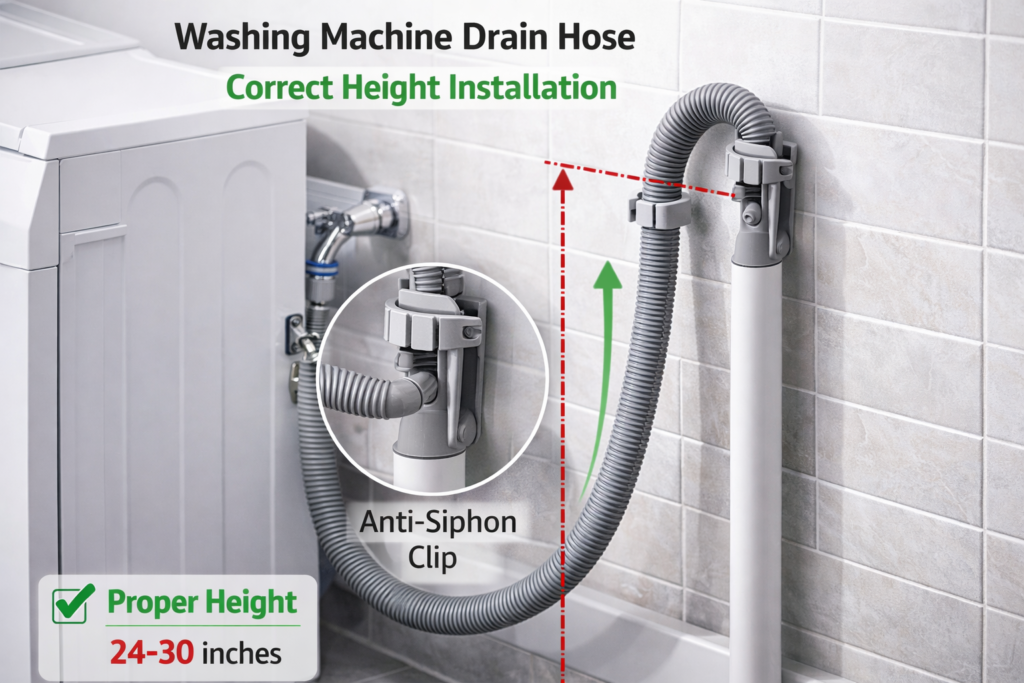
From the machine’s perspective, this appears as a failure to fill properly. After a certain period, the system may stop the cycle and drain completely as a precaution. This is one of the most frequent reasons a washing machine fills then immediately drains, especially after installation or relocation. Simple adjustments can often resolve this issue. Raising the drain hose, ensuring it is not sealed tightly into the pipe, and maintaining an air gap can significantly improve water retention and restore normal operation
When the Machine Misreads the Water Level
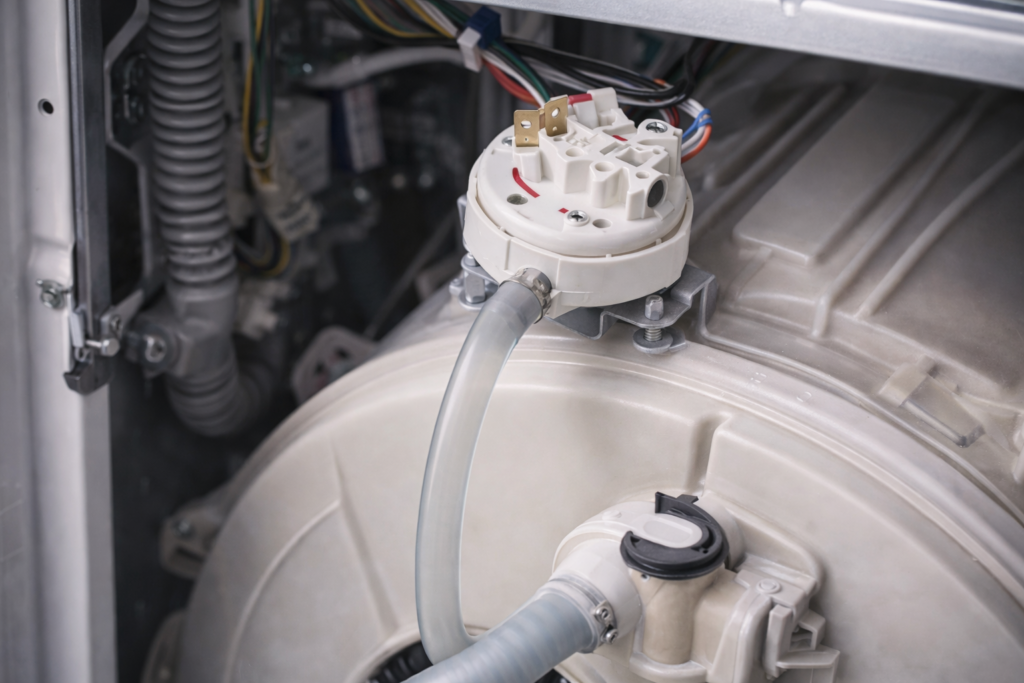
Inside the washer, a pressure-based sensor monitors water levels by detecting changes in air pressure within a connected tube. This system does not directly measure water but instead interprets pressure variations to determine how full the drum is. If the pressure hose becomes blocked, kinked, or disconnected, the readings can become inaccurate. In such cases, the machine may incorrectly assume that the correct water level has already been reached, even when the tub is only partially filled. This misinterpretation can trigger the drain cycle prematurely.
The sequence typically unfolds as follows: water enters normally, the sensor sends incorrect data, and the control system responds by draining. This explains why a washing machine fills then immediately drains without initiating agitation or completing the wash cycle. In real-world scenarios, this issue can appear suddenly. A washer that functioned properly one day may begin malfunctioning after being moved, cleaned, or opened for inspection, as these actions can disturb internal hoses or connections
This issue often happens when a washing machine fills then immediately drains due to improper installation or water flow imbalance.
If your washing machine fills then immediately drains, checking the hose height and internal sensors should be your first step.
Why Slow Filling Causes a Washing Machine to Fill Then Immediately Drain
Not all cases involve water leaving the machine too quickly. In some situations, the issue stems from water entering too slowly. Modern washers are programmed with time limits for filling. If the expected water level is not reached within a specific timeframe, the system assumes a fault and cancels the cycle. Restricted water flow can result from partially clogged inlet filters, reduced household water pressure, or a worn water inlet valve. When filling takes longer than expected, the washer may interpret this delay as a malfunction and initiate draining instead of continuing
In this context, the machine is not malfunctioning in a traditional sense. It is following programmed logic designed to prevent inefficient operation or potential overflow conditions. A homeowner may notice that the washer begins normally, takes longer to fill, and then drains abruptly without washing, indicating a flow-related issue rather than a drainage failure
Step-by-Step Fix Guide
- Raise the drain hose to at least 30 inches
- Ensure the hose is not sealed tightly into the pipe
- Clean inlet filters and check water pressure
- Inspect pressure switch hose for blockages
- Restart the machine after making adjustments
A Small Component That Can Stop the Entire Cycle
Washing machines rely on multiple safety checks before allowing the drum to move. One critical component is the door or lid lock mechanism. The system must confirm that the door is securely closed before proceeding with agitation or spinning. If the washer cannot verify that the door is properly locked, it may stop the cycle altogether. In some models, this results in the machine draining the water instead of continuing. This behavior can appear inconsistent, as the washer fills normally but then pauses and empties without completing the cycle.
In everyday use, this may occur when a load is started before leaving home. The machine fills as expected, but upon returning, the clothes remain unwashed in a drained drum. In such cases, the issue may be as simple as a door latch that did not fully engage or a faulty lid switch.
In many situations, a washing machine fills then immediately drains due to incorrect drain hose positioning or internal sensor confusion.
Understanding why a washing machine fills then immediately drains helps prevent repeated cycle interruptions and water loss.
What This Problem Cannot Realistically Do
It is common to assume that a washer exhibiting this behavior is on the verge of complete failure. In most cases, this assumption is inaccurate. A machine that fills and drains immediately is typically responding to a detected issue rather than causing damage itself. This condition is unlikely to harm internal components, flood the home under normal circumstances, or damage clothing during the brief cycle. The system is designed to stop and drain as a protective measure, reducing the risk of more serious problems.
Some online resources suggest that this issue always points to a defective control board or major electrical fault. While such causes are possible, they are less common than installation errors, flow restrictions, or sensor-related issues. Understanding these limitations helps avoid unnecessary repairs and expenses
When You Should Call a Technician
Some situations require professional inspection rather than DIY fixes.
- The machine continues draining after all adjustments
- You hear unusual electrical or clicking sounds
- The control panel behaves unpredictably
- Water fills extremely slowly despite normal pressure
Safety and Practical Considerations
Working with a washing machine involves both water and electricity, which requires careful handling. Before inspecting or adjusting any components, it is essential to disconnect the power supply and turn off the water source. Accessing internal parts without proper precautions can lead to electrical hazards or water leaks. Even simple adjustments, such as repositioning the drain hose, should be done securely to prevent future issues.
It is also important to maintain realistic expectations. Not every problem requires replacing parts. Many cases of a washing machine fills then immediately drains issue can be resolved through minor corrections. Acting too quickly to replace components may lead to unnecessary costs without addressing the root cause.
Two Everyday Situations That Explain the Issue
Consider a scenario where a washing machine is installed in a new location. The drain pipe may be positioned lower than before, and the hose might be inserted too deeply. As a result, the washer repeatedly fills and drains. Adjusting the hose height restores normal operation without any need for repairs.
In another situation, a household experiences varying water pressure throughout the day. The washer functions correctly in the morning but fails to complete cycles in the evening when pressure drops. The difference lies not in the appliance itself but in the water supply conditions. These examples illustrate how environmental factors and installation details can significantly influence washer performance. The issue is often external rather than mechanical.
Where Explanations Sometimes Go Too Far
There is a tendency to interpret any unusual washer behavior as evidence of a serious internal failure. Some guides immediately point to control board defects, complex sensor malfunctions, or electrical faults. This perspective often overlooks simpler explanations. In many cases, a washing machine fills then immediately drains because of installation issues, water flow problems, or minor sensor disruptions. These causes are far more common and easier to address.
This does not mean that serious faults never occur. Rather, it highlights that they should not be assumed without first ruling out more straightforward possibilities.
Why Understanding Still Evolves
Washing machine technology has advanced significantly over time. Earlier models relied on mechanical timers and basic switches, while modern appliances use digital control systems, sensors, and programmed responses. As these systems become more sophisticated, the way problems present themselves also changes. Issues that once had simple mechanical explanations may now involve software logic or sensor interpretation.
Technicians continue to refine diagnostic approaches as they gain experience with newer designs. As a result, understanding of these issues continues to evolve, and explanations become more precise over time.
A Closer Look Before Taking Action
When dealing with this issue, careful observation can be more valuable than immediate intervention. Watching how the machine behaves during a cycle can provide important clues.
Pay attention to whether water drains while the machine is still filling, whether filling takes longer than usual, or whether the cycle pauses before draining. These details can help identify whether the issue relates to siphoning, water flow, or sensor behavior. Replacing parts without identifying the underlying cause may not resolve the problem. A methodical approach often leads to simpler and more effective solutions.
Living With Small Mechanical Imperfections
Household appliances do not always operate with perfect consistency. Variations in water pressure, installation conditions, and normal wear can influence performance over time.
A washer that occasionally drains early may not be experiencing a failure. Instead, it may be responding to subtle changes in its environment. Recognizing this can reduce unnecessary concern and help focus attention on practical adjustments rather than immediate repairs . Understanding how these systems respond to their surroundings provides a clearer perspective on what is actually happening inside the machine
How to Prevent This Issue in the Future
- Install the drain hose at the correct height
- Clean filters and hoses regularly
- Avoid overloading the washing machine
- Check water pressure occasionally
- Run maintenance cycles to keep the system clean
Frequently Asked Questions
Why does my washing machine fill then immediately drain without washing?
This usually happens due to a siphoning issue, incorrect drain hose placement, or a faulty water level sensor. If water is draining while the tub is still filling, the machine cannot reach the correct level and may stop the cycle. In some cases, slow water flow or a pressure switch problem can also trigger this behavior.
How do I know if my washing machine has a siphoning problem?
You can check this by observing the drain hose while the machine is filling. If water is flowing out at the same time, siphoning is likely the cause. This often occurs when the drain hose is too low, pushed too deep into the standpipe, or sealed too tightly without an air gap.
Can low water pressure cause a washing machine to drain immediately?
Yes, low water pressure can lead to this issue. If the washer takes too long to fill, it may time out and automatically drain the water instead of continuing the cycle. Checking inlet filters, water supply valves, and overall pressure can help identify this problem.
Is it safe to keep using a washing machine with this problem?
It is generally safe in the short term because the machine is designed to protect itself by stopping and draining. However, repeated cycles without fixing the issue can waste water and energy, and may eventually lead to wear on internal components. It’s best to diagnose and fix the problem as soon as possible.
Do I need a technician to fix this issue?
Not always. Many cases of a washing machine that fills then immediately drains can be fixed by adjusting the drain hose, cleaning filters, or checking connections. A technician may only be needed if the issue involves internal components like the control board, pressure switch, or wiring.