Washing Machine Stuck on Sensing Cycle
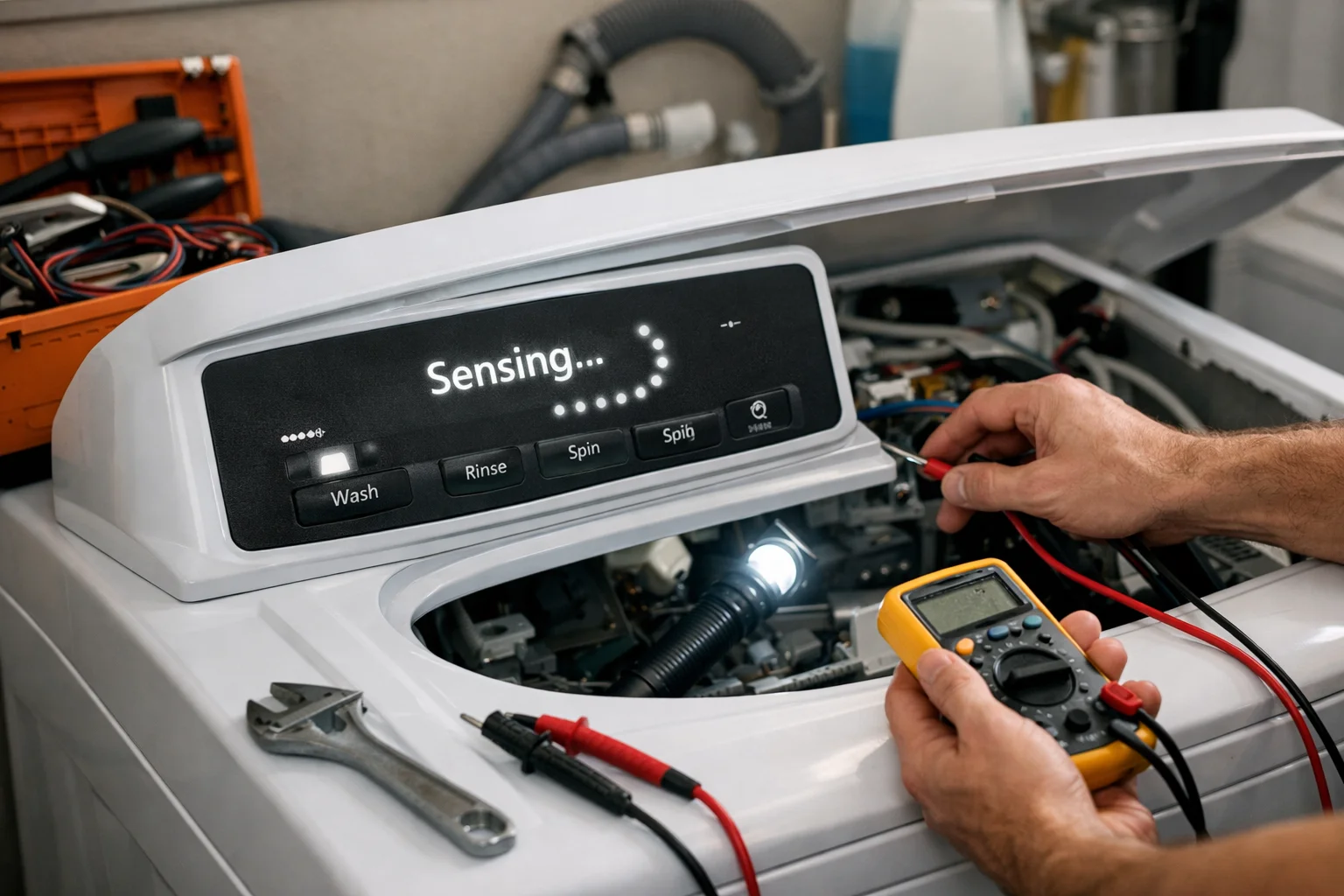
A washing machine stuck on sensing cycle fix situation is rarely a sign of a major failure. In most cases, the system is trying to measure load size, balance, or water intake but cannot complete the process correctly. As a result, the washer pauses during sensing and does not move forward into the wash cycle.
A washing machine stuck on the sensing cycle is usually caused by an unbalanced load, slow water supply, or a faulty lid switch. In most cases, you can fix it by redistributing clothes, resetting the washer, or checking water flow.

Signs Your Washing Machine Is Stuck on the Sensing Cycle
Before trying any washing machine stuck on sensing cycle fix, it helps to confirm that your washer is actually experiencing a sensing-cycle problem. In most cases, the machine repeatedly attempts to detect the laundry load or water level but never moves into the wash cycle. If you notice one or more of the signs below, your washer is likely stuck during the sensing stage.
🔄 Sensing Light Keeps Flashing
The sensing indicator stays on or keeps blinking for several minutes without the wash cycle starting.
💧 Water Never Fills Properly
Your washer begins sensing but little or no water enters the drum, preventing the cycle from continuing.
🧺 Drum Moves Slightly Then Stops
The basket rotates a few inches during load detection but immediately stops instead of beginning the wash cycle.
⏳ Washer Never Starts Washing
The washer remains in sensing mode for several minutes and never advances to washing, rinsing, or spinning.
🔒 Lid Locks but Nothing Happens
The door or lid locks normally, but the machine stays stuck on the sensing cycle without progressing.
⚠️ Cycle Will Not Move Forward
Even after waiting several minutes, the washer remains stuck before the wash cycle starts, indicating a possible sensing issue.
If your washer is stuck on sensing mode, avoid repeatedly pressing the Start button. Instead, continue with the troubleshooting steps below to identify whether the issue is caused by an unbalanced load, restricted water supply, a faulty lid switch, or another common problem.
Table of Contents
This guide explains a complete washing machine stuck on sensing cycle fix with simple and practical steps.
What the Sensing Cycle Is Actually Trying to Do
Modern washing machines are designed to operate with precision rather than simply filling with water and starting immediately. Before the wash cycle begins, the machine enters a sensing phase where it gathers essential information. This includes estimating the size of the laundry load, evaluating how evenly the clothes are distributed, and determining the appropriate water level.
Several internal components work together during this stage. Sensors detect movement and weight, while the control board processes that data to make decisions. At the same time, water inlet valves prepare to regulate flow, and the motor may perform small adjustments to help balance the drum. This coordinated system ensures efficient washing and water usage.
When any part of this process fails to provide accurate feedback, the machine hesitates. This hesitation appears as a washer stuck in sensing mode. It is important to understand that this behavior does not always indicate a malfunction. In many situations, the machine is simply unable to interpret the conditions it is detecting
Why a Washer Gets Stuck in the First Place
When users look for a washing machine stuck on sensing cycle fix, they often expect a single clear cause. In reality, the issue typically arises from a combination of mechanical, electrical, and environmental factors working together.
Common triggers include uneven laundry distribution, restricted or slow water intake, and a lid or door that is not properly recognized as closed. Sensor miscalibration, especially after power interruptions, can also interfere with normal operation. In addition, minor electronic inconsistencies may disrupt communication between components.
Washing machines rely heavily on accurate feedback. If the data received from sensors appears inconsistent or incomplete, the system will not proceed. This cautious design prevents errors during washing but can result in delays. The situation is similar to trying to operate a device that displays conflicting signals—progress is paused until clarity is restored.
This problem is often described as a washer stuck on sensing mode issue in many households.
Understanding this helps in finding the right washing machine stuck on sensing cycle fix quickly.
Reset Washer
Balance Load
Check Water
Check Lid
The Simple Fixes That Work More Often Than Expected
If your washer sensing but not starting, these fixes can help immediately.
Before assuming a serious fault, it is worth trying a few practical troubleshooting steps. These actions help reset how the machine interprets its internal and external conditions. They are not temporary shortcuts but logical adjustments that often resolve the issue.
Resetting the system is one of the most effective initial steps. Unplugging the washer for several minutes allows the control board to clear temporary glitches and restart with a clean state. This process can resolve minor electronic inconsistencies that affect the sensing phase.
Redistributing the laundry load is equally important. Clothes often bunch together, particularly heavier items such as towels or denim. When weight is uneven, the machine struggles to calculate balance accurately. Opening the lid and rearranging items can quickly restore proper distribution and allow the cycle to proceed.
Checking water flow is another essential step. If water enters too slowly due to partially closed valves or clogged inlet filters, the washer may remain in sensing mode. Ensuring that both hot and cold water supplies are fully open and unobstructed can resolve this delay.
Finally, confirming that the lid or door is securely closed is critical. Even a slightly misaligned latch can prevent the machine from recognizing that it is safe to start. These straightforward adjustments address a large percentage of cases involving a washing machine stuck on sensing cycle fix, even though they may seem overly simple at first glance.
Step-by-Step Washing Machine Stuck on Sensing Cycle Fix
If your washing machine is stuck on the sensing cycle, work through the following steps in order. These troubleshooting methods solve the majority of cases without replacing expensive parts. Test the washer after completing each step before moving to the next one.
Step 1 — Reset the Washer
Unplug the washing machine for 3–5 minutes. This clears temporary electronic glitches that may prevent the control board from completing the sensing cycle. Plug the washer back in and start a new cycle.
Step 2 — Redistribute the Laundry
An uneven load is one of the most common reasons a washer gets stuck on sensing mode. Open the lid, separate heavy clothing, and spread the load evenly around the drum before restarting the cycle.
Step 3 — Check the Water Supply
Confirm that both hot and cold water valves are fully open. Inspect the inlet hoses for kinks and clean the inlet filter screens if they appear clogged. Poor water flow can keep the washer in the sensing stage.
Step 4 — Inspect the Lid Switch or Door Lock
If the washer cannot detect that the lid is securely closed, it may never leave the sensing cycle. Make sure the lid closes properly and inspect the latch for visible damage.
Step 5 — Run a Calibration Cycle
Many modern washing machines include a calibration mode that resets load detection. Follow the instructions in your owner’s manual to recalibrate the washer after a power outage or component replacement.
Step 6 — Inspect Internal Components
If the washer still remains stuck on sensing, inspect the water inlet valve, pressure sensor, shift actuator, and control board. These components may require testing or replacement if all previous troubleshooting steps fail.
Troubleshooting Tip
Always begin with the simplest checks before replacing parts. Most washing machine sensing problem solution cases are resolved by correcting an unbalanced load, restoring proper water flow, or resetting the control system.
Estimate Your Washing Machine Repair Cost
Not sure whether your washing machine stuck on sensing cycle fix is worth repairing? Use our free Washing Machine Repair Cost Calculator to estimate repair costs based on the faulty component. It only takes a minute and helps you decide whether repairing or replacing your washer is the smarter choice.
Why Use This Calculator?
- Estimate common washer repair costs.
- Compare repair versus replacement expenses.
- Identify high-cost appliance components.
- Plan your repair budget before calling a technician.
- Completely free and easy to use.
Tip: If your estimated repair cost is close to the price of a new washer, replacing the appliance may be the better long-term investment.
When the Problem Runs a Bit Deeper

If basic troubleshooting does not resolve the issue, the cause may involve specific internal components. While this does not necessarily indicate a major repair, it does require closer inspection of how the machine functions.
The water inlet valve plays a key role in maintaining consistent water flow. If it becomes partially blocked or worn, it may deliver uneven water pressure. This inconsistency can prevent the machine from completing its sensing calculations, causing it to remain stuck.
The pressure sensing system is another critical component. It uses a small air tube to measure water levels inside the drum. If this tube becomes clogged or disconnected, the washer loses its ability to detect how much water is present. Without accurate readings, the system cannot move forward.
In some models, the shift actuator controls transitions between different phases, such as sensing, washing, and spinning. If this part fails, the washer may remain in the initial stage without progressing. Similarly, the control board serves as the central processing unit of the machine. If it misinterprets signals from sensors, the system may appear functional but fail to advance.
Each of these components contributes to the machine’s decision-making process. When the system cannot reach a clear conclusion, the cycle remains incomplete.
Sometimes a washer stuck on sensing no water problem indicates a faulty inlet valve.
You May Also Like
If your washing machine is stuck on the sensing cycle, these related FixAppLab guides can help you diagnose cycle problems, water supply issues, control system faults, and other common washer failures more effectively.
- Washing Machine Won’t Finish Cycle
- Washer Not Completing Cycle
- Washing Machine Stuck on Wash Cycle
- Washing Machine Keeps Pausing
- Washing Machine Not Transitioning Between Cycles
- How to Enter Washing Machine Diagnostic Mode
- Washing Machine Water Inlet Valve Problems
- Complete Washing Machine Problems Guide
- How to Reset a Washing Machine (Step-by-Step)
Should You Repair or Replace Your Washing Machine?
After identifying the correct washing machine stuck on sensing cycle fix, the next question is whether repairing the washer is worth the cost. The answer depends on the age of the appliance, the failed component, and the estimated repair expense.
| Situation | Best Choice |
|---|---|
| Unbalanced load or clogged inlet filter | ✔ Repair Yourself |
| Faulty lid switch | ✔ Usually Worth Repairing |
| Water inlet valve failure | ✔ Repair Recommended |
| Control board failure | Depends on repair cost |
| Multiple major component failures on an older washer | Consider Replacement |
If the estimated repair cost exceeds about 50% of the price of a comparable new washing machine, replacement is often the more cost-effective long-term decision.
Everyday Situations That Trigger the Issue
Real-life scenarios often explain why this issue occurs so frequently. Many situations that seem routine can interfere with the sensing process.
In one example, a person loads a few heavy items such as towels and a hoodie into the washer late at night. These items cluster on one side of the drum, creating an uneven load. The machine attempts to balance the weight but cannot do so effectively, causing it to remain in sensing mode.
Another common scenario occurs after plumbing work or changes in water supply. Slight fluctuations in water pressure may not be noticeable during normal use, but the washer detects these inconsistencies. As a result, it delays the cycle while waiting for stable input.
These situations are part of everyday use and do not indicate unusual behavior. They highlight how sensitive modern washing machines are to changes in load distribution and water flow.
If your washer is also not spinning properly or making unusual sounds, it may indicate deeper mechanical issues.
The Role of Calibration and Why It Matters
Many washing machines rely on calibration routines to maintain accurate performance over time. These routines ensure that the system correctly interprets sensor data and maintains consistent operation.
After extended use or power interruptions, internal measurements can drift slightly. This can affect how the machine evaluates load size or water levels. Running a calibration cycle helps realign these measurements and restore proper function.
Although calibration is not widely discussed, it plays an important role in resolving issues related to a washing machine stuck on sensing cycle fix. The process is similar to recalibrating a scale to ensure accurate readings. The machine itself is not faulty; it simply needs to reset its internal reference points.
This step can resolve many washing machine sensing problem solution cases effectively.
Safety and Practical Considerations

Working with household appliances requires a careful and practical approach. Safety should always be the first priority when inspecting or troubleshooting a washing machine.
Always disconnect the power supply before accessing internal components. Avoid forcing parts into place, as this can cause additional damage. When dealing with water connections, ensure that valves are properly closed to prevent leaks. If panels need to be opened, use appropriate tools and follow safe handling practices.
There is also a practical aspect to consider. Not all repairs are suitable for a do-it-yourself approach. Tasks involving electrical testing or component replacement may require professional assistance. The goal is not only to resolve the issue but to do so without introducing new risks or complications.
For more maintenance tips, you can check this guide from Consumer Reports.
How to Prevent a Washer from Getting Stuck on the Sensing Cycle
The easiest washing machine sensing problem solution is preventing the issue before it starts. Regular maintenance and proper loading habits help the washer complete the sensing cycle correctly and reduce unnecessary wear on internal components.
- Do not overload the washing machine.
- Distribute heavy items evenly around the drum.
- Clean the water inlet filter screens every few months.
- Make sure household water pressure remains consistent.
- Inspect inlet hoses for kinks or restrictions.
- Run the washer calibration cycle whenever recommended by the manufacturer.
- Use the correct wash cycle for the size and type of laundry.
- Address unusual noises or repeated sensing problems before they become more serious.
Simple maintenance habits can prevent many cases where a washer is stuck on sensing mode. Regular cleaning and balanced loads improve washing performance while reducing unnecessary stress on the washer’s sensors and control system.
Looking at the Situation a Bit Differently
When addressing a washing machine stuck on sensing cycle fix, it can be helpful to shift perspective. Rather than viewing the machine as malfunctioning, it is more accurate to see it as unable to confirm the conditions it needs to proceed.
This approach encourages more effective troubleshooting. Checking whether the load is balanced, verifying that water flows properly, and ensuring that sensors receive clear input can often lead directly to a solution.
In many cases, the issue turns out to be less complicated than it initially appears, reflecting a system that needed clearer input rather than extensive repair
In most cases, a washing machine stuck on sensing cycle fix is simple and can be solved without professional help.
Final Verdict
A washing machine stuck on sensing cycle fix is usually much simpler than many homeowners expect. In most situations, the problem is caused by an unbalanced load, restricted water flow, a temporary control board glitch, or a faulty lid switch rather than a major mechanical failure.
Begin with the basic troubleshooting steps such as resetting the washer, balancing the laundry, checking the water supply, and inspecting the lid lock. These simple checks resolve many cases where a washer is stuck on sensing mode without replacing expensive parts.
If your washing machine won’t move past sensing after completing every troubleshooting step, inspect components such as the water inlet valve, pressure sensor, shift actuator, and electronic control board. For advanced electrical testing or internal repairs, contacting a qualified appliance technician is the safest and most reliable option.
Key Takeaways
- Reset the washer before replacing any parts.
- Balance heavy laundry loads evenly.
- Verify proper hot and cold water flow.
- Clean clogged water inlet filter screens.
- Inspect the lid switch if sensing never finishes.
- Consider professional diagnosis if the problem continues.
Frequently Asked Questions
Why is my washing machine stuck on the sensing cycle?
A washing machine usually gets stuck on the sensing cycle due to an unbalanced load, slow water intake, or a faulty lid switch. The machine cannot proceed until it accurately detects load size and water levels. In many cases, redistributing clothes or checking the water supply can resolve the issue.
How do I fix a washing machine stuck on sensing cycle?
Start with simple steps such as unplugging the washer for 3–5 minutes to reset it, balancing the laundry inside, and ensuring the lid or door is fully closed. Also check that water valves are open and inlet filters are clean. These basic fixes solve most washing machine sensing problems.
Can a clogged water inlet or drain cause sensing issues?
Yes, restricted water flow can prevent the washer from completing its sensing phase. If water enters too slowly or cannot drain properly, the machine may stay stuck. Cleaning inlet filters and checking the drain hose for blockages can help restore normal operation.
Does resetting the washer fix the sensing cycle problem?
Resetting the washer often clears temporary electronic glitches that interfere with the sensing cycle. While it may not fix damaged components, it is an effective first step in troubleshooting a washing machine stuck on sensing cycle.
When should I call a technician for this issue?
If the problem continues after basic troubleshooting, there may be a faulty component such as the pressure switch, control board, or shift actuator. In such cases, professional diagnosis is recommended to safely repair the washing machine and prevent further damage
Explore our complete guide on washing machine problems and solutions to diagnose any washer issue step by step.


6 comments
[…] Fix Guide Washing Machine Stuck on Sensing Cycle? Simple Fix Guide If your washer gets stuck on the sensing cycle and won’t start washing, it may be due to water supply issues, sensor problems, or a faulty lid switch. Learn how to troubleshoot and fix the problem step by step. Read Full Guide → […]
[…] Washing Machine Stuck on Sensing Cycle: Causes and Fixes […]
[…] Washing Machine Stuck on Sensing Cycle […]
[…] Washer Stuck on Sensing Cycle – Easy Fix Guide […]
[…] Washing Machine Stuck on Sensing Cycle – Easy Fix Guide […]
[…] Washing Machine Stuck on Sensing Cycle – Causes & Easy Fixes […]