Washing Machine Agitator Not Working Properly? 10 Easy Fixes (2026 Guide)
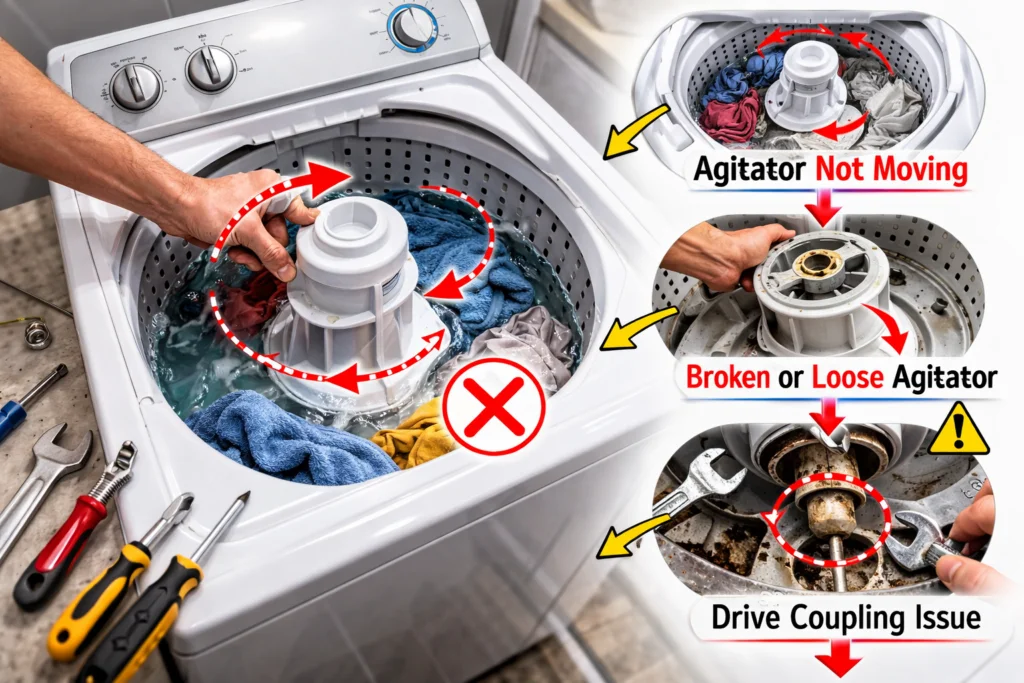
A washing machine agitator not working properly can leave clothes dirty, poorly rinsed, or unevenly washed even when the washer still fills, drains, and spins. The problem may be caused by worn agitator dogs, a damaged agitator connection, a drive coupler, belt, motor, actuator, or another part of the washer’s drive system.
Quick Answer
If your washing machine agitator is not working properly, first check whether the load is too large and look for clothing or debris interfering with the agitator. If the problem continues, worn agitator dogs, stripped splines, a damaged coupler, loose drive belt, actuator, motor, or transmission can be responsible. A washer that still spins and drains normally may have a problem specifically within the agitation or drive system rather than a complete washer failure.
Key Takeaways
- A washer can still fill, drain, and spin when its agitation system has a problem.
- Worn agitator dogs are a common cause on compatible dual-action agitators.
- A loose connection, damaged coupler, belt, actuator, motor, or transmission can also stop proper agitation.
- Simple checks can help identify the problem before expensive parts are replaced.
- Repairing a small mechanical component may be more practical than replacing the entire washer.
Table of Contents
What Does a Washing Machine Agitator Do?
The agitator is the vertical component found in the center of many traditional top-load washing machines. During the wash portion of the cycle, it moves back and forth to create mechanical action inside the tub.
This movement helps circulate water and detergent through clothing while loosening dirt, body oils, and other soils from fabrics. Without enough agitation, the washer may complete a normal-looking cycle but fail to clean clothes effectively.
Different washing machines use different designs. Some have a traditional single-piece agitator, while others use a dual-action agitator with an upper section that moves differently from the lower section. Because of these design differences, the exact failed component depends on the washer’s manufacturer and model.
Signs Your Washer Agitator Is Not Working Properly
The symptoms can range from complete loss of movement to agitation that is simply too weak. Recognizing the pattern can help narrow down the cause.
The washer may fill and continue the cycle, but the agitator remains stationary.
Movement may be present but insufficient to properly circulate clothing and water.
This can point toward worn directional cogs or another internal connection problem on compatible designs.
Poor mechanical action can reduce cleaning performance even when the washer completes the cycle.
Strange noises may indicate a problem with the drive system or another mechanical component.
10 Common Causes of a Washing Machine Agitator Not Working Properly
A washing machine agitator not working properly does not always mean the agitator itself is broken. The problem can originate from several connected components.
1. Worn Agitator Dogs
Agitator dogs, sometimes called directional cogs, help the upper portion of certain dual-action agitators grip and move correctly. When they become worn, the upper agitator may spin freely or fail to engage properly.
2. Stripped or Damaged Agitator Splines
Splines connect the agitator to the drive shaft. If these teeth become worn or stripped, the washer may produce normal drive sounds while the agitator slips instead of moving correctly.
3. Broken Drive Coupler
Some washers use a motor coupling to transfer power between the motor and transmission. A damaged coupler can interrupt power transfer and prevent normal agitation.
4. Loose or Broken Drive Belt
Belt-driven washers rely on proper belt tension to transfer motor power. A stretched, slipping, or broken belt can result in weak or absent agitation.
5. Clothing or Debris Trapped Around the Agitator
A small item of clothing, fabric, or debris can become trapped around the agitator or its base. This can restrict movement and sometimes create unusual sounds.
6. Weak or Failing Drive Motor
A motor that is overheating, struggling, or failing to produce sufficient torque may not move the agitator correctly, particularly under a heavier load.
7. Transmission or Gearcase Problem
The transmission or gearcase helps convert motor rotation into the mechanical movement needed by the washer. Internal wear can cause weak, irregular, or missing agitation.
8. Faulty Shift Actuator
Some modern top-load washers use a shift actuator to control different drive functions. If this component fails, the washer may not enter the correct agitation mode.
9. Wiring or Control Problem
Damaged wiring, loose connectors, sensors, or control components can prevent the washer from correctly commanding the drive system.
10. Overloaded Washer
A heavily packed washer can make agitation appear weak or ineffective. Before replacing parts, test the machine with a smaller, evenly distributed load.
How to Diagnose a Washing Machine Agitator Problem
A systematic diagnosis can prevent unnecessary part replacement. Start with simple observations and only move toward deeper inspection when the symptoms justify it.
- Check the load. Remove some clothing if the washer is heavily packed and test a smaller load.
- Observe the wash cycle. Watch whether the agitator moves back and forth normally, moves weakly, or stays still.
- Listen carefully. Clicking, grinding, humming, or slipping sounds can provide useful clues.
- Unplug the washer before inspection. Never inspect internal components while the appliance is connected to power.
- Check the agitator for excessive looseness. A loose agitator or damaged connection may indicate worn internal components.
- Compare agitation with spinning. If the washer spins normally but will not agitate, the problem may be limited to the agitation drive system.
10 Easy Fixes for a Washer Agitator Not Working Properly
Once you understand the symptom, work through these fixes from the simplest solution to the more involved mechanical checks.
1. Reduce the Load
Remove heavy or excessive clothing and run a smaller load. If the agitator works normally afterward, overloading may have contributed to the problem.
2. Remove Any Obstruction
Unplug the washer and inspect around the agitator and its base. Remove any visible clothing, fabric, or debris that could restrict movement.
3. Inspect the Agitator
Look for cracks, looseness, stripped splines, or other visible damage. A damaged agitator may need replacement rather than adjustment.
4. Check the Agitator Dogs
On compatible dual-action designs, inspect the directional cogs for wear. If they cannot grip properly, replacing the appropriate agitator dog kit may restore normal movement.
5. Inspect the Drive Coupler
If your washer uses a motor coupler, inspect it for cracks or broken sections. A damaged coupler can prevent motor power from reaching the drive system.
6. Check the Drive Belt
On belt-driven models, inspect the belt for excessive looseness, damage, glazing, or breakage. Replace it according to the washer manufacturer’s procedure if necessary.
7. Check for Motor Problems
A motor that hums, overheats, or repeatedly stops may need further diagnosis. Do not repeatedly operate a washer if the motor appears to be overheating.
8. Inspect the Shift Actuator
If your washer uses a shift actuator, a failure may prevent the drive system from selecting the correct agitation function. Model-specific diagnostic procedures are recommended.
9. Inspect Wiring and Connectors
Loose or damaged connectors can interrupt communication between the controls and drive components. Electrical testing should only be performed if you are comfortable and qualified to do so.
10. Reset and Retest the Washer
After completing basic checks, disconnect the washer from power according to the manufacturer’s instructions, allow the control system to reset, and test the machine with a suitable small load.
How to Tell Which Agitator Part Is Bad
Different failures can produce similar symptoms. The following comparison can help you decide which area deserves closer inspection.
| Symptom | Possible Cause | What to Check |
|---|---|---|
| Upper agitator spins freely | Worn agitator dogs | Directional cogs and agitator engagement |
| Agitator is loose | Worn splines or connection | Agitator shaft and internal teeth |
| Motor runs but agitator does not move | Coupler, belt, actuator, or drive problem | Drive system components |
| Agitation is weak with heavy loads | Overloading or weakening drive system | Load size, belt, motor, and drive |
| No agitation with unusual motor behavior | Motor or control problem | Motor, wiring, actuator, and controls |
What If the Agitator Moves but Does Not Clean Properly?
A washer agitator does not have to stop completely to have a problem. Weak or inconsistent movement can also reduce cleaning performance.
Start with a smaller load and make sure clothing is distributed reasonably. If the agitator works normally with a light load but struggles with heavier loads, the washer may have a developing drive problem or may simply be overloaded.
If agitation remains weak with different load sizes, inspect the agitator connection and drive components. Persistent grinding, overheating, or repeated stopping should be professionally diagnosed rather than repeatedly tested.
Washing Machine Agitator Repair Cost
The cost to repair a washer agitator depends on the failed component, washer model, parts availability, labor rates, and whether you perform the repair yourself or hire a technician.
- Agitator dogs: usually a relatively small mechanical repair.
- Coupler: generally less expensive than major drive components.
- Drive belt: cost varies by washer model and belt design.
- Motor: typically a more expensive repair than small agitator components.
- Transmission or gearcase: can be a major repair and should be compared with the washer’s age and overall condition.
Repair prices vary by model, location, parts availability, and labor. Get a current estimate before approving a major repair.
Estimate Your Washing Machine Repair Cost
Not sure whether your washer repair is worth the cost? Use our washing machine repair cost calculator to get a quick estimate before deciding what to do next.
Use the Repair Cost Calculator →Should You Repair or Replace the Washing Machine?
An agitator problem does not automatically mean the washer needs to be replaced. The right decision depends on the repair cost, washer age, condition, reliability, and whether other major components are also failing.
Repair May Make Sense When
- The failed part is relatively inexpensive.
- The washer is otherwise reliable.
- There are no major leaks or electrical problems.
- The repair cost is reasonable compared with replacement.
Replacement May Make Sense When
- Several major components are failing.
- A major transmission or drive repair is required.
- The washer has become consistently unreliable.
- The repair approaches the practical value of the appliance.
Safety: When to Stop and Call a Professional
Always disconnect the washing machine from electrical power before inspecting internal mechanical or electrical components.
- Never reach inside a moving washer.
- Do not bypass lid switches, door locks, or other safety devices.
- Stop troubleshooting if you smell burning or see damaged wiring.
- Do not repeatedly run a washer that is overheating or making severe mechanical noises.
- Use model-specific service information when accessing internal components.
If the suspected problem involves the motor, transmission, control board, internal wiring, or another component you are not comfortable servicing, a qualified appliance technician is the safer option.
Frequently Asked Questions
Why is my washing machine not agitating but still spinning?
This usually points toward an issue in the agitation or drive system. Possible causes include worn agitator components, a damaged coupler, belt, actuator, motor, or transmission. The exact cause depends on the washer design.
Why does my washer agitator spin freely?
On compatible dual-action agitators, worn agitator dogs can cause the upper section to spin freely instead of gripping correctly. A damaged or loose agitator connection can create a similar symptom.
Can I fix a washing machine agitator myself?
Some problems, such as a visible obstruction or certain worn mechanical parts, may be suitable for DIY repair. Motor, transmission, control, and electrical problems are more complex and may require professional service.
Is it safe to use a washer if the agitator is not working?
The washer may continue operating, but cleaning performance can suffer. If there is overheating, a burning smell, severe grinding, damaged wiring, or another dangerous symptom, stop using the washer until it has been diagnosed.
Related Washing Machine Guides
Continue troubleshooting with these related FixAppLab guides covering agitation, spinning, movement, and other common washer problems.
Explore Common Washing Machine Problems
If your washer has another problem, explore our complete washing machine troubleshooting hub for guides covering draining, filling, spinning, shaking, noises, electrical issues, cycle problems, and more.
Visit the Washing Machine Problems Guide →Muhammad Khalid
Founder of FixAppLab • Appliance Troubleshooting Writer
Muhammad Khalid is the founder of FixAppLab, a website focused on practical appliance troubleshooting guides. His work covers common washing machine, dryer, refrigerator, and household appliance problems, with an emphasis on helping homeowners understand symptoms, possible causes, repair options, and maintenance.
View Full Author Profile →Appliance designs vary by manufacturer and model. Always consult the owner’s manual or model-specific service information before performing repairs.


6 comments
[…] Related : Washing Machine Agitator Not Working Properly […]
[…] Related : Washing Machine Agitator Not Working Properly? 10 Easy Fixes (2026 Guide) […]
[…] ➤ Washing Machine Agitator Not Working Properly – Causes & Fixes […]
[…] Washing Machine Agitator Not Working Properly – Complete Fix Guide […]
[…] Washing Machine Agitator Not Working Properly […]
[…] Washing Machine Agitator Not Working Properly: Causes and Fixes […]