5 Simple Fixes: Whirlpool Washer Won’t Agitate But Will Spin
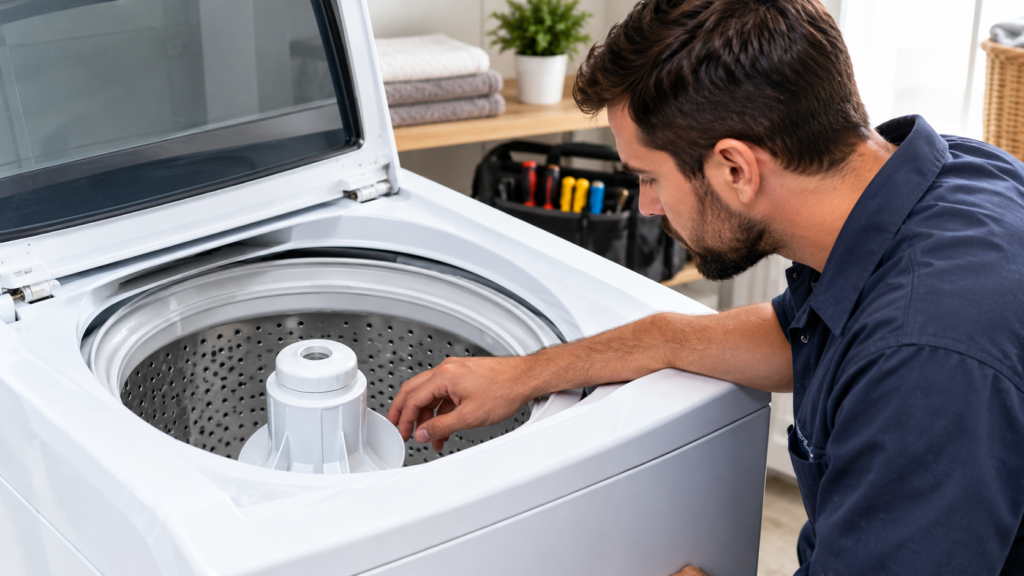
If your Whirlpool washer won’t agitate but will spin, the problem is usually a worn or broken part in the agitation path, not a dead washer. The usual suspects are worn agitator dogs, a worn drive block, a stripped wash plate hub, a failed shift actuator, or a worn motor coupling. Many of these parts are inexpensive, and you can check several of them at home with basic tools.
Quick Key Takeaways
- Agitating and spinning use different parts, so a washer can spin normally and still fail to wash.
- On washers with a center agitator, start with the agitator dogs, then check the drive block.
- On newer models, the shift actuator, splutch, and wash plate hub are the usual suspects.
- Do the easy checks first: a smaller load, the right cycle, listening to the wash phase, and the hand test.
- A transmission, motor, capacitor, or wiring problem is best left to a technician.
Table of Contents
Why a Whirlpool Washer Won’t Agitate but Will Spin
Agitating and spinning are two different jobs. During agitation, the agitator or wash plate moves back and forth to push clothes through the water. During the spin cycle, the whole basket turns in one direction to throw the water out.
If your washer fills, drains, and spins normally, the power supply, drain pump, and lid switch are probably fine. That’s why a Whirlpool washer won’t agitate but will spin even though the machine seems healthy otherwise: the fault sits in the parts that create the back-and-forth wash motion, or in the parts that switch the washer between wash mode and spin mode.
Which parts those are depends on your washer type:
- Traditional top-loaders with a center post use a motor, a transmission, and a two-piece agitator. Plastic parts called agitator dogs let the agitator move one way and lock the other way.
- Newer top-loaders (including many Cabrio and low-profile wash plate models) often use a drive belt, a splutch assembly, and an electronic shift actuator to move between wash and spin.
Find your model number before you order anything. It tells you which design you have.
💡 Pro Tip: Know Your Model Number First
Whirlpool builds several top-load designs, and parts that fit one washer often won’t fit another. The model number is printed on a label on the washer, and its location varies by model, so check your owner’s manual if you can’t spot it.
Write the number down and use it to look up the parts diagram before you buy anything. If you remove a part, take a photo of it first so you can compare it with the replacement.
Quick Diagnosis: What Your Washer Is Telling You
| What you notice | Likely cause |
|---|---|
| Agitator spins freely in both directions by hand | Worn agitator dogs |
| Motor runs, agitator barely moves or doesn’t move | Worn drive block, stripped hub, or worn coupling |
| Clicking when the wash cycle should start | Shift actuator or splutch problem |
| Motor hums but nothing moves | Capacitor, motor, or jammed mechanism |
| Grinding noise or oil under the washer | Transmission or gearcase problem |
⚠️ Safety Note
- Unplug the washer before you touch anything inside it.
- Turn off the water supply if you plan to move the machine.
- Tip the washer back only if you can secure it safely, and get a second person to help.
- Capacitors can hold an electrical charge even when the washer is unplugged. Leave testing them to someone with the right training and tools.
For official manual guidance and safety warnings, visit the Whirlpool Official Support Center.
What to Check First
Before you take anything apart, rule out the easy causes. When your Whirlpool washer won’t agitate but will spin, these quick checks sometimes solve it or at least narrow it down.
Reduce the load. A heavy or tightly packed load strains the drive system. Run a short cycle with a small, balanced load and see if anything changes.
Check the cycle and water level. A low-water cycle can leave clothes barely moving. Too much water can make clothes float so they don’t agitate well. Try a normal or deep fill cycle suited to the load.
Listen during the wash phase. The sound tells you a lot:
- Motor running, no agitator movement: likely a mechanical problem, such as a worn agitator part, drive block, coupling, or transmission.
- Humming or buzzing: the motor may be trying to start but can’t.
- Clicking: possibly a shift actuator or another part trying to change modes and failing.
Power cycle the washer. Unplug it for several minutes, plug it back in, and run a short cycle. This can clear a temporary control glitch, but it won’t repair a damaged part.
Always unplug the washer before touching anything inside it. Turn off the water supply too if you plan to move the machine.
Most Common Causes
Here are the most common reasons a Whirlpool washer won’t agitate but will spin, roughly from most to least likely.
Worn Agitator Dogs

On washers with a center agitator, worn dogs are the first thing to check when a Whirlpool washer won’t agitate but will spin. The dogs are small plastic cogs inside the agitator, under the fabric softener cup at the top. They let the agitator turn freely one way and grip the other way, which creates the washing action. Over time the plastic wears down and stops gripping.
Hand test: With the washer empty and unplugged, turn the agitator counterclockwise. If it catches and the basket moves with it, the dogs are probably fine. If the agitator spins freely in both directions and the basket doesn’t move, the dogs are likely worn out.
Fix: An agitator repair kit includes the dogs and related small parts. The job usually means removing the cap, unscrewing the center bolt, and lifting out the top section of the agitator. Steps vary by model, so check your parts diagram first.
You May Also Like
If your Whirlpool washer won’t agitate but will spin, these related washing machine repair guides may help you identify the problem and find the right fix faster:
- Washing Machine Agitator Not Working Properly: Causes and Fixes
- Washer Fills With Water But Won’t Agitate: 9 Causes and Easy Fixes
- 7 Washer Shift Actuator Problems: Symptoms, Diagnosis & Repair Guide
- Washing Machine Agitation Slow: Causes and Fixes
- Washing Machine Transmission Failure Symptoms: 9 Warning Signs
Worn Drive Block
The drive block (sometimes called the drive bell) sits at the bottom of the agitator and connects it to the transmission shaft. If it’s rounded off or worn, the transmission can move while the agitator barely moves or doesn’t move at all.
It’s easy to mix up the drive block and the agitator dogs, but they sit in different places. The dogs are at the top of the agitator and the drive block is at the bottom. If your Whirlpool washer won’t agitate but will spin right after you replaced the dogs, check the drive block next.
Stripped Wash Plate or Drive Hub
Washers with a flat wash plate instead of a tall agitator use a plastic hub that fits onto a splined shaft. If those plastic splines wear smooth, the shaft turns but the wash plate doesn’t grip it.
You may hear the motor working while the wash plate stays still. Removing the center cap and bolt and lifting the plate may show plastic dust or smooth, rounded splines. The fix is to replace the worn wash plate or hub parts made for your exact model.
Failed Shift Actuator
On many newer top-load Whirlpool models, the shift actuator helps the washer change between agitation and spin. A failed or stuck actuator is a leading suspect when a Whirlpool washer won’t agitate but will spin on these models, because the washer can still spin but never properly enters wash mode.
Common signs include no agitation with normal spinning, clicking when the washer tries to change modes, and a fault code on some models. If your washer shows a code, write it down before resetting the machine. Diagnostic steps differ between models, so follow your owner’s manual or service sheet instead of a generic procedure.
You May Also Like
If you’re troubleshooting a washer that spins but has trouble with its wash motion, these related repair guides can help you check the motor, drive system, and other possible causes:
Damaged Splutch or Cam Components
Some newer models use a splutch assembly, a combined clutch and pulley that works with the shift actuator. If its plastic parts are cracked, worn, or jammed with grime, the washer may not be able to lock into wash mode. Look for cracked plastic, broken tabs, or loose parts, and listen for grinding or scraping when the washer tries to shift.

Worn Motor Coupling
Older direct-drive Whirlpool washers use a plastic-and-rubber motor coupling to connect the motor to the transmission. A completely broken coupling usually stops both agitating and spinning. A partly worn one can slip under load, so it’s worth checking if the machine hums or smells like hot rubber during the wash phase.
Inspecting it means unplugging the washer and getting to the motor and transmission area, which typically requires removing the cabinet. A cracked or broken coupling needs to be replaced.
Weak Motor or Capacitor
If the motor hums during wash mode but doesn’t turn, a failing capacitor or motor could be responsible. Agitation makes the motor reverse direction repeatedly against the weight of water and clothes, so it can expose problems that plain spinning doesn’t.
Don’t keep restarting a motor that only hums, because it can overheat. Capacitors can also hold an electrical charge after the washer is unplugged, so testing one safely takes the right knowledge and tools. If you’re not experienced with electrical testing, this is a good time to call a technician.
Transmission or Gearcase Failure
If your Whirlpool washer won’t agitate but will spin and the parts above all check out, the transmission may be failing. A common check is to unplug the washer, get access to the motor area, rotate the motor shaft by hand, and watch the transmission input shaft. If the input shaft turns but the agitator or wash plate doesn’t move back and forth, the transmission is the likely problem.
Other warning signs are grinding noises, oil or grease under the machine, and a locked shaft.
Less Common Electrical Causes
Loose or damaged wiring, a faulty lid switch, a bad timer on older models, or a control issue can also interfere with agitation. A bad lid switch more often stops the washer from doing anything at all, so it’s less likely when spinning works normally. Checking connectors and wiring for loose or damaged parts is still worthwhile, as long as the power is disconnected.
Troubleshooting Order: Cheapest Checks First
To avoid buying parts you don’t need, use this order when your Whirlpool washer won’t agitate but will spin:
- Run a small, balanced load on the correct cycle.
- Listen to what the washer does during the wash phase.
- Do the agitator hand test.
- Inspect the agitator, drive block, or wash plate hub for wear.
- Check for error codes, then look at the shift actuator and splutch if your model has them.
- Inspect the motor coupling, if your model uses one.
- Check whether the transmission input shaft turns when the agitator doesn’t.
Match each finding to your exact model number before buying anything. Whirlpool uses several designs, and a part that fits one washer won’t fit another.
Common Mistakes to Avoid
One of the most common mistakes when a Whirlpool washer won’t agitate but will spin is replacing the agitator dogs when the real problem is the drive block, or the other way around. Other easy mistakes include ordering parts without confirming the model number, skipping the hand test, and restarting a humming motor again and again. Take a few minutes to diagnose first and you’ll usually save money.
Can You Fix It Yourself?
When a Whirlpool washer won’t agitate but will spin, some repairs are beginner-friendly and some aren’t.
Usually reasonable for a careful DIYer:
- Replacing agitator dogs with a repair kit
- Replacing a worn drive block
- Replacing a stripped wash plate or hub
- Replacing a shift actuator, if you’re comfortable tipping the washer back safely
Better left to a professional:
- Replacing a transmission or gearcase
- Testing or replacing a motor or capacitor
- Chasing control board or wiring faults
When to Call a Technician
Call a technician if your Whirlpool washer won’t agitate but will spin and you also notice any of these:
- A burning smell
- A motor that gets very hot
- Damaged or melted wiring
- A tripped circuit breaker
- Oil or grease leaking from under the machine
- Severe grinding noises
Repair or Replace?
It depends on what failed. Small parts like agitator dogs, a drive block, or a wash plate hub are usually inexpensive, and replacing them can give an older washer several more years. A transmission, motor, or control board costs much more.
If your Whirlpool washer won’t agitate but will spin because of one of those bigger parts, weigh the repair cost against the washer’s age and condition. A newer washer may still be worth fixing. An older washer with an expensive failure may not be.
How to Prevent It From Happening Again
- Don’t overload the tub, especially with towels, blankets, and jeans.
- Spread heavy items evenly around the tub.
- Use the recommended amount of HE detergent, since too many suds add drag.
- Fix leaks promptly, because water reaching the drive area can damage parts underneath.
Frequently Asked Questions
Why does my Whirlpool washer spin but not agitate?
Agitation and spinning use different mechanisms. A Whirlpool washer won’t agitate but will spin when parts that create the back-and-forth motion, such as agitator dogs, a drive block, a wash plate hub, a shift actuator, or the transmission, fail while the spin function keeps working.
What is the most common reason a Whirlpool washer won’t agitate but will spin?
On washers with a center agitator, worn agitator dogs are one of the most common causes. On newer models, the shift actuator and wash plate hub are common suspects.
Can a bad motor coupling cause this?
It can on direct-drive models, though a fully broken coupling usually stops spinning too. A worn coupling can slip under load.
Will resetting the washer fix it?
Only if the cause is a temporary control glitch. A reset won’t repair a worn or broken part.
Is it safe to keep running the washer?
Not if you hear humming without movement, smell burning, or see leaks. Running a struggling motor or a failing mechanism can cause more damage.
Final Thoughts
When your Whirlpool washer won’t agitate but will spin, the cause is usually something specific and fixable. Start with the simple checks, use the hand test and your ears to narrow it down, and confirm your model number before buying parts. If the problem turns out to be the transmission, motor, or electronics, a professional diagnosis can keep you from guessing and replacing the wrong part.


Comments