Washing Machine Motor Not Working? Here’s What to Check First
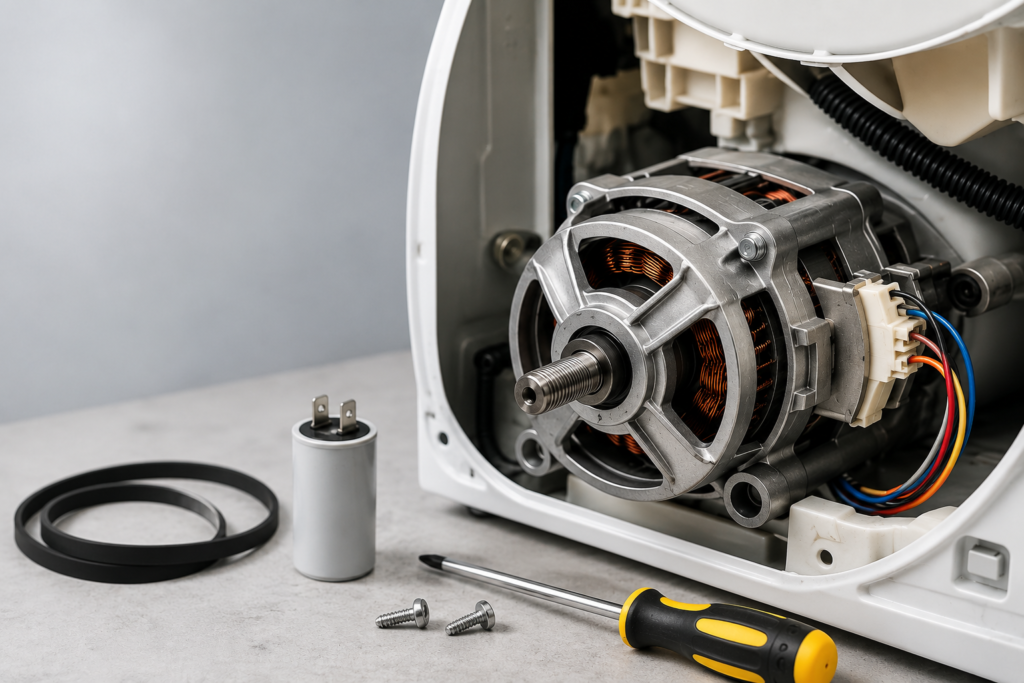
A washing machine motor not working can stop the washer from agitating, tumbling, or spinning even when the machine still turns on and fills with water. The problem may come from a worn drive belt, faulty capacitor, damaged motor components, a failed lid switch, or an electrical issue rather than the motor itself.
Before replacing the motor, it is important to identify what the washer is actually doing. A humming sound, complete silence, intermittent movement, or a motor that works briefly and then stops can each point to a different cause. Starting with the simplest checks can help prevent an unnecessary and expensive motor replacement.
Quick Answer: Why Is the Washing Machine Motor Not Working?
If the washing machine motor is not working, the cause may be a broken drive belt, faulty capacitor, worn motor components, a failed lid switch or door lock, wiring problem, control board fault, or motor overheating. A humming motor does not always mean the motor itself has failed—it may be receiving power but unable to turn the drum. Check the easiest external causes first before testing or replacing the motor.
Key Takeaways
- A washing machine motor problem does not always mean the motor itself needs replacement.
- Broken belts, faulty capacitors, switches, wiring, and control components can prevent motor operation.
- A humming sound can indicate that the motor is receiving power but cannot start properly.
- Overloading can place extra stress on the motor and other drive components.
- Burning smells or repeated overheating are reasons to stop using the washer.
- Testing the simpler components first can save money and prevent unnecessary repairs.
Quick Troubleshooting Guide
| Problem | Most Likely Cause | What You Can Do |
|---|---|---|
| Drum not turning | Broken drive belt | Inspect or replace the belt. |
| Motor hums but won’t run | Faulty capacitor | Test or replace the capacitor. |
| Stops during spin | Overloaded washer | Reduce the laundry load. |
| No motor sound | Lid switch or door lock failure | Check the safety switch. |
| Burning smell | Motor overheating | Stop using the washer immediately. |
In this article
How a Washing Machine Motor Actually Powers the Machine
Inside every washing machine is a motor responsible for turning the drum or agitator. Although the design differs across models, the fundamental principle remains the same: electrical energy is converted into motion that moves clothing through water and detergent.
When a wash cycle begins, the machine’s control system sends power to the motor. The motor then drives the mechanism responsible for agitation and spinning. Some machines use a belt system that transfers motion from the motor to the drum. Others rely on a direct-drive configuration, where the motor connects directly to the drum assembly. During a typical cycle, the motor performs several essential functions:
- Rotating the agitator or drum during the wash phase
- Pausing briefly between movements
- Increasing speed during the spin cycle
- Slowing down safely when the cycle finishes
If the motor cannot perform these tasks, the washer may fill with water but fail to move the clothing inside. In other cases, the machine may stop partway through a cycle or produce a humming sound without any drum movement. Understanding the motor’s role helps explain why even a relatively small problem elsewhere in the system can make it appear as though the motor itself has failed
Signs That Point Toward a Motor-Related Issue
When a washing machine begins behaving differently, the symptoms often provide useful clues about what might be happening internally. These signs do not always mean that the motor itself is damaged, although they frequently involve components connected to it. Several patterns tend to appear repeatedly in everyday situations.
A completely silent machine is one example. If the washer fills with water but produces no mechanical sound afterward, the motor may not be receiving power. Another common situation involves a low humming noise. This usually suggests that electricity is reaching the motor but something is preventing it from rotating. In other cases, the washer attempts to spin but stops quickly or struggles to reach full speed. When this happens, mechanical resistance may be interfering with normal operation. Typical warning signs may include
- The drum refusing to rotate
- A humming sound during the wash or spin cycle
- A burning smell near the back of the appliance
- Error codes appearing on the control panel
- The washer stopping suddenly during the spin phase
While these signals can guide troubleshooting, they rarely reveal the full explanation on their own
Step-by-Step Troubleshooting Checklist
- Unplug the washing machine before inspecting any internal components.
- Check that the lid switch or door lock is working correctly.
- Inspect the drive belt for cracks, wear, or slipping.
- Rotate the drum by hand to check for mechanical resistance.
- Look for loose wiring around the motor.
- Test the motor capacitor if your washer uses one.
- If everything appears normal, test the motor using a multimeter or contact a technician.
8 Common Causes of a Washing Machine Motor Not Working
Although the motor itself sometimes fails, most washing machine motor problems are actually caused by worn mechanical parts, electrical faults, or safety systems that prevent the motor from operating. Below are the most common causes homeowners encounter.
- Faulty lid switch or door lock
- Broken or loose drive belt
- Failed motor capacitor
- Damaged motor coupling
- Overloaded washing machine
- Faulty control board
- Loose or damaged wiring
- Burned-out motor winding
Mechanical Problems That Can Stop the Motor from Turning

Mechanical resistance is one of the most common reasons a washing machine appears to have a motor failure. In many cases, the motor is still working but cannot transfer motion to the drum. A worn drive belt provides a familiar example. Over time, belts can stretch, crack, or slip off their pulleys. When this happens, the motor may continue spinning internally while the drum remains stationary.
Another possibility involves a damaged coupling. In direct-drive machines, a small component connects the motor shaft to the transmission system. If this part breaks, the motor may spin freely without moving the drum. Foreign objects can also interfere with movement. Coins, metal fragments, or pieces of fabric occasionally become lodged between the drum and the outer tub. When the motor attempts to rotate the drum against this obstruction, the washer may stop automatically to prevent damage. Bearings and internal supports add another layer to the system. These parts allow the drum to rotate smoothly. As they wear down, friction increases, and the motor must work harder to move the load.
If your washer drum is not moving at all, you may also want to check why the washing machine drum is not turning, as this issue is often linked to motor or belt problems.In many homes, the earliest indication of these problems comes from unusual sounds .scraping, grinding, or rhythmic knocking during a wash cycle.
You May Also Like
If your washing machine motor is not working, these related guides can help you troubleshoot other motor, drive, spinning, and agitation problems.
- Washing Machine Drum Not Turning – Causes & Easy Fixes
- Washing Machine Motor Overheating – Causes and What to Check
- How to Test a Washing Machine Capacitor
- 7 Powerful Washing Machine Capacitor Problems and Easy Fixes
- How to Test a Washing Machine Motor With a Multimeter
- Washing Machine Drive Pulley Problems
- Washer Fills With Water but Won’t Agitate – Causes & Fixes
- Washing Machine Not Spinning Properly – Causes & Easy Fixes
- 6 Reasons a Washing Machine Is Making Grinding Noise
Electrical Components That Can Interrupt the Motor
Even when the mechanical parts remain intact, the motor still depends on several electrical components to function properly. One of the most overlooked elements is the lid switch or door lock system. Washing machines include safety sensors that prevent spinning when the lid or door is open. If this switch becomes faulty or misaligned, the washer may refuse to run the motor even though everything else appears normal.
Capacitors play another important role in certain models. These small components assist the motor during startup and help maintain rotation. When a capacitor weakens or fails, the motor may receive power but struggle to begin turning. Control boards also influence how the machine operates. Modern washers rely on electronic circuits to manage timing, speed changes, and safety functions. If the control board develops a fault, the signal that activates the motor may never reach it.
Wiring problems occasionally contribute as well. Loose connections or damaged insulation can interrupt the electrical pathway between the control system and the motor. Because these components are located inside the appliance, the issue may remain hidden until someone begins a closer inspection.
In some cases, the issue may be related to spinning problems, so it helps to understand why a washing machine is not spinning properly.Everyday Situations That Trigger Motor Problems
Many washing machine problems develop gradually rather than appearing suddenly. Everyday habits and environmental conditions often contribute in subtle ways. One common situation occurs when laundry loads become unusually heavy. Bedding, towels, and thick fabrics can push the washer beyond its comfortable operating range. As the drum struggles to rotate, the motor must work harder and may eventually overheat.
Another situation involves unbalanced loads. Washing a single heavy item. such as a blanket or a pair of shoes. can cause the drum to wobble during spinning. Many modern washers automatically stop the motor when they detect this imbalance. Consider a simple household example. A family washes a large comforter by itself. During the spin cycle, the comforter shifts to one side of the drum. The washer senses uneven weight distribution and stops the cycle. From the outside, it may appear as though the motor has failed.
In another home, the washer sits on slightly uneven flooring. Over time, repeated vibration gradually loosens internal components and places strain on the drive system. Months later, the machine begins producing unusual noises before eventually refusing to spin. Neither situation involves sudden mechanical failure. Instead, small stresses accumulate until the appliance can no longer operate smoothly
Overloading can also cause the washer to stop unexpectedly, similar to situations explained in washing machine stops mid cycle problems.What the Motor Problem Cannot Realistically Do

Appliance issues often attract exaggerated explanations. Online discussions sometimes suggest that any unusual washer behavior points directly to a destroyed motor. In reality, the situation is usually more complex.
A washing machine motor rarely fails without warning. In many cases, symptoms appear gradually—such as unusual noises, slower spinning, or occasional interruptions during cycles. Another common misconception involves error codes. People sometimes assume that a specific code always signals a motor failure. In many instances, the code simply indicates an imbalance, a drainage problem, or another temporary interruption.
It is also unrealistic to expect a simple reset to permanently fix mechanical wear. Resetting the machine may clear a temporary software glitch, but worn belts, broken couplings, or failing bearings still require physical repair. Recognizing these limitations helps prevent unnecessary part replacements and encourages a more careful evaluation of the appliance
If you hear unusual sounds, you may want to read about washing machine grinding noise causes to better understand internal damage.How to Prevent Washing Machine Motor Problems
- Avoid overloading the washer with heavy blankets or towels.
- Distribute clothes evenly before starting a wash cycle.
- Check pockets for coins, screws, and other metal objects.
- Keep the washing machine level to reduce vibration.
- Clean the washer regularly according to the manufacturer’s recommendations.
- Investigate unusual noises before they become major repairs.
Practical Safety and Maintenance Considerations
Working with household appliances requires caution. Washing machines combine electricity, water, and moving mechanical parts within a confined space. Before inspecting any internal component, it is important to disconnect the power supply. Even a machine that appears inactive may still carry electrical current
Access panels should only be removed once the appliance is completely unplugged. Inside the cabinet, sharp edges and heavy components can create potential hazards. Routine maintenance can reduce the likelihood of serious motor-related issues. Helpful practices include:
- Avoiding excessive overloading of the drum
- Distributing laundry evenly before starting a cycle
- Checking clothing pockets for coins or metal objects
- Ensuring the washer stands level on the floor
Occasionally listening to the machine while it operates can also reveal early warning signs. Grinding or scraping sounds rarely resolve without attention. When repairs involve electrical testing or the disassembly of major components, professional technicians typically provide the safest solution
Average Washing Machine Motor Repair Costs
| Repair | Typical Cost (USA) |
|---|---|
| Drive Belt Replacement | $80–150 |
| Motor Capacitor | $100–220 |
| Motor Coupling | $90–180 |
| Motor Replacement | $250–600 |
Before replacing expensive parts, use our Washing Machine Repair Cost Calculator to estimate whether repairing your washer is the better option.
Why Diagnosing Motor Issues Can Be Surprisingly Complex
Although washing machines appear simple from the outside, their internal systems combine mechanical engineering with electronic control. Multiple components interact during every cycle. Sensors monitor water levels, switches confirm that doors are locked, pumps manage drainage, and control boards coordinate timing. The motor operates within this network rather than functioning independently.
Because of this complexity, two machines displaying similar symptoms may have entirely different causes. One washer might refuse to spin because a belt slipped off its pulley. Another may stop because the drain pump failed, and the control system prevents spinning while water remains in the drum.
Technicians typically diagnose the problem through a process of elimination. They test electrical continuity, inspect mechanical components, and review error codes before determining the underlying issue. Engineering improvements continue to refine these appliances. Newer machines increasingly rely on digital sensors and brushless motors designed for efficiency and durability. As technology evolves, the ways these systems fail. or protect themselves. may also change
Estimate Your Repair Cost
Not sure whether it’s worth repairing your washing machine? Our free repair cost calculator estimates typical repair costs based on the faulty part, helping you decide whether to repair or replace your washer.
Use the Washing Machine Repair Cost Calculator →About the Author
Muhammad Khalid
Founder of FixAppLab • Appliance Repair Content Specialist
Muhammad Khalid is the founder of FixAppLab, where he publishes practical appliance repair guides designed to help homeowners solve common washing machine, dryer, and refrigerator problems with confidence. His articles focus on clear troubleshooting steps, preventive maintenance, and repair education using easy-to-understand language.
Every guide is carefully researched and regularly updated to reflect current appliance repair practices, helping readers make informed decisions before replacing expensive parts or calling a technician.
Learn More About FixAppLab →


4 comments
[…] Washing Machine Motor Not Working: Common Reasons and Solutions […]
[…] ➤ Washing Machine Motor Not Working: Complete Troubleshooting Guide […]
[…] Washing Machine Motor Not Working – Causes & Fixes […]
[…] Washing Machine Motor Not Working: Possible Causes […]