Washing Machine Stops After 3 Minutes
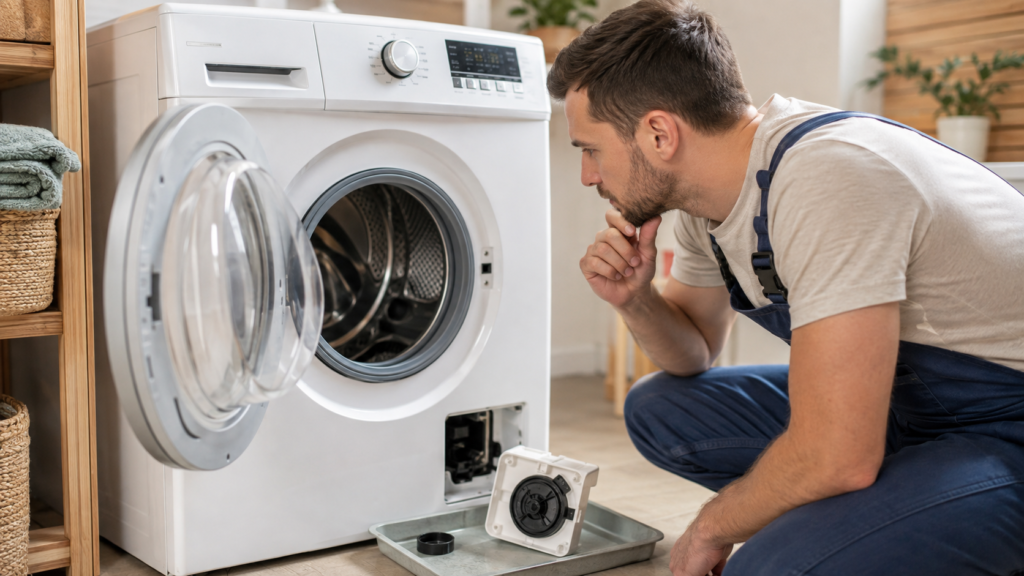
Yes, a washing machine that stops after 3 minutes is almost always fixable at home. The most common causes are a clogged drain filter, an unbalanced load, a door or lid lock that isn’t sensing “closed,” or a water supply issue keeping the tub from filling on schedule. Because the machine stops at nearly the same point every single time, that’s actually useful information — it means one specific step in the cycle is failing, not that the whole appliance is on its way out .If your washing machine stops after 3 minutes, the troubleshooting steps below will help you identify the most likely cause and the appropriate solution.
Quick Key Takeaways
Use this calculator to estimate potential washing machine repair costs before contacting a technician. While the estimate cannot replace a professional inspection, it can help you understand whether repairing your appliance is likely to be a practical option.
Table of Contents
Why a Washing Machine Stops After 3 Minutes in the First Place
Every washer follows a fairly predictable routine in the opening minutes of a cycle. It fills with water, confirms the door or lid is locked, checks that the water has reached the correct level, and on some models runs a quick drain test before committing to the full wash. If any single step doesn’t complete the way the control board expects, the machine halts rather than continuing with incomplete or unreliable information.
That’s really the whole explanation for a washing machine that stops after 3 minutes on a consistent basis. It isn’t random, and it isn’t necessarily a sign the machine is dying. It’s a built-in safety response to something not lining up during that early window. Once you understand what the machine is actually trying to do in those first few minutes, narrowing down the cause becomes a lot less like guesswork
Quick Diagnosis: What the Timing Tells You

Before pulling out tools or panels, pay attention to exactly when the stop happens. This alone often points you toward the right fix:
- Stops while filling with water → water supply, inlet hose, or pressure switch
- Stops right as the drum starts turning → door lock, lid switch, or unbalanced load
- Stops during an attempted spin → motor overload or a worn drive belt
- Stops with unusual foam or suds visible → too much detergent
- Stops randomly with no clear pattern → possible control board fault
Keep this in mind as you work through the sections below, since it can save you from checking parts that were never the problem to begin with.
Start With the Drain Filter

A surprising number of washers that stop early in the cycle turn out to have nothing more than a clogged drain filter. Many machines run a brief drain check near the start of a cycle to confirm the pump can actually move water before committing to a full fill. If that filter is packed with lint, a stray coin, or a scrap of fabric, the pump struggles, and the machine reads this as an error rather than risk overflowing later in the wash.
The filter is usually tucked behind a small access panel at the bottom front of the machine. Place a shallow tray or towel underneath before opening it, since a bit of residual water typically drains out. Twist the filter counterclockwise, pull it free, and clear out anything caught inside it’s common to find hair ties, buttons, or small toys wedged in there. Once it’s clean, screw it back in firmly and run a short test cycle to see if the washing machine still stops after 3 minutes or completes normally. If the washing machine stops after 3 minutes even after cleaning the filter, continue with the next troubleshooting steps below.
Check for an Unbalanced or Overloaded Drum

An unbalanced load is another frequent reason a washing machine stops after 3 minutes, especially right as it tries to begin its first spin or agitation phase. If heavy items like towels, jeans, or a comforter bunch up on one side of the drum, the built-in sensor detects the imbalance and stops the machine to prevent the drum from banging against the housing.
Open the door, pull the clothes apart, and spread them evenly around the drum instead of leaving them in a clump. It also helps to avoid washing a single bulky item on its own. pairing it with a few smaller pieces keeps the weight distributed more evenly. If you’re consistently overloading the drum past the recommended fill line, that habit is worth adjusting, since it’s one of the simplest fixes on this entire list and prevents the problem from coming back
You May Also Like
If your washing machine stops after 3 minutes, these related troubleshooting guides can help you diagnose other common washing machine problems faster:
Inspect the Door Lock or Lid Switch

Front-load washers won’t run at all without full confirmation that the door is locked, and top-load machines rely on a lid switch that serves the same purpose. If that mechanism is worn, slightly misaligned, or the sensor inside has failed, the machine may start filling, then stop the moment it checks for a lock signal it never actually receives.
Push the door firmly closed and listen for a distinct click. Check the seal around the door for anything caught in it. a loose sock, a stray coin, or built-up detergent residue can all prevent it from seating fully, and even a small obstruction is enough to cause a washing machine to stop after 3 minutes on the same step every time. On top-loaders, press down on the lid switch by hand. If it feels loose, doesn’t spring back, or sags compared to the rest of the panel, the switch itself may be failing and could need replacing.
Look at the Water Supply and Pressure Switch
If your washing machine stops after 3 minutes specifically while it’s still filling, the issue is more likely tied to water flow than to the drum or door. The machine expects to reach a target water level within a set amount of time. When the flow is too slow to hit that target, it eventually gives up and halts the cycle rather than running with an incomplete fill.
Check the hoses behind the machine first. A kinked hose, a valve that isn’t fully open, or sediment buildup in the small mesh screens at the hose connections can all restrict flow enough to trigger a stop. Low household water pressure during busy times of day, like early morning or evening, can produce a similar effect. If the hoses and valves check out fine but filling still seems sluggish, the pressure switch. sometimes called the water level sensor may be sending inaccurate readings to the control board and could need testing or replacement.In many homes, a washing machine stops after 3 minutes simply because it cannot reach the required water level in time.
Rule Out an Overloaded or Overheating Motor
When a washing machine stops after 3 minutes right as it moves into the wash or spin phase, an overworked motor is worth considering. Most machines include thermal protection that cuts power if it senses too much strain, which is common with very full or unusually heavy loads like blankets and comforters.
Try running a load with about half the usual amount of laundry inside. If the cycle completes normally, an overloaded drum was very likely putting excess strain on the motor. If the machine still stops at the same point even with a lighter load, the motor or the drive belt connecting it to the drum may genuinely be worn out. and that’s a repair better left to a technician who has the tools to test it safely rather than replace parts by trial and error
Don’t Overlook Detergent Amount
It sounds unrelated to a mechanical stop, but using more detergent than a cycle calls for can also cause a washing machine to stop early. Excess suds can confuse the machine’s sensors, and some models pause the cycle to let foam settle before continuing, or stop altogether if the foam level seems abnormal. Stick to the amount recommended on the packaging for your load size and water hardness, and be especially careful with high-efficiency detergent in a standard machine . using regular detergent in an HE washer is one of the most common causes of oversudsing homeowners run into.
Try a Full Reset Before Assuming the Worst
Before moving on to more involved troubleshooting, it’s worth ruling out a simple electronic glitch. Unplug the washing machine, wait about sixty seconds, and plug it back in. A brief power interruption or minor surge can sometimes leave the control board in a confused state, and a full reset clears that without touching or replacing anything.
Run a short test cycle afterward, ideally with the drum empty, to see whether the machine now completes it without stopping. This one step resolves more cases than people expect, and it costs nothing but a minute of waiting.
Common Mistakes That Make the Problem Worse
A few habits tend to turn a simple fix into a recurring headache:
- Restarting the cycle repeatedly without checking anything. this just repeats the same failure instead of addressing it
- Ignoring a full drain filter for months. lint and debris build up gradually, so the problem often gets worse before it gets better
- Assuming it’s the control board first. this is usually the least likely cause and the most expensive to replace unnecessarily
- Overloading the drum “just this once”. a single oversized load is often enough to trigger an imbalance stop
Working through the simpler checks first almost always saves both time and money. Understanding why a washing machine stops after 3 minutes helps prevent unnecessary repairs and repeated cycle failures.
Should You Repair or Replace Your Washer?
| Situation | Recommended Choice |
|---|---|
| Low-cost repair | Repair is usually worthwhile. |
| Major repair on an older machine | Compare repair cost with replacement cost. |
| Multiple recurring problems | Replacing the washer may offer better long-term value. |
When It’s Time to Call a Technician
Cleaning a filter, redistributing a load, or checking a water valve are all things most homeowners can handle safely without any special tools. Testing a pressure switch, replacing a drive belt, or diagnosing a control board is a different level of repair, since it usually involves opening panels, working near electrical components, and sometimes using a multimeter to confirm which part has actually failed.
If you’ve worked through the simpler causes and your washing machine still stops after 3 minutes every single time, bringing in an appliance technician is usually more cost-effective than replacing parts through trial and error. particularly on newer machines where the control board can be an expensive component to guess wrong on.
Getting Your Wash Cycle Back on Track
Most of the time, a washing machine that stops after 3 minutes comes down to something simple: a filter that needs cleaning, a load that needs rearranging, or a hose that needs straightening out. Working through the checks in order .filter, load balance, door lock, water supply, then motor. covers the vast majority of cases without ever needing to open up the machine.
If you’ve been through each of these steps and the washing machine still stops after 3 minutes on every attempt, that consistency points toward a specific failed component rather than a fluke, and it’s a reasonable point to bring in a professional to test the part with certainty instead of continuing to guess.. If your washing machine stops after 3 minutes every time, a systematic inspection is usually the fastest way to identify the real cause.
Explore Our Complete Washing Machine Problems Guide
Not sure what’s causing your washer to malfunction? Our complete Washing Machine Problems Guide brings together hundreds of troubleshooting articles covering common error codes, draining problems, spinning issues, unusual noises, water supply faults, electrical failures, and many other appliance repair topics. It’s the perfect starting point if you’re still diagnosing the problem or want to explore additional repair solutions.
Inside This Guide You’ll Find:
- Step-by-step troubleshooting guides
- Common washing machine error codes explained
- Repair and maintenance tutorials
- Parts testing and diagnostic guides
- DIY fixes for the most common washer problems
- Preventive maintenance tips to extend appliance life
Looking for more washing machine repair help? Browse our complete troubleshooting library or explore the latest repair guides and maintenance tips from FixAppLab.
🔧 Explore Washing Machine Repair Guides 📚 Visit the FixAppLab BlogAbout the Author
FixAppLab Editorial Team
The FixAppLab Editorial Team creates practical appliance repair guides, troubleshooting resources, maintenance tips, and repair cost tools designed to help homeowners diagnose common household appliance problems with confidence. Every article is carefully reviewed for clarity, accuracy, and usefulness before publication.
Our goal is to provide easy-to-follow information that helps readers better understand appliance issues, compare repair options, and decide when a DIY solution may be appropriate or when professional service is recommended.
Every guide follows our editorial standards and is written with a strong focus on accuracy, readability, user experience, and search quality best practices.
Additional Appliance Safety Resource
If your washing machine stops after 3 minutes even after completing all of the troubleshooting steps in this guide, always follow safe repair practices before attempting further diagnosis. For additional appliance safety information and consumer guidance, visit the official
U.S. Consumer Product Safety Commission (CPSC)
website.
Additional Appliance Safety Resource
If your washing machine stops after 3 minutes even after completing all of the troubleshooting steps in this guide, always follow safe repair practices before attempting further diagnosis. For additional appliance safety information and consumer guidance, visit the official U.S. Consumer Product Safety Commission (CPSC) website.
Related guides
More Washing Machine Problems guides
Washing Machine Has Power but Won’t Start? 9 Easy Fixes
If your washing machine has power but won't start, the cause is usually simple: an active control lock, a door…

LG Washing Machine Not Spinning? 9 Helpful Fixes to Try Today
An LG washing machine not spinning is usually caused by an unbalanced load, a drain problem, or a door lock…

Washer Spinning Slowly and Clothes Still Wet
A washer spinning slowly and clothes still wet is usually caused by an unbalanced load, the wrong spin setting, or…
Comments