LG Washer vs Samsung Washer: 7 Key Differences & Best Pick
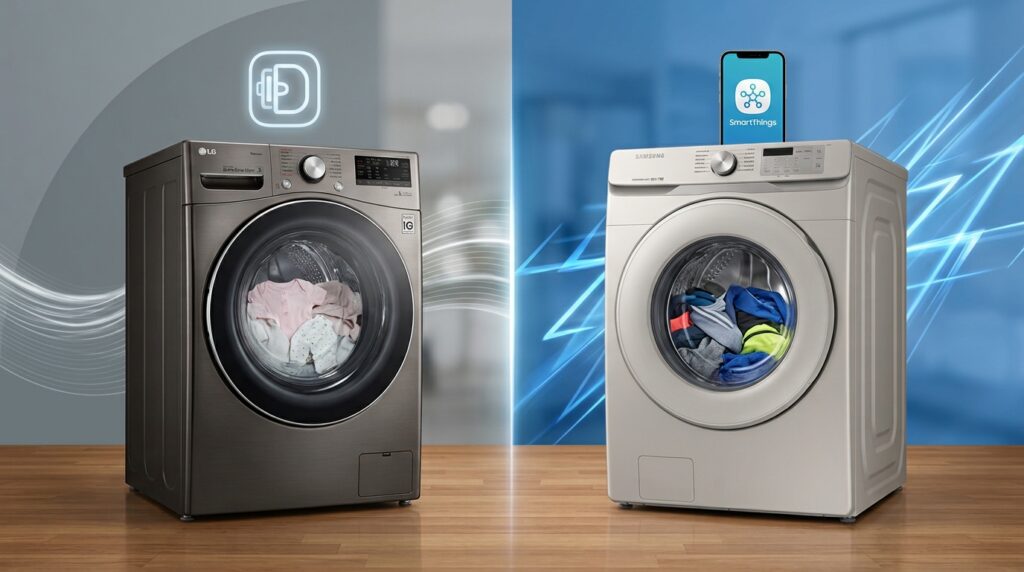
There’s no single winner in the LG washer vs Samsung washer debate — LG is the better pick if you want a quieter, more durable direct-drive motor and stronger fabric care, while Samsung is the better pick if you want faster cycles, smarter app features, and a lower entry price. The right answer really depends on what you wash most often, how much noise you’re willing to live with, and whether smart-home connectivity matters to you. Below, we walk through every category that actually affects day-to-day laundry so you can settle the LG washer vs Samsung washer question based on your own household, not just brand loyalty.
LG Washer vs Samsung Washer: The Quick Answer
Choose LG if quiet operation, direct-drive design, fabric care, and long-term durability are your main priorities. Choose Samsung if faster cycles, smart-home features, and value are more important to you.
Table of Contents
If you’re comparing an LG washer vs Samsung washer, both brands offer excellent cleaning performance, efficient motors, modern features, and a wide range of front-load and top-load models. The better choice depends on your laundry habits, available space, budget, and the features you actually need.
- Quiet operation
- Fabric care
- Long-term durability
- Direct-drive motor design
- Heavy laundry loads
- Fast wash cycles
- Smart-home connectivity
- EcoBubble technology
- Modern smart features
- Feature-focused value
LG Washer vs Samsung Washer: Quick Comparison

| Category | LG Washer | Samsung Washer |
|---|---|---|
| Motor type | Inverter Direct Drive (beltless) | Digital Inverter (belt-driven) |
| Noise level | Very quiet | Quiet, slightly louder |
| Standout wash tech | TurboWash, steam, 6 Motion | EcoBubble, Super Speed |
| Smart app | LG ThinQ | Samsung SmartThings |
| Reliability track record | Slight edge | Competitive, more variable |
| Best for | Heavy loads, quiet homes, long-term use | Fast cycles, smart-home integration, value |
If you only remember one thing from this LG washer vs Samsung washer comparison, let it be this: both brands make genuinely good machines, and the “best” one is the one that matches how your household actually does laundry.
LG Washer vs Samsung Washer: Motor Design
Any real LG washer vs Samsung washer comparison has to start with the motor, because it quietly influences almost everything else on this list — noise, vibration, repair frequency, and how long the machine lasts.
LG washers use an Inverter Direct Drive motor, which connects straight to the drum with no belt in between. Fewer moving parts mean less vibration, quieter spin cycles, and one less component that can wear out or need replacing down the road. This same philosophy shows up in LG’s 6 Motion technology, which varies the drum’s movement pattern to clean thoroughly while still being gentle on fabric.
Samsung typically takes a different route, using a Digital Inverter motor connected through a traditional belt-and-pulley system, paired with Vibration Reduction Technology (VRT Plus) to keep things calm during high-speed spins. It’s a proven, reliable setup — millions of Samsung washers run on it without issue — but it does mean there’s an extra mechanical link that can eventually loosen or wear compared to LG’s beltless design.
If your laundry room sits near a bedroom or shared wall, this part of the LG washer vs Samsung washer decision usually tips toward LG for quieter operation. If you’re less concerned about noise and more focused on fast, powerful cycles, Samsung’s motor setup holds its own for everyday use.
LG Washer vs Samsung Washer: Cleaning Performance
When it comes to actual cleaning results, both brands are genuinely competitive. The real differences in this LG washer vs Samsung washer matchup show up more in how clothes get clean than in the final result.
LG leans on TurboWash and, on select models, TurboWash 360°, which uses multiple water jets to push detergent through the load faster. Paired with steam technology on higher-end models, LG washers are particularly good at loosening allergens and stubborn stains without needing a pre-soak. That makes LG a strong pick for households dealing with heavy loads like towels, jeans, or bedding.
Samsung’s signature feature is EcoBubble, sometimes marketed as AI EcoBubble on newer models. It mixes detergent, air, and water into a foam that penetrates fabric quickly, even in cold water. This is genuinely useful if you want to cut energy costs by washing at lower temperatures without sacrificing cleaning power. Samsung also offers Super Speed, which can finish a full wash cycle in under 30 minutes on some models — a real advantage for busy households running multiple loads a week.
So if fabric care and heavy-load cleaning top your list, LG usually has the edge. If speed and low-temperature efficiency matter more, Samsung tends to come out ahead.
LG Washer vs Samsung Washer: Smart Features
Both companies want your washer connected to your phone, but they approach it a little differently, which is another piece of the LG washer vs Samsung washer puzzle worth understanding before you buy.
LG’s app, ThinQ, lets you monitor cycles remotely, download new wash programs, and get smart diagnostics if something goes wrong. It’s straightforward and practical rather than flashy — useful, but not the star of the show. Some LG models also include AI DD (AI Direct Drive), which senses fabric type and load size, then automatically adjusts the wash motion and cycle length.
Samsung’s SmartThings ecosystem goes a step further into full smart-home territory. Beyond remote monitoring, it supports AI-based energy tracking, custom automation routines, and integration with other SmartThings-compatible devices around the house. If you already own Samsung appliances or smart-home gadgets, a Samsung washer tends to fit into that ecosystem more naturally.
Neither app should be the deciding factor if the rest of the machine doesn’t meet your needs, but if you’re building out a connected home, Samsung currently offers the deeper integration.
LG Washer vs Samsung Washer: Reliability
This is where most buyers really want an answer: in the LG washer vs Samsung washer comparison, which one breaks down less?
LG generally scores higher in long-term reliability surveys and tends to get more favorable mentions from repair technicians, largely thanks to the direct-drive motor’s simpler design. Fewer moving parts mean fewer failure points, and LG’s steady spare-parts availability makes repairs more predictable when something does eventually go wrong.
Samsung washers are competitively priced and hold up well for most households, but user and technician feedback sometimes points to more frequent service calls on certain models, along with occasional challenges sourcing parts for older units. That doesn’t mean Samsung washers are unreliable — it just means LG tends to carry a slight statistical edge when it comes to years of trouble-free use.
If long-term durability and fewer repairs are your top priority, the data generally favors LG. If you’re comfortable with a shorter replacement cycle in exchange for more features per dollar, Samsung remains a solid, dependable choice.
Noise and Vibration

Noise deserves its own section in any LG washer vs Samsung washer breakdown, since it’s one of the most common complaints homeowners bring up after buying a new machine.
LG’s beltless motor design, paired with its anti-vibration system, keeps most models notably quiet, even during high-speed spin cycles. Samsung has made real improvements here too with VRT Plus, and modern Samsung washers are far from loud — but in side-by-side comparisons, LG usually still comes out a touch quieter.
Keep in mind that noise isn’t only about the brand you choose. An unbalanced load, an uneven floor, worn suspension parts, or a poor installation can make any washing machine noisy, regardless of manufacturer. If your washer suddenly starts making unusual noises, check installation and load balance first before assuming it’s a design flaw.
Energy Efficiency and Water Usage
Both brands offer efficient inverter-motor washers, and the gap between them here is smaller than in most other categories.
Samsung’s EcoBubble technology is specifically built to clean effectively at lower water temperatures, which can meaningfully cut down on energy use for hot-water cycles. LG focuses more on smart water management, using load-sensing technology to avoid using more water than a given load actually needs.
In practice, energy efficiency depends far more on the specific model and its ENERGY STAR rating than on which of the two brands you choose. Before buying, always compare the energy guide label on the exact model you’re considering rather than assuming one brand is automatically greener than the other.
Front-Load vs Top-Load: Both Brands Cover You
Whichever way you lean in the LG washer vs Samsung washer decision, you’ll have both front-load and top-load options to choose from.
Front-load washers from both brands tend to offer better water efficiency, higher spin speeds, and stacking compatibility with a matching dryer, which makes them a good fit for smaller laundry spaces. Top-load models are easier to load without bending over and often come with larger drum capacities, which suits bigger families or households doing frequent large loads like bedding and towels.
LG additionally offers compact and shallow-depth models, a real advantage if you’re retrofitting a washer into a tight closet or older apartment. Samsung’s lineup, meanwhile, includes some of the largest-capacity drums on the market if raw capacity is what you need most.
You May Also Like
If you’re comparing an LG washer vs Samsung washer, these related washing machine guides can help you understand common washer problems, maintenance needs, troubleshooting steps, and repair considerations before or after your purchase:
- Complete Washing Machine Problems & Troubleshooting Guide
- Washing Machine Not Spinning Properly: 9 Causes and Easy Fixes
- Washing Machine Taking Too Long to Wash: 10 Easy Fixes
- Washing Machine Not Filling With Water: 10 Causes and Easy Fixes
- Washer Not Completing Cycle: Causes and Troubleshooting
- Washing Machine Making Loud Noise When Spinning: 9 Common Causes
- Washing Machine Shaking Too Much: Causes and Solutions
- How to Maintain a Washing Machine for Long Life
- How to Avoid Washing Machine Breakdowns
- Washer Repair vs Replace: Which Option Makes More Sense?
Explore these guides to get more practical information about washing machine troubleshooting, maintenance, repairs, and long-term washer performance.
Price Range: What You’ll Actually Pay
Pricing between LG and Samsung is closer than most people expect, and it tends to vary more by capacity and feature set than by brand alone.
Basic top-load models from either brand typically start in a similar entry-level range, while mid-range front-load washers with steam, smart features, and larger drums push into the premium tier for both companies. Samsung’s lower-priced models tend to pack in more advanced features for the money, which is part of why the brand appeals to budget-conscious shoppers who still want smart functionality. LG’s pricing tends to reflect its focus on motor durability and long-term reliability, so you’re often paying a bit more upfront for a machine built to need fewer repairs later.
Rather than comparing brands on price alone, compare the specific model’s capacity, motor warranty, and included features. That’s a far more accurate way to judge value in the LG washer vs Samsung washer decision than the logo on the front panel.
Before choosing between an LG washing machine and Samsung washer, look beyond the brand name. The exact model can have a bigger impact on performance, efficiency, maintenance, and ownership costs.
Choose a drum size based on your household. Large families may benefit from a high-capacity washer, while smaller households can save space with a compact model.
Measure the laundry area carefully. Check washer depth, width, door clearance, and available space before purchasing.
Compare the energy rating and estimated electricity consumption of the exact model instead of assuming one brand is always more efficient.
Check both the overall appliance warranty and motor warranty. Coverage can vary considerably between individual models and markets.
Confirm that authorized technicians and replacement parts are available in your area. Good service support can reduce long-term repair headaches.
Pay for features that match your routine. Smart controls and specialty cycles are useful only if you will actually use them.
When comparing LG vs Samsung washing machines, prioritize capacity, dimensions, wash performance, energy efficiency, warranty coverage, and local repair support before choosing extra features.
There is no universal winner in the LG washer vs Samsung washer comparison. Use your laundry priorities to decide which brand makes more sense for your home.
| Your Priority | Better Match | Why |
|---|---|---|
| Quiet washing | LG | Direct-drive motor design and strong vibration control. |
| Heavy or frequent laundry | LG | Strong wash performance and useful fabric-care technologies. |
| Fast wash cycles | Samsung | Super Speed is available on selected models. |
| Smart-home integration | Samsung | SmartThings provides broader connected-home integration. |
| Long-term durability focus | LG | Direct-drive architecture is a major attraction for durability-focused buyers. |
| Features for the money | Samsung | Selected models offer a strong combination of smart and convenience features. |
Don’t choose an LG or Samsung washer based only on brand reputation. Compare the exact models, their capacity, dimensions, warranty, energy efficiency, features, and local service availability. A well-matched model from either brand can be an excellent long-term choice.
LG Washer vs Samsung Washer: Which One Should You Buy?
Here’s a simple way to settle the LG washer vs Samsung washer decision for your own home:
Choose LG if you want the quietest possible operation, strong performance on heavy or delicate loads, a beltless motor built for long-term durability, and a shallow-depth option for tight spaces.
Choose Samsung if you want faster wash cycles, deeper smart-home integration through SmartThings, strong low-temperature cleaning through EcoBubble, and more features at a lower entry price.
Final Verdict
For most households, both brands will clean clothes well and last for years with proper care and routine maintenance. The real difference in the LG washer vs Samsung washer debate comes down to priorities — quiet, durability-focused washing favors LG, while speed, smart features, and value favor Samsung. Whichever you choose, check the exact model’s capacity, motor warranty, and energy rating before buying, since those details matter more to your day-to-day experience than the brand name on the door.
Estimate Your Washing Machine Repair Cost
Comparing a new LG or Samsung washer is only part of the decision. If your current washing machine has a problem, use our repair cost calculator to estimate potential repair expenses before deciding whether repairing or replacing the appliance makes more sense.
Use the calculator to:
- Estimate common washing machine repair costs
- Compare repair expenses with replacement costs
- Make a more informed repair-or-replace decision
For the most accurate specifications, available features, and current washer options, check the official LG washing machine website before choosing a model.
Muhammad Khalid
Muhammad Khalid is the founder of FixAppLab, a website dedicated to practical appliance troubleshooting, repair guidance, maintenance tips, and cost information. He focuses on creating clear, easy-to-follow resources that help homeowners better understand washing machine, refrigerator, and dryer problems.


Comments