Samsung Washer 4E Error Code: 7 Easy Fixes to Get Your Washer Working Again
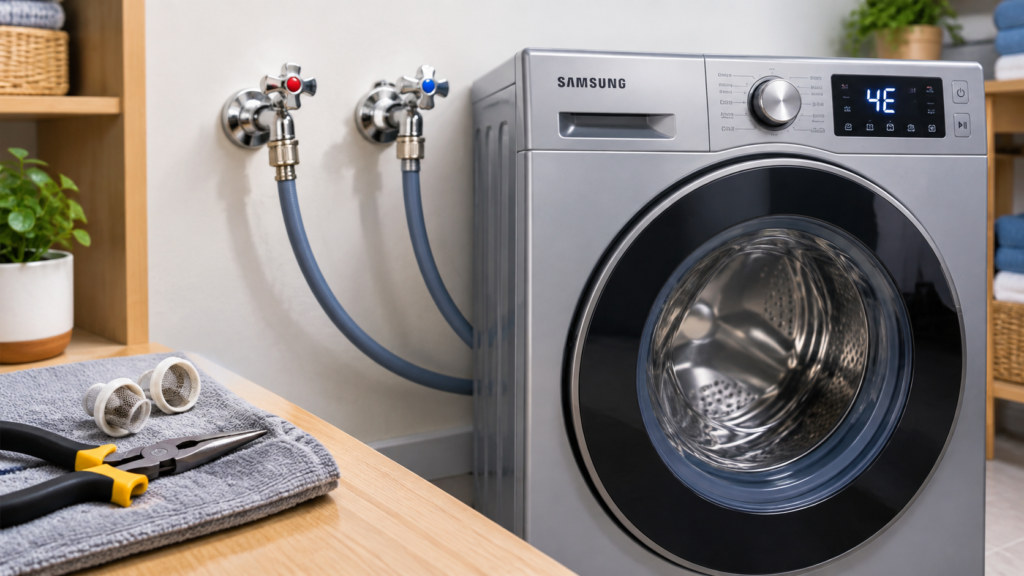
Yes, the Samsung washer 4E error code almost always means your washing machine isn’t getting enough water during the fill stage — and in most cases, you can clear it yourself in under 30 minutes without calling a technician. The Samsung washer 4E error code is a water-supply alert, not proof that something inside the machine has broken. Here’s exactly what triggers it and how to fix it, step by step.
Quick Key Takeaways
- The Samsung washer 4E error code usually means the washer is not receiving enough water during the fill cycle.
- Check the water valves, inlet hoses, and mesh filters before assuming the washer has a mechanical fault.
- A kinked hose or clogged inlet filter is often a simple cause that can be fixed without a technician.
- If normal water pressure and clean filters do not solve the problem, the inlet valve, wiring, or water-level sensor may need inspection.
Table of Contents
What Does the Samsung Washer 4E Error Code Mean?
Every time you start a cycle, your washer’s control board watches how much water flows into the drum during the fill stage. It expects the tub to reach the correct level within a set window, usually somewhere around six to ten minutes. When that doesn’t happen, the machine pauses and displays the Samsung washer 4E error code as a built-in safety feature — it’s designed to stop the motor, pump, and heating element from running without enough water rather than risk damaging them.
So while a flashing 4E code is frustrating, it’s rarely the washer itself that’s at fault. The problem is almost always somewhere along the path water travels to reach the drum: the household supply, the hoses, the filters, or the valve that lets water in. On newer Samsung models, this same issue sometimes shows up as a 4C code instead, but the cause and the fix are the same.
Samsung also recommends checking the water supply, hose condition, water pressure, and mesh filter when a 4E or 4C code appears. See Samsung’s official 4E/4C troubleshooting guide for model-specific guidance.
Common Causes of the 4E Error Code on a Samsung Washer
Before taking anything apart, it helps to know what usually triggers this code:
- A water supply valve that isn’t fully open. Even a slightly closed tap can restrict flow enough to trip the error.
- Low household water pressure. Samsung washers generally need at least 20 psi to fill properly.
- A kinked or pinched inlet hose, often from the washer being pushed too close to the wall.
- A clogged mesh inlet filter, where sediment and mineral deposits build up over time.
- A blocked detergent dispenser drawer, which can restrict water from reaching the drum.
- A faulty water inlet valve, the component that physically opens to let water through.
- A failing water pressure sensor, which is less common but can misread the fill level even when water is flowing normally.
Most of these are quick, no-cost fixes you can handle yourself. It’s really only the valve and sensor issues that sometimes call for a replacement part.
Quick Fixes to Try First
Quick Troubleshooting Guide
| Check | What to Do | If the Problem Continues |
|---|---|---|
| Water valves | Make sure the supply valves are fully open. | Check the hoses and household water pressure. |
| Inlet hoses | Straighten any kinked or crushed sections. | Inspect the inlet filters. |
| Mesh filters | Remove and clean visible sediment or debris. | Check water flow again. |
| Water flow | Confirm the supply produces a strong, steady flow. | Consider an inlet valve or sensor problem if supply is normal. |
Safety Note
Before disconnecting water hoses or inspecting components, turn off the washer and unplug it from the electrical outlet. Shut off the water supply valves before removing any inlet hose. Keep water away from electrical connections, and do not open electrical components unless you are comfortable working safely with appliance wiring.
1. Check That the Water Valves Are Fully Open
This is the simplest possible cause of the Samsung washer 4E error code, so start here. Locate the hot and cold water shut-off valves behind your washer and make sure both are turned all the way counterclockwise. It’s common for one of these to end up only partially open after an installation, a move, or plumbing work — and even a partially closed valve can be enough to trigger the error. Interestingly, most Samsung washers expect both hot and cold lines to be active even if you’ve selected a cold-water cycle, so don’t assume one open valve is enough.
2. Inspect the Inlet Hoses for Kinks
Carefully pull the washer away from the wall (unplug it first) and check both supply hoses along their full length. Look for bends, pinches, or crushed sections, especially near where the hose meets the machine. A kinked hose is one of the most overlooked causes of the Samsung washer 4E error code, simply because it’s easy to miss when the washer is pushed flush against the wall. If you find a kink, straighten it out and leave a few inches of clearance behind the machine so it doesn’t happen again.
3. Clean the Mesh Inlet Filters

This step resolves the Samsung washer 4E error code more often than any other single fix, so don’t skip it even if the hoses look fine. Here’s the process:
- Turn off both the hot and cold water valves.
- Unscrew the supply hoses from the back of the washer.
- Look just inside the connection ports — you’ll see small mesh screens.
- Gently pull them out with needle-nose pliers and rinse them under running water, using an old toothbrush to clear away mineral buildup or debris.
- Reinsert the filters and reconnect the hoses securely.
- Turn the water back on and check for leaks before running a cycle.
If the filters come out coated in heavy sediment or rust, that’s often a sign of a broader hard-water issue in your home, and it’s worth addressing separately since it will keep clogging the filters again.
4. Test Your Water Pressure

Disconnect a fill hose and run it into a bucket with the valve fully open. Water should come out in a strong, steady stream. If it trickles out weakly, the issue causing your Samsung washer 4E error code is upstream of the machine entirely — likely low household pressure, a partially closed main shut-off, or a plumbing problem — and no amount of washer troubleshooting will fix that on its own. Testing another faucet in the house is a good way to confirm whether the whole house has low pressure or just the washer’s line.
5. Clean the Detergent Dispenser Drawer
Pull the drawer all the way out and check for hardened detergent or fabric softener buildup blocking the water delivery jets. A clogged dispenser can restrict water from reaching the drum properly, which the control board sometimes misreads as a fill problem and flags with the same 4E code. Scrub the drawer and its housing with warm water, then let everything dry completely before reinstalling it.
6. Power Cycle the Washer
Once you’ve checked the supply, hoses, filters, and dispenser, unplug the washer for about five minutes (or switch off its dedicated breaker if it’s hardwired) to let the control board fully reset. Plug it back in and run a short cycle. This step alone won’t fix an actual hardware fault, but it does clear false readings caused by a temporary glitch — and it’s worth doing after any of the fixes above anyway, since a reset is often what actually makes the Samsung washer 4E error code disappear for good.
Quick-Check Summary
| Step | What to check | Fixes the error most of the time? |
|---|---|---|
| 1 | Water valves fully open | Often |
| 2 | Hoses free of kinks | Often |
| 3 | Mesh inlet filters clean | Most common fix |
| 4 | Water pressure normal | Sometimes |
| 5 | Detergent drawer clear | Occasionally |
| 6 | Power reset | Clears temporary glitches only |
What If the Samsung Washer 4E Error Code Keeps Coming Back?
If you’ve confirmed the water supply is normal, the hoses are clear, the filters are clean, and the pressure checks out, but the code keeps returning, the cause is likely mechanical rather than something you can flush or clean out.
Water inlet valve. This component uses an electrical solenoid to open and let water through. If it’s stuck or has failed electrically, water won’t reach the tub no matter how good your pressure and hoses are. If you’re comfortable with a multimeter, you can test the valve’s solenoid coils for continuity — a reading of infinite resistance (often shown as OL) typically means the valve needs replacing.
Wiring harness. Loose or corroded connections between the control board and the inlet valve can also cause a fill error even when everything else is working correctly. A visual inspection of the harness, with the washer unplugged, can reveal obvious damage or loose terminals.
Water pressure sensor. On some models, a separate sensor reports fill status to the control board. If it fails, the washer can display the 4E error code even with completely normal water flow. This one usually calls for professional diagnosis, since reaching the sensor often means removing panels.
Replacement inlet valves are relatively inexpensive and available for most Samsung washer models, so if you’re handy, this is often a manageable DIY repair. If you’re not comfortable working around electrical components, this is the point where it makes more sense to bring in a certified appliance technician rather than keep guessing at parts.
Is It Safe to Keep Using the Washer With This Error?
The cycle pauses automatically when the Samsung washer 4E error code appears, so running the washer isn’t dangerous in the moment. That said, if the same code keeps interrupting your loads, it’s worth resolving rather than repeatedly restarting the cycle. Repeated fill failures can add unnecessary strain to the pump and other components over time, even if the immediate risk is low.
Common Mistakes to Avoid
- Checking only one water valve: Inspect both hot and cold supply connections where applicable to your model.
- Ignoring the inlet filters: A hose can look completely normal while the small mesh screen is blocked with sediment.
- Replacing parts too quickly: Check water flow, hose condition, and filters before buying an inlet valve or sensor.
- Forgetting to check for leaks: After reconnecting a hose, turn the water supply on slowly and inspect the connection before starting a cycle.
- Repeatedly restarting the washer: If the 4E error returns after basic checks, find the underlying cause instead of repeatedly resetting the machine.
Preventing the 4E Error From Coming Back
A little routine maintenance goes a long way toward keeping the Samsung washer 4E error code from reappearing:
- Clean the inlet filters every six to twelve months, more often if you have hard water.
- Leave a few inches of clearance between the washer and the wall to prevent hose kinks.
- Avoid over-tightening the water supply valves, which can wear out the valve mechanism over time.
- If the washer sits in a garage or unheated space, protect the hoses from freezing during cold months.
- Consider a water softener or inline sediment filter if mineral buildup is a recurring problem in your home.
When to Call a Technician
Most homeowners can resolve the Samsung washer 4E error code with the checks above — the valve, hose, and filter steps cover the majority of cases. But if you’ve worked through every step and the error still returns, especially after confirming normal water pressure and clean filters, that’s a reasonable point to stop troubleshooting on your own. A failed inlet valve, a damaged wiring harness, or a bad pressure sensor are all repairs that involve testing electrical components safely, and a licensed appliance technician can usually diagnose the exact cause in a single visit rather than through trial and error.
Popular Washing Machine Troubleshooting Guides
Looking for help with another washing machine problem? Explore these troubleshooting guides and use our repair cost calculator to better understand possible repair expenses.
- Washing Machine Not Filling With Water: 10 Causes and Easy Fixes
- Washer Water Pressure Too Low: Causes and Fixes
- Washing Machine Water Inlet Valve Problems
- How to Test a Washer Water Inlet Valve
- Washing Machine Not Detecting Water Level
- Washing Machine Error Codes Explained
- How to Enter Washing Machine Diagnostic Mode
- Washing Machine Repair Cost Calculator
Final Thoughts
In the vast majority of cases, the Samsung washer 4E error code points to something outside the machine itself — a closed valve, a kinked hose, or a clogged filter — rather than a serious mechanical failure. Working through the checks in order (valves, hoses, filters, pressure, dispenser, reset) resolves the issue for most people on the first attempt. If the error code keeps showing up after all of that, a faulty water inlet valve is the next most likely culprit, and it’s a straightforward part for a technician to test and replace. Either way, troubleshooting the simple causes first will save you both time and an unnecessary repair bill.


1 comment
[…] Samsung Washer 4E Error Code: Troubleshooting and Fixes […]