
A washing machine that fills and spins but won’t agitate is usually experiencing a mechanical disconnect between the motor and the agitator. In simple terms, the appliance still has power, but that energy is not being converted into the back-and-forth motion required to clean clothes effectively. This type of washer problem is common and often points to a worn or failed internal component
If your washing machine won’t agitate but spins, the most common causes include worn agitator dogs, a damaged motor coupling, or a loose drive belt that prevents proper movement during the wash cycle.
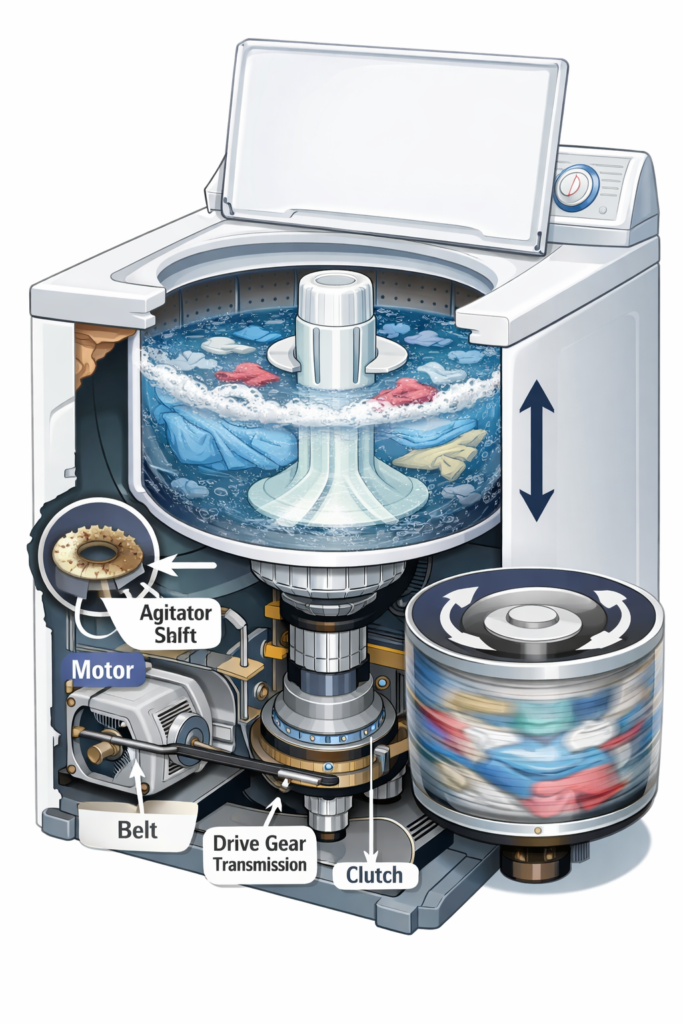
Table of Contents
How the Agitation System Actually Works
Inside a top-load washing machine, agitation is a controlled mechanical process rather than random movement. The drive motor generates power, which is transferred through either a drive belt or a direct-drive motor coupling into the transmission system. The transmission then converts rotational energy into the oscillating motion that drives the agitator back and forth during the wash cycle.
The agitator itself plays a central role in cleaning performance. It pushes water and detergent through fabric, helping to loosen dirt and distribute cleaning agents evenly. When functioning correctly, this motion is consistent and balanced, allowing clothes to be cleaned thoroughly without excessive wear.
When a washing machine won’t agitate but spins, the issue typically lies somewhere along this power transfer path. The water system and drum are usually unaffected, which explains why the washer can still complete the spin cycle. Spinning relies on continuous rotation, while agitation depends on directional movement controlled by internal components.
Why Spinning Still Works While Agitation Fails
This situation often causes confusion because spinning appears to confirm that the washer is working. In reality, spinning and agitation are mechanically distinct functions. Although they share certain components, they rely on different types of motion and control.
Spinning involves continuous, high-speed rotation of the drum to remove water from clothes. Agitation, on the other hand, requires a repeated change in direction. The transmission system is responsible for switching between these two modes.
If a small component such as a motor coupling, internal gear, or agitator mechanism fails, the washer may still spin because that function is less mechanically demanding. Agitation requires more precise control, making it more sensitive to wear or damage. This is why a washing machine won’t agitate but spins even when the motor appears to be running normally.
Small Parts That Cause Washing Machine Won’t Agitate but Spins Issue
In many cases, the root cause is not a major failure but a small, worn component. These parts are designed to handle repeated stress and naturally degrade over time.
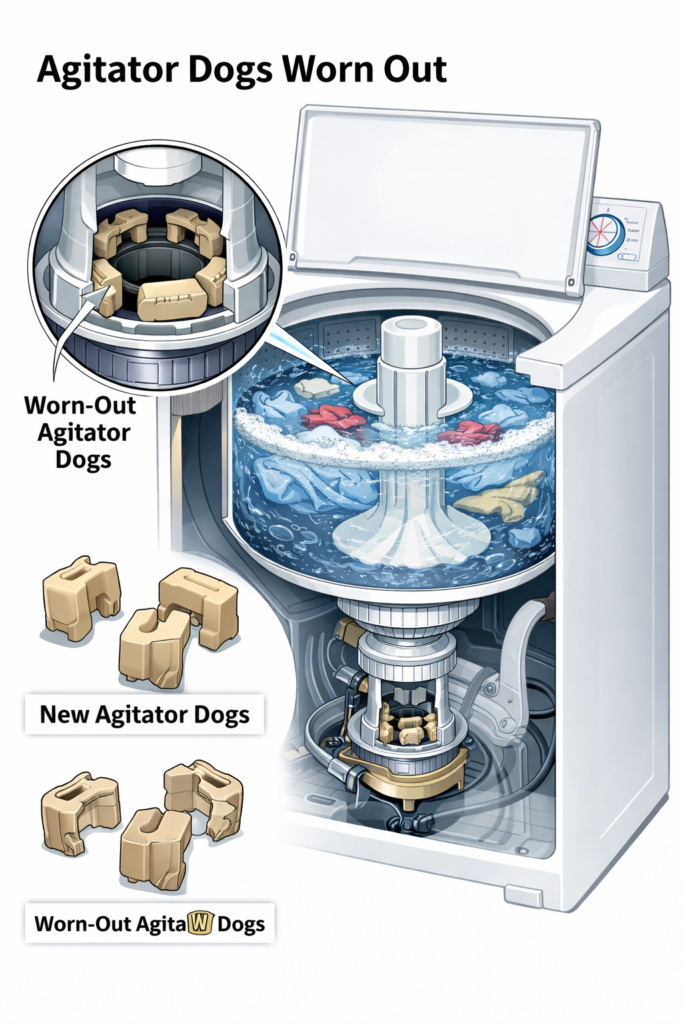
Agitator Dogs or Internal Cogs
Agitator dogs are small plastic pieces located inside the agitator assembly. Their function is to engage and grip during movement, allowing the agitator to rotate properly in one direction while resetting in the other. Over time, these parts can wear down and lose their ability to catch.
When this happens, the motor and transmission may still operate, but the agitator will either remain still or slip during the wash cycle. This is one of the most common explanations for a washing machine that won’t agitate but spins, especially in older top-load models.
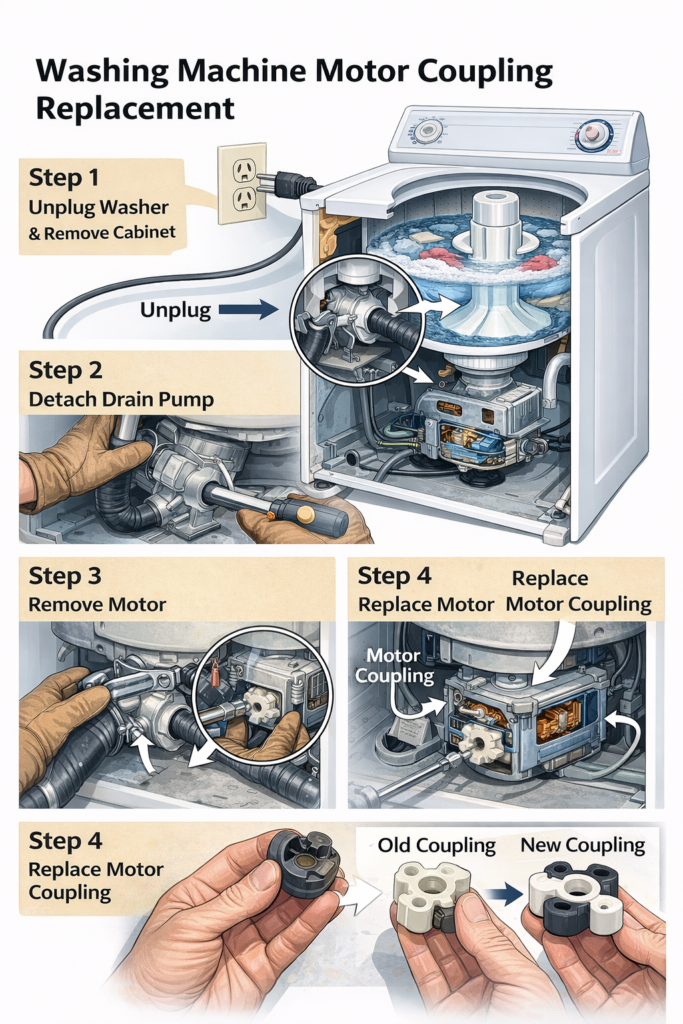
Motor Coupling
In direct-drive washers, the motor coupling connects the motor to the transmission. This component is intentionally designed to fail under excessive load to protect more expensive parts such as the motor and gearbox.
If the coupling breaks, the motor may continue to run, and in some cases, spinning may still occur. Agitation, however, typically stops completely. Uneven wear on the coupling can create inconsistent symptoms, where one function works while another does not.
Fixing This Issue: What to Expect
Advantages
- Most fixes are low-cost
- DIY repair is possible
- Common parts are easy to replace
Limitations
- Transmission repair is expensive
- Some issues need expert help
- Time-consuming troubleshooting
Drive Belt (in Belt-Driven Models)
In belt-driven washing machines, the drive belt transfers power from the motor to the transmission. Over time, belts can stretch, crack, or slip out of alignment.
A worn belt may still allow the washer to spin under lower resistance conditions. At the same time, it may fail to provide the controlled torque required for agitation. These types of issues often feel more serious than they are, even though the repair is usually straightforward.
Why Washing Machine Won’t Agitate but Spins in Deeper Issues
If basic components such as agitator parts, belts, or couplings are intact, the issue may involve more complex internal systems.
Transmission Wear
The transmission contains gears that alternate between spin and agitation modes. These gears experience continuous mechanical stress during normal operation. Over time, they can wear down or fail internally.
When transmission problems occur, the motor may still run, and the washer may sound active. Despite this, the agitator does not move because the internal gear mechanism is no longer functioning properly. Diagnosing this issue often requires opening the machine, and repairs can be more expensive.
Timer or Control System Issues
Modern washing machines rely on timers or electronic control boards to regulate cycle functions. These systems determine when the washer should agitate, rinse, or spin.
If the control system fails to send the correct signal, the washer may skip the agitation phase entirely. In some cases, the machine may proceed directly to rinsing or spinning without performing a proper wash cycle. This type of issue is less common but still possible, particularly in older or heavily used machines.
Lid Switch Problems
Many top-load washers include a lid switch that prevents operation when the lid is open. This is a safety feature designed to reduce the risk of injury.
If the lid switch becomes faulty, the washer may behave unpredictably. In some situations, spinning may still function while agitation is disabled. Because the machine appears partially operational, this issue is often overlooked during troubleshooting.
What This Problem Cannot Realistically Do
It is easy to assume that one visible symptom indicates multiple underlying failures. In reality, a washing machine that won’t agitate but spins is usually dealing with a specific and isolated mechanical issue.
This condition does not typically mean that the water inlet system is malfunctioning or that the drum is damaged. It also does not suggest that the entire motor has failed. In most cases, the washer retains full power and basic functionality.
It is also important to recognize that this issue does not automatically require replacing the entire appliance. Many online repair suggestions jump directly to major component replacement, which can lead to unnecessary expense. A more effective approach is to begin with simple inspections and focus on commonly worn parts.
Two Everyday Scenarios That Explain the Issue
The Overloaded Weekend Wash
In a busy household, multiple heavy loads—such as towels, blankets, and denim—are often washed in succession. This repeated strain places additional pressure on internal components, particularly the motor coupling.
Over time, the coupling weakens. Eventually, the washer fills and begins its cycle as usual, but during the wash phase, the agitator does not move. The machine may still spin later, creating the impression that the problem appeared suddenly, even though the damage developed gradually.
The Gradual Wear Problem
A washing machine used consistently over several years may begin to show subtle signs of wear. These can include faint clicking noises, reduced agitation strength, or occasional slipping during cycles.
As the agitator dogs continue to wear down, they eventually lose their ability to engage. At that point, the washer sounds as if it is operating normally, but the clothes remain largely motionless during the wash cycle. This type of failure often goes unnoticed until performance declines significantly.
Both scenarios illustrate how small components can wear out over time, leading to a situation where the washing machine won’t agitate but spins.
Safety and Practical Considerations
Repairing or inspecting a washing machine involves both electrical and mechanical risks. Even basic troubleshooting steps should be approached with care.
- Always unplug the washer before opening any panels
- Avoid placing hands near moving or rotating parts
- Be cautious of sharp metal edges inside the cabinet
- Use appropriate tools designed for appliance repair
It is also important to recognize personal limits. Some repairs, such as replacing a transmission or diagnosing electrical control boards, may require technical expertise. Attempting complex repairs without proper knowledge can lead to further damage or safety hazards.
Always unplug your washing machine before inspecting or repairing internal parts to avoid electrical shock or injury.
A Realistic Look at Repair vs Replacement
There is a common assumption that any washer malfunction justifies replacing the entire unit. In many cases, this assumption is not accurate.
When a washing machine won’t agitate but spins, the issue is often linked to components that are relatively inexpensive and designed to wear out over time. Replacing these parts can restore normal function and extend the life of the appliance.
At the same time, there are situations where repair may not be practical. If multiple major components fail simultaneously or if the washer is nearing the end of its lifespan, replacement may be a more reasonable option. The key is to determine whether the problem is isolated or part of a broader pattern of wear.
Learn how washing machines work in detailWhere Advice Often Goes Too Far
Some repair guides suggest that agitation problems are usually caused by major failures such as a damaged transmission or faulty motor. This perspective can be misleading.
In practice, smaller mechanical components fail far more frequently than large assemblies. Simple inspections can often identify the root cause without the need for extensive disassembly.
Replacing major parts without proper diagnosis can result in unnecessary expense and effort. A step-by-step approach, starting with the most common and accessible components, is generally more effective and reliable.
This is a common situation where a washing machine won’t agitate but spins due to internal mechanical issues.
If your washing machine won’t agitate but spins, checking small components first can save time and repair cost.
A Note on Evolving Understanding
Washing machine design continues to evolve, particularly with the increasing use of electronic controls and sensor-based systems. As a result, the causes behind agitation problems can vary depending on the model and age of the appliance.
Older machines tend to fail in predictable mechanical ways, often involving belts, couplings, or agitator components. Newer models may involve electronic control boards, sensors, or software-driven cycles, which introduce additional complexity.
Because of these differences, troubleshooting methods are not always universal. Understanding the specific design of the washer is an important part of accurate diagnosis.
Taking a Step Back Before Fixing
When a washing machine won’t agitate but spins, it is natural to want to fix the issue immediately. Taking a moment to observe the machine’s behavior can provide valuable insight.
Listening carefully to operational sounds can help identify whether the motor is running smoothly or under strain. Observing when the problem occurs within the cycle can also narrow down the cause.
These simple observations often lead to a clearer understanding of the issue, reducing the need for guesswork and unnecessary repairs.
In many cases, the machine is not failing completely—it is simply indicating that a small but essential component needs attention before normal operation can resume
Washing Machine Won’t Agitate but Spins – Complete Troubleshooting Guide
Frequently Asked Questions
Why does my washing machine spin but not agitate?
If your washing machine won’t agitate but spins, it usually means the motor is working but the motion isn’t transferring to the agitator. This is commonly caused by worn agitator dogs, a broken motor coupling, or a loose drive belt. Since spinning and agitation use different mechanisms, one can fail while the other still works.
Is it expensive to fix a washer that won’t agitate but spins?
In most cases, no. The problem is often due to small, inexpensive parts like agitator cogs or a motor coupling. These components are designed to wear out over time and are relatively easy to replace. However, if the issue involves the transmission or control board, the repair cost may be higher.
Can I fix a washing machine that won’t agitate but spins myself?
Yes, many common causes can be fixed at home with basic tools. Replacing agitator dogs, checking the drive belt, or inspecting the motor coupling are beginner-friendly repairs. Always unplug the washer before starting, and if the issue seems complex, it’s safer to consult a technician.
How do I know if the transmission is bad in my washing machine?
A faulty transmission is less common but possible. Signs include the motor running normally while the agitator does not move at all, even after checking other parts. You may also hear unusual grinding noises. If all simpler components are working, the transmission may need professional inspection or replacement.
Still Facing This Issue?
If your washing machine won’t agitate but spins, explore our detailed repair guides to fix the problem step by step.
Explore All Washing Machine Fixes →Still Dealing With Washing Machine Problems?
Don’t rely on guesswork. Explore our step-by-step repair guides to identify the exact issue and fix your washer quickly without unnecessary costs.
✔ Appliance Repair Guides
✔ Washing Machine Troubleshooting
✔ Practical DIY Fix Solutions
Pingback: Washing Machine Agitator Not Working Properly? 10 Easy Fixes (2026 Guide) - fixapplab.com