Washing Machine Water Leaking From Bottom: 10 Causes and Easy Fixes That Work
A washing machine water leaking from bottom typically signals an internal issue such as a worn seal, loose hose, or drainage malfunction. If you are wondering why is my washing machine leaking from the bottom, the cause often depends on when the leak appears during the wash cycle—whether it occurs while filling, spinning, or draining. In many cases, a washing machine leaking from underneath is linked to problems such as a clogged drain pump filter, damaged internal hoses, or a faulty water pump that develops over time.
Key Takeaways
If your washing machine is leaking from the bottom, these are the most important things to know before starting any troubleshooting:
- Most bottom leaks originate from hoses, drain pumps, filters, or worn seals.
- The timing of the leak matters. Water leaking during filling, draining, or spinning often points to different components.
- Clogged drain filters and loose hose connections are among the most common causes.
- Small leaks rarely fix themselves. Ignoring them can lead to appliance damage, mold growth, or flooring issues.
- A simple inspection can often identify the source before expensive repairs become necessary.
- Early diagnosis helps prevent larger repair costs and reduces the risk of additional water damage.
Table of Contents
What’s Actually Happening Inside the Machine
A washing machine is more than a rotating drum—it is a carefully managed system of water flow, pressure regulation, and timed operations. Water enters through the inlet valve, fills the tub to a controlled level, and then drains through a pump and hose system. Each stage depends on properly functioning seals, sensors, and connections working together.
When water appears underneath the appliance, it indicates that this system is no longer fully contained. The leak follows a physical path, often originating from a weakened seal, a cracked component, or a connection that has loosened over time. It is rarely random and usually reflects a specific failure point within the system.
The timing of the leak provides important clues. If it occurs during filling, the issue often involves the water inlet valve or supply hoses. Leaks during draining typically point to the drain pump or drain hose, while continuous leaking—even when the machine is off—may suggest structural damage such as a cracked tub or internal hose failure. Understanding this sequence helps narrow down the cause with greater accuracy
The Most Likely Causes You’ll Encounter
In most households, a washing machine water leaking from bottom can be traced to a few common issues. These problems may seem complex at first, but they are usually identifiable through careful inspection. A clogged drain pump filter is one of the most frequent causes. Small objects such as lint, coins, or hairpins can accumulate and obstruct proper drainage. When water cannot exit efficiently, it may back up and escape from the lowest point of the machine.
In many cases, a washing machine leaking from underneath is linked to internal hose damage, pump issues, or worn-out seals that develop over time.
Internal hoses are another typical source of leakage. These hoses transport water between key components, including the tub, pump, and inlet valve. Over time, exposure to heat, vibration, and pressure can weaken the material. Even a small crack or loose clamp can result in a steady leak beneath the appliance.
In front-load washers, the door gasket (rubber seal) plays a critical role in containing water. Constant exposure to moisture, detergent, and friction can lead to wear and tear. Debris trapped in the folds or small tears in the seal can redirect water downward, making it appear as though the leak is coming from the bottom. The water pump itself can also fail. Its housing may develop hairline cracks, or internal seals may deteriorate. When this happens, water leaks out during the drain cycle and collects under the machine, often going unnoticed until pooling becomes visible
Common Signs of a Bottom Leak
- Water pooling under the washing machine
- Wet floor after wash cycle
- Musty smell or hidden moisture
- Water dripping during draining or spinning
- Unusual vibration with leaking
Quick Leak Diagnosis Guide
The timing of the leak often provides the biggest clue about which component may be responsible.
| When The Leak Happens | Most Likely Cause |
|---|---|
| During Filling | Water inlet hose or inlet valve |
| During Washing | Door gasket, excess detergent, overflow issue |
| During Draining | Drain pump or drain hose |
| During Spin Cycle | Pump leak, loose hose, vibration damage |
| Constant Leak | Internal hose damage or cracked tub |
How Everyday Habits Contribute More Than You Think
Not every instance of a washing machine leaking from underneath begins with a broken part. Many issues develop gradually due to everyday usage habits that place extra strain on the appliance. Overloading the drum is a common factor. Washing machines are designed to operate with balanced loads. Excess weight increases internal pressure and places additional stress on seals, hoses, and suspension components. Over time, this strain weakens connections and contributes to leaks.
Using too much detergent can also create problems. Excessive suds expand beyond the intended areas within the machine. This foam can move into internal compartments and escape through small gaps, eventually dripping from the base. High-efficiency machines are particularly sensitive to this issue.
An uneven installation surface further complicates matters. When a washing machine is not level, it vibrates more during spin cycles. These vibrations can loosen hose clamps, shift internal components, and gradually create points where water can escape. While these habits may not cause immediate failure, they increase the likelihood of developing a leak over time.
Two Real-Life Situations That Show How It Develops
In one situation, a homeowner noticed a small puddle forming beneath the machine after each wash cycle. Since the appliance continued to function normally, the issue was ignored. Over time, the leak worsened, and the root cause turned out to be a loose internal hose clamp that had gradually shifted due to repeated vibration. A minor adjustment could have prevented damage to the flooring.
In another case, someone consistently used extra detergent in an attempt to improve cleaning results. The machine began leaking from the bottom during operation. The underlying issue was not a faulty component but rather excess foam buildup overwhelming the system. Once the detergent amount was reduced, the leaking stopped without requiring any repairs. These examples illustrate that leaks often develop gradually and are not always caused by immediate mechanical failure
A Practical Way to Identify the Source

Diagnosing a washing machine water leaking from bottom is more effective when approached methodically rather than through guesswork. Observing when the leak occurs provides valuable direction.
- During filling: likely related to inlet valves or water supply hoses
- During washing: possible door seal, overflow, or detergent-related issue
- During draining: often linked to the drain pump or drain hose
- Continuous leaking: may indicate internal hose damage or a cracked tub
A simple but effective technique is the paper towel test. Placing paper towels around the base of the machine can help identify the exact point where water first appears. The earliest wet spot typically reveals the source of the leak. Checking the drain pump filter is often the easiest starting point. It is accessible, requires minimal tools, and frequently resolves the issue. From there, inspecting external and internal hoses—if safely accessible—provides a clearer understanding of the problem.
If your washing machine leaking water from bottom during spin cycle, it usually indicates a problem with the drain pump or hose connections under pressure.
Quick Fix Steps
- Turn off power and water supply immediately
- Check and clean the drain pump filter
- Inspect hoses for cracks or loose connections
- Make sure the machine is level
- Reduce detergent usage if excessive
Common Mistakes That Make Leaks Worse
- Continuing to use the washer after noticing water underneath.
- Ignoring small drips because the machine still appears to work normally.
- Using excessive detergent that creates overflow and hidden moisture.
- Pulling the washer away from the wall without disconnecting hoses.
- Assuming every leak comes from the drain hose without proper inspection.
- Delaying filter cleaning until drainage problems become severe.
What This Problem Cannot Realistically Do
When dealing with a washing machine water leaking from bottom, it is easy to assume the worst. In reality, not every leak indicates severe or irreversible damage. This issue does not automatically mean the appliance is beyond repair. Many leaks originate from replaceable components such as hoses, clamps, or filters. Addressing these parts can often restore normal function without major expense.
It also does not necessarily pose an immediate electrical hazard, particularly if the machine is turned off promptly. Modern washing machines include basic safety features designed to minimize risk in such situations. At the same time, the problem will not resolve on its own. Small leaks tend to worsen if ignored, potentially leading to structural damage within the machine or to surrounding surfaces such as flooring. Maintaining realistic expectations helps in making informed decisions about repair and maintenance
Place dry paper towels under different areas of the washing machine to quickly identify the exact source of the leak. This simple method is often more effective than visual inspection alone.
You May Also Like
If your washing machine is leaking water from the bottom, these related troubleshooting guides may help you identify the exact cause, prevent further damage, and restore normal washer performance.
- Washing Machine Water Not Pumping Out – Causes & Fixes
- Washer Drain Filter Blockage Fix Guide
- Washing Machine Not Draining Water – Complete Troubleshooting Guide
- Washing Machine Stops Mid Cycle Full of Water
- Washing Machine Water Pump Motor Failure – Signs & Fixes
- Why Washing Machine Not Rinsing Properly – Easy Fix Guide
Safety and Practical Considerations
Always unplug the washing machine and turn off the water supply before inspecting any internal parts. Water leakage combined with electricity can create serious safety risks.
Basic safety measures are essential when addressing any appliance issue involving water. Since water and electricity present a risk when combined, precaution should always come first. Always unplug the washing machine before inspecting it. Turning off the water supply prevents additional leakage during troubleshooting. These steps reduce the risk of electrical shock and limit further water damage.
If the appliance needs to be moved, do so carefully. Washing machines are heavy, and tilting them abruptly can cause residual water to spill. When accessing internal components, avoid forcing panels or parts, as many are secured with clips or screws that require proper handling. From a practical standpoint, repeated leaks can damage flooring materials, especially wood or laminate. Addressing the issue early helps prevent long-term structural damage to the surrounding area. If your washer leaking water from bottom continues even after basic checks, it is important to stop using the appliance and inspect internal components carefully to avoid further damage
When to Call a Technician
Many washing machine leaks can be traced to filters, hoses, or loose connections. However, some situations require professional diagnosis and repair.
- Water continues leaking after hoses and filters have been checked.
- The drain pump housing appears cracked or damaged.
- The outer tub is leaking or visibly cracked.
- Electrical smells or signs of moisture near wiring are present.
- Multiple components have failed at the same time.
- The machine leaks heavily during every cycle.
When Repair Becomes Less Practical
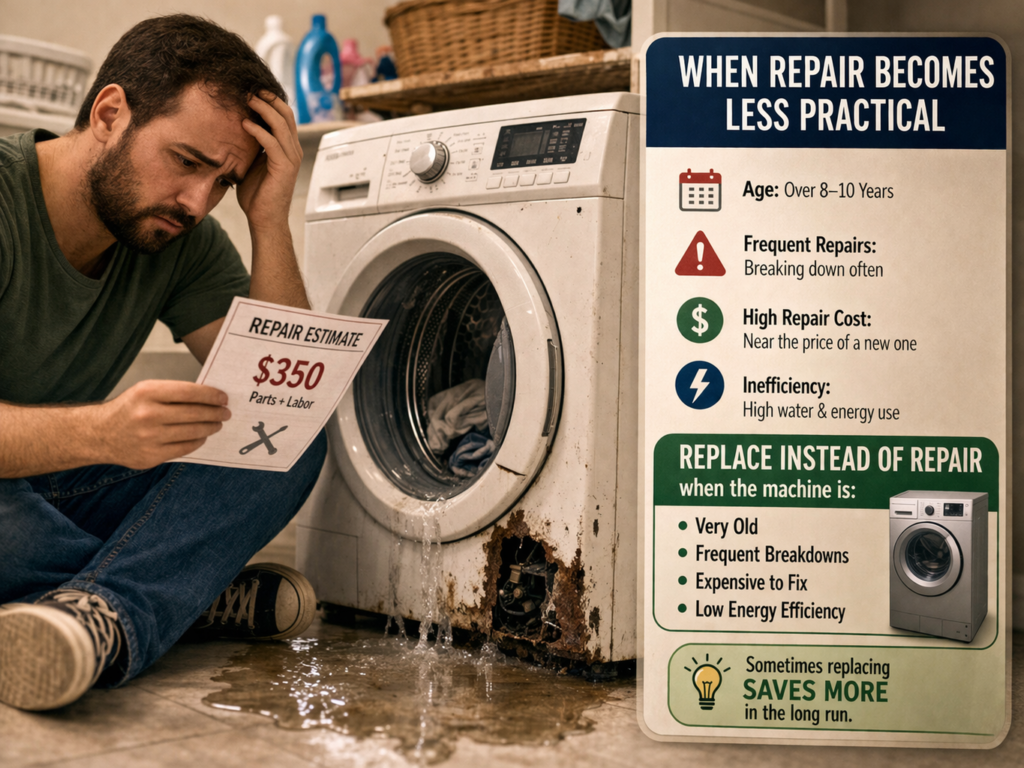
Not all problems associated with a washing machine leaking from the bottom are worth repairing, particularly in older units. A cracked outer tub is a common example of a costly issue. Repairing or replacing this component often requires significant labor and expense, sometimes approaching the cost of a new machine. In such cases, replacement may be the more practical option.
Frequent failures across multiple components can also indicate that the appliance is nearing the end of its service life. Continuing to repair different parts may lead to increasing costs over time without providing long-term reliability. Making a balanced decision involves considering both the age of the washing machine and the cost of repairs relative to replacement.
A Note on Evolving Understanding and Design
Modern washing machines continue to evolve, incorporating advanced sensors, improved water control systems, and more efficient sealing technologies. These advancements aim to reduce issues such as leakage and improve overall performance. At the same time, increased complexity introduces new potential failure points. What was once a purely mechanical system may now involve electronic controls and sensors that require a different approach to diagnosis and repair.
Understanding of these systems is still developing as manufacturers refine their designs. As a result, solutions that worked for older machines may not always apply directly to newer models. Staying informed and, when necessary, seeking professional guidance can help address these differences effectively.
A Balanced View on Common Claims
A common assumption is that most washing machine leaks are quick and easy to fix. While this is true in some cases, it does not reflect the full range of possibilities. Certain issues, such as a clogged filter or loose hose, can be resolved with minimal effort. Others involve internal components that require partial disassembly and technical expertise. Treating every leak as a simple DIY fix can lead to incomplete repairs or overlooked problems.
At the same time, assuming that every leak requires professional intervention may result in unnecessary costs. The most practical approach lies in evaluating the specific cause and choosing the appropriate level of repair
Looking at the Issue with a Wider Perspective
A washing machine water leaking from bottom is rarely the result of a single isolated fault. Instead, it reflects how various components interact over time under real-world conditions. Factors such as wear and tear, usage habits, installation quality, and routine maintenance all influence the likelihood of leaks. What appears as a sudden issue is often the final outcome of gradual changes within the system.
Taking a broader perspective—viewing the washing machine as an interconnected system rather than a single appliance—allows for a more thoughtful and effective approach to diagnosing and resolving the problem. In the end, it often comes down to a small internal component that has simply stopped performing as it once did.
A washing machine leaking water underneath causes and fixes should always be addressed early, as small leaks can quickly turn into major appliance or flooring damage.
Frequently Asked Questions
Why is my washing machine water leaking from bottom during the spin cycle?
A washing machine water leaking from bottom during the spin cycle is often linked to the drain pump or drain hose. During spinning, water is rapidly expelled, putting pressure on these components. If the pump housing is cracked or the hose connection is loose, water can escape underneath the machine.
Can a clogged filter cause a washing machine to leak from underneath?
Yes, a clogged drain pump filter is one of the most common reasons for a washing machine leaking from underneath. When debris blocks the filter, water cannot drain properly and may overflow internally, eventually leaking from the bottom of the appliance.
Is it safe to use a washing machine that is leaking from the bottom?
Using a washing machine water leaking from bottom is not recommended. Even a small leak can worsen over time and may lead to electrical risks, water damage, or internal component failure. It is best to turn off the machine, unplug it, and identify the issue before using it again.
How do I fix a washing machine leaking water from the bottom?
To fix a washing machine leaking water from the bottom, start by checking the drain filter, hoses, and connections for blockages or damage. Ensure the machine is level and avoid overloading or using excess detergent. If the issue involves internal parts like the pump or tub, professional repair may be necessary.
Muhammad Khalid
Founder of FixAppLab • Appliance Troubleshooting Writer • Home Appliance Research Publisher
Muhammad Khalid is the founder of FixAppLab, a website dedicated to helping homeowners diagnose appliance problems and understand practical troubleshooting solutions. His content focuses on washing machines, dryers, refrigerators, and common household appliance failures. Through detailed guides, symptom-based troubleshooting articles, and repair education resources, he aims to make appliance problems easier to understand for everyday users.
Browse appliance troubleshooting resources, maintenance guides, repair explanations, and practical DIY information designed to help readers identify common appliance faults and make informed repair decisions.


3 comments
I absolutely love this post and the way it encourages us to raise our consciousness.
I think it’s so important to focus on being
more aware of our choices, our thoughts, and our intentions.
From my own experience, I’ve found that really
focusing on self-care and mindfulness helps to bring about a sense
of inner peace and balance. For me, one of the best ways to do
this is through Womens Massage NJ. It’s not only incredibly relaxing,
but it can also help to bring about a greater sense of connection to oneself and to the world around us.
I highly recommend it as a way to take a break from the hustle
and bustle of everyday life and to really focus on stillness and self-awareness.
I cannot consider anything we get worried about in life makes a difference.
All the time squandered taking into consideration the several
things that people experience every single moment is definitely undoubtedly
necessary, as no other person will probably face existence for any of us.
Personally I think that citizens ought to be even more mentally stable.
Knowledge is delightful, yet so much of what we should think
about is so abstract. Having a cup of coffee is a zen activity that brings one back to the present moment.
We must become more in the here and now, without being overcome by existence and the crises we experience each
day.
This unique blog page is thrilling. Articles or blog posts such as this
are by and large missed, if truth be shared.
Commonly the very best of the Online world is just not the most broadly elevated written content, but yet instead everything other than them, the forgotten about masses with personal blogs that are seriously far better as compared to those
of primary influencers. This is this sort of a blogging site.
My spouse and I will certainly deliver recommendations, possibly even when ever not made to do
so. Very first is, continue writing. Second is, continue to keep crafting continually.
Lastly is, employ your blog website to build your own personal approach.
I am definitely not a blog owner I guess; I am in fact a Postpartum Massage Therapist.
I practice Postpartum Massage Therapy, facilitating
females to heal soon after having a newborn. It’s gratifying activity.
That is exactly what I commit virtually all of my time accomplishing, yet I have also cherished penning from the moment I was little.
I am a well-read individual and every year or so I read a heap way higher when compared with myself personally.
haha In the upcoming year or so, maybe I will get
really serious concerning blogs. The problem is, it cannot just simply
an impression; the function of creating and posting frequently helps
make a weblog expand over some amount of time.