
A washing machine stops before rinse cycle when it cannot safely move to the next stage. In most situations, the appliance pauses due to drainage problems, load imbalance, or a minor mechanical fault. Many users notice that their washing machine stops before rinse cycle unexpectedly, but understanding what the washer is trying to do at that moment makes troubleshooting much more straightforward.
- Main Issue: Washing machine stops before rinse cycle due to drainage or lid switch problems.
- Common Causes: Unbalanced load, clogged drain filter, or water supply issues.
- Quick Solution: Cleaning the filter or redistributing clothes often fixes the problem.
- Clean the drain pump filter
- Check the drain hose for blockages
- Balance the laundry load inside the drum
- Make sure water supply is working properly
- Test the lid switch or door lock
Table of Contents
How the Rinse Stage Actually Works
To understand why a washing machine stops before rinse cycle, it helps to examine what happens just before this stage begins. After completing the wash phase, the machine must drain the dirty water, stabilize the drum, and prepare to refill with clean water for rinsing. Each of these steps must occur in the correct sequence for the cycle to continue.
This transition involves more than simply advancing to the next setting. The washer runs a series of internal checks to confirm that conditions are safe and functional. It verifies whether the water has drained completely, whether the drum is balanced enough for spinning, whether the lid or door lock is properly engaged, and whether fresh water can enter at the correct pressure.
If any one of these conditions is not met, the machine will pause. From the user’s perspective, it may appear that the washer has stopped working. In reality, it is waiting for a condition that has not been fulfilled, preventing it from moving forward into the rinse cycle.
When a Pause Is Not Really a Failure
It is common to assume something is broken when a washer remains full of water and refuses to continue. In many cases, the machine is functioning exactly as designed. Modern washing machines include built-in safety mechanisms to prevent internal damage and ensure stable operation.
For example, if the drum begins spinning while the load is uneven, it can cause excessive vibration or physical impact inside the machine. If water has not drained properly, rinsing would be ineffective. Similarly, if the system detects that the lid or door is not securely closed, it will not proceed to the next stage.
This explains why the issue may seem inconsistent. One load may complete without problems, while another stops midway. The difference often lies in internal conditions such as load distribution or water flow, rather than a permanent mechanical failure.
The Most Common Mechanical
Always unplug your washing machine before inspecting internal parts. Electrical components inside the washer can cause serious injury if handled while connected to power.
There is no single universal cause behind a washing machine stopping before rinse cycle. Instead, several specific components are commonly involved. Identifying these areas can significantly narrow down the troubleshooting process.
Lid switch or door lock
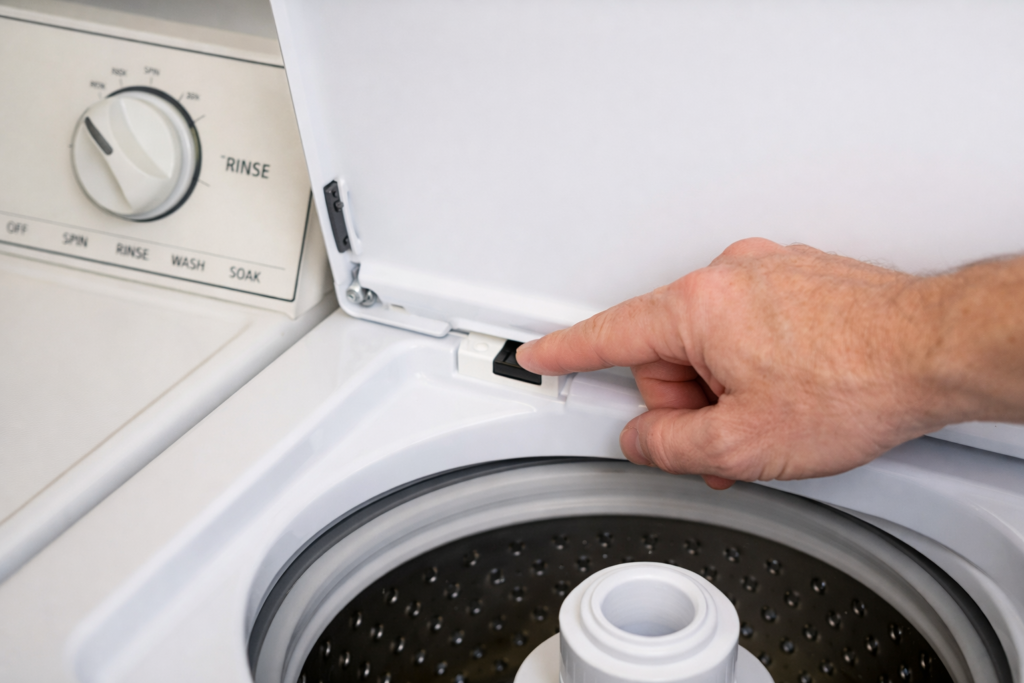
The washer requires confirmation that it is safe to spin. If the lid switch or door lock mechanism fails or becomes unreliable, the machine may behave as if the door is open. In this situation, the wash cycle may complete, but the machine will stop before entering the rinse or spin phase. Often, there is little to no sound indicating further activity.
Although small, this component plays a critical role in the cycle. A faulty lid switch is one of the most frequent and easily overlooked reasons a washer does not proceed to rinsing.
A faulty lid switch can also cause a washing machine to stop before rinse cycle.
Drainage issues
Before the rinse cycle begins, all used water must be removed from the drum. If water remains inside, the machine cannot continue. Drainage problems are among the most common causes of this issue.
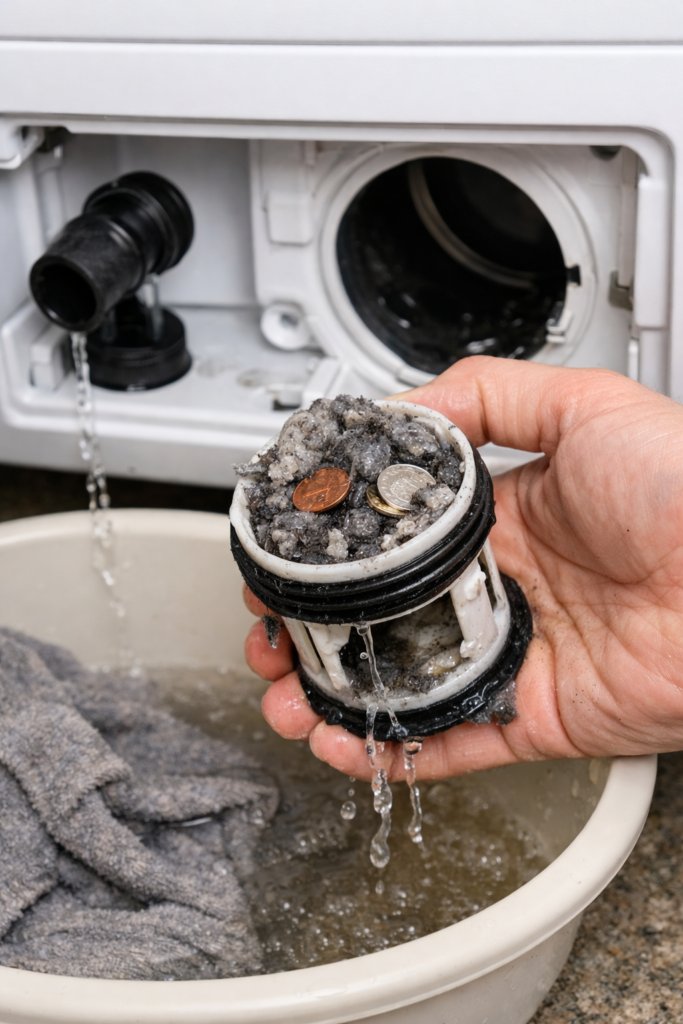
Typical reasons include a clogged drain pump filter filled with lint or debris, a kinked or twisted drain hose, or a blockage within the household plumbing system. When drainage is restricted, the washer may appear stuck rather than actively malfunctioning.
If your washing machine stops before rinse cycle, the most common reason is drainage problem.
Timer or control system wear
In older washing machines, mechanical timers control the progression of cycles. Over time, internal contacts or gears can wear out, leading to inconsistent operation. The machine may fail to advance automatically or only work when the dial is positioned precisely.
This can create the impression of random behavior, although the problem is usually confined to a worn timer mechanism or control system component.
Run a “drain and spin” cycle to quickly check if the issue is related to drainage.
Load Balance: A Subtle but Powerful Factor
A frequent reason a washing machine stops before rinse cycle is not related to a faulty part but rather to how the laundry is arranged inside the drum. Load balance plays a crucial role in the machine’s ability to proceed safely.
Bulky items such as blankets, towels, or heavy clothing can shift during washing. When the washer attempts to spin, it may detect uneven weight distribution. To prevent excessive vibration or internal damage, the machine pauses and does not move forward to the rinse stage.
This explains why one load may run smoothly while another fails to complete. The solution is often simple—redistributing the clothes evenly or reducing the load size. In such cases, no repair is needed; the issue is resolved by adjusting how the machine is used.
Sometimes a washing machine stops before rinse cycle because the load is not balanced properly.
how washing machines workWater Flow and Why It Matters More Than Expected
The rinse cycle depends on a consistent supply of clean water. If the washing machine cannot draw in enough water, it may stop rather than continue with an incomplete process. Water flow issues are often subtle and not immediately obvious.
Several factors can interfere with proper water intake. These include a partially closed supply valve, low household water pressure, sediment buildup in the inlet screen, or a malfunctioning water inlet valve. Each of these can reduce the amount of water entering the machine.
In some homes, water pressure fluctuates throughout the day. This can make the issue appear inconsistent, as the washer may function normally at one time and stop at another. Identifying water supply conditions is an important part of diagnosing why a washing machine stops before rinse cycle.
What This Problem Cannot Realistically Do
There is a common assumption that when a washer stops mid-cycle, it indicates a major internal failure. In most cases, this is not accurate. The issue is usually limited to a specific system rather than the entire machine.
A washing machine stopping before rinse cycle does not typically mean that the motor has completely failed, that the appliance must be replaced, or that multiple internal components are damaged simultaneously. These scenarios are far less common than localized issues such as drainage or sensor faults.
Some explanations exaggerate the severity of the problem, suggesting that any interruption in the cycle signals a serious breakdown. In reality, most washers are designed to stop intentionally when conditions are not suitable for safe operation. This built-in behavior helps prevent more significant damage.
Everyday Situations That Show How This Happens
Real-life examples often make this issue easier to understand. In one case, a user loads a heavy blanket along with several towels. The wash cycle completes normally, but when the machine attempts to spin, the load shifts unevenly. The washer pauses and does not reach the rinse cycle. After redistributing the items, the machine works as expected.
In another situation, the washing machine finishes the wash phase but remains full of water. There is no movement or sound. Upon inspection, the drain pump filter is found to be clogged with small debris such as lint and coins. Once the filter is cleaned, the washer resumes normal operation.
These scenarios highlight that the problem often stems from specific conditions rather than complex mechanical failure. Observing how the machine behaves provides valuable clues for identifying the cause.
Safety and Practical Considerations
Working with a washing machine requires attention to both electrical and water-related safety. Before performing any checks, it is important to unplug the appliance and, if necessary, turn off the water supply. Keeping towels nearby is also helpful when opening filters or hoses, as residual water may spill out.
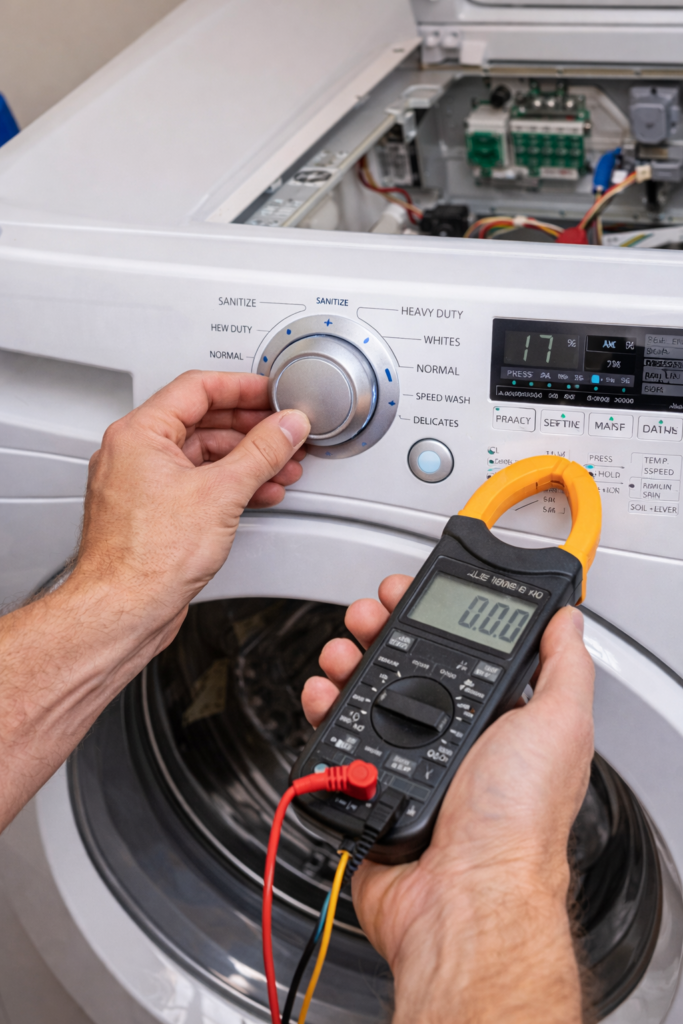
When testing components such as switches or valves, using proper tools like a multimeter can provide accurate results. Attempting to diagnose issues without appropriate tools may lead to incorrect conclusions or unnecessary replacement of parts.
It is also important to avoid forcing the machine to continue by repeatedly adjusting the dial or restarting the cycle. While this may temporarily move the process forward, it can contribute to further wear on internal components. Addressing the root cause is always a more reliable approach.
Where Knowledge Is Still Evolving
Washing machines have become increasingly sophisticated, incorporating sensors, electronic control boards, and automated diagnostics. These systems improve efficiency but can also make troubleshooting less straightforward.
In some cases, a washing machine may stop before rinse cycle due to a sensor misreading rather than a physical malfunction. Diagnosing such issues can be challenging without access to model-specific information or diagnostic tools.
As appliance technology continues to develop, understanding how these systems interact becomes more important. What appears to be a simple pause may involve multiple internal checks and signals working together.
A Quiet Perspective on Fixing the Issue
When a washing machine stops before rinse cycle, the natural reaction is to search for a single, definitive cause. In practice, the machine is responding to a condition that prevents it from continuing safely.
Approaching the problem step by step—checking drainage, load balance, water supply, and control components—often leads to a clear solution without unnecessary expense. Some fixes are as simple as adjusting a hose or redistributing laundry, while others may involve replacing a worn part.
The machine is not stopping without reason; it is responding to conditions that require attention, even if those conditions are not immediately visible.
While many cases are simple to fix, some signs may indicate a deeper issue inside the washing machine that requires professional attention.
- The machine stops at the same point every time
- No sound at all after the wash cycle
- The drum remains full of water consistently
- The control panel becomes unresponsive
These signs may point to control board failure or internal component damage that may require expert repair.
Some issues go beyond basic troubleshooting. If your washing machine stops before rinse cycle even after checking drainage, load balance, and water supply, it may indicate a deeper internal fault.
- Unusual noises without progressing to the next cycle
- No response after turning the control dial
- Electrical burning smell or visible sparks
- Repeated failure even after basic fixes
In these situations, it’s safer to contact a qualified technician instead of attempting further repairs.
Frequently Asked Questions
Why does my washing machine stop before the rinse cycle but still wash normally?
If your washing machine stops before the rinse cycle, it usually means the wash phase is working but something is preventing the machine from moving forward. The most common reasons include drainage issues, a faulty lid switch, or an unbalanced load. If water is not draining properly or the machine cannot safely spin, it will pause before entering the rinse stage
Can a clogged drain filter cause the washing machine to stop before rinse?
Yes, a clogged drain pump filter is one of the most common causes of this problem. When the filter is blocked with lint, coins, or debris, the washer cannot drain water efficiently. As a result, the machine will not proceed to the rinse cycle because it requires an empty drum before refilling with clean water
How do I fix a washing machine that stops before the rinse cycle?
Start with simple troubleshooting steps. Check and clean the drain filter, inspect the drain hose for kinks or blockages, and make sure the load is evenly distributed. Also, ensure the water supply is strong and the inlet valve is not clogged. If the issue continues, test the lid switch or timer using a multimeter, as these components commonly fail and stop the cycle progression.
Is it safe to keep using a washer that stops before rinse cycle?
It is not recommended to keep using a washing machine that stops before the rinse cycle without fixing the issue. Running the machine repeatedly in this condition can put extra strain on the motor, pump, and internal components. Addressing the root cause early can prevent more serious and costly repairs later
Related Guides
Washing Machine Smells Bad? Causes & Easy Fixes
Remove bad odors from your washer by fixing mold, residue buildup, and drainage issues quickly.
Door IssueWashing Machine Door Not Locking? Fix It Fast
Learn why your washer door won’t lock and how to fix latch or control issues easily.
Drum ProblemWashing Machine Drum Not Turning? Causes & Fixes
Fix drum movement problems caused by belts, motors, or load issues.
Pause IssueWashing Machine Keeps Pausing? 8 Fixes
Stop your washer from pausing by fixing sensor, load, or water issues.