7 Washing Machine Shock Absorber Failure Symptoms You Should Never Ignore
Washing machine shock absorber failure symptoms typically appear as strong vibration, loud banging noises, or the machine shifting out of position during a cycle. These signs indicate a loss of internal control, where drum movement is no longer properly stabilized. Once that balance is disrupted, even routine laundry loads can become unpredictable and stressful for the appliance

Quick Summary
Key Takeaways
Understanding these core warning signs can help you identify shock absorber issues early and prevent further damage:
- Excessive vibration: Often the first noticeable sign that the shock absorbers are no longer working effectively.
- Loud banging noises: Indicates the drum is hitting internal parts due to lack of proper damping.
- Washer movement (“walking”): Shows severe imbalance and loss of internal stability.
- Ignoring symptoms: Can lead to damage in bearings, springs, and other internal components.
Table of Contents
Washing Machine Shock Absorber Failure Symptoms: What They Actually Mean
Most users rarely consider what happens inside a washing machine once a cycle begins. The drum rotates at high speed, water circulates, and clothes shift continuously. All of this motion generates force, and shock absorbers are designed to manage that energy so it does not transfer to the outer cabinet or frame.
These components function by resisting sudden movement. When the drum shifts off-center, the shock absorbers slow it down and guide it back into alignment. Without this resistance, the drum does not simply spin—it tilts, rebounds, and swings in ways the machine was never engineered to handle.
In a properly functioning washer, this process goes unnoticed. The machine runs smoothly with minimal vibration and noise. As the damping system begins to weaken, that stability gradually fades, leading to noticeable operational changes.
These washing machine shock absorber failure symptoms often start gradually but become more severe over time. Ignoring washing machine shock absorber failure symptoms can lead to serious internal damage and costly repairs.
Early Signs That Often Get Overlooked
Washing machine shock absorber failure symptoms rarely appear suddenly. Instead, they develop gradually, which makes them easy to overlook in the early stages. You may first notice slightly stronger vibration during the spin cycle. The sound profile may also change, becoming heavier or less consistent. Since the washer continues to function, these subtle differences are often dismissed as normal wear.
Another early indicator is the manual drum response. When pressed down, a healthy drum returns smoothly to its position. If the drum bounces more than once or feels loose, it suggests reduced damping resistance. Although these early warning signs do not immediately stop the machine from working, they indicate that internal control is declining. Delaying attention at this stage can place additional stress on other components.
Self-Check Guide
Quick Check: Is Your Washer at Risk?
Answer these quick questions to identify early signs of washing machine shock absorber failure:
- ✔ Does your washing machine shake violently during spin cycles?
- ✔ Do you hear loud thumping or banging noises while the drum is spinning?
- ✔ Does the drum bounce multiple times when pressed down by hand?
- ✔ Is your washing machine moving or “walking” from its original position?
If you answered “yes” to any of these, your washer may have worn shock absorbers and should be checked before further damage occurs.
You May Also Like
-
Washing Machine Shaking Too Much: Causes and Practical Fixes
Understand why your washer vibrates excessively and how to fix balance issues before they damage internal parts.
When the Symptoms Become Hard to Ignore

As wear progresses, washing machine shock absorber failure symptoms become more pronounced and disruptive. The machine’s behavior shifts from slightly irregular to clearly unstable. Common signs at this stage include
- Strong shaking that can be felt through the floor
- Loud thumping or banging during high-speed spin cycles
- The washing machine moving or “walking” across the floor
- Repeated pauses or imbalance error codes
The sound is often the first major concern. It becomes heavier and more forceful, indicating that the drum is no longer properly controlled. Instead of smooth rotation, it begins to strike internal limits. Movement is another clear indicator. A washer that shifts position reflects internal forces being transferred outward. At this stage, the machine may still operate, but it is no longer functioning within safe mechanical limits.
Common Problems and What They Mean
Strong vibration
Likely caused by worn shock absorbers or internal imbalance affecting drum stability.
Loud banging noise
Indicates the drum is hitting the internal frame due to weak or failed dampening.
Unbalanced error codes
The washing machine cannot properly stabilize the load during spin cycles.
Clothes too wet after cycle
Reduced spin efficiency caused by instability and poor drum control.
What Causes the Problem to Develop Over Time
Shock absorbers typically fail due to gradual wear rather than sudden damage. Each spin cycle places stress on these components, slowly reducing their ability to control movement. Over time, internal resistance decreases as materials degrade. This leads to weaker damping performance and increased drum instability. The process is progressive, often going unnoticed until symptoms become severe.
Several usage patterns can accelerate this wear
- Frequently overloading the washing machine
- Running consecutive heavy-duty cycles
- Installing the washer on an uneven or unstable surface
- Ignoring early signs of excessive vibration
Even under normal conditions, shock absorbers have a finite lifespan. They are designed to absorb energy, which means they naturally lose effectiveness with continued use
How to Prevent Shock Absorber Damage
Simple maintenance habits can significantly extend the life of your washing machine’s shock absorbers and prevent costly repairs.
✔ Avoid overloading
Overloading puts excessive pressure on the drum and suspension system, accelerating wear.
✔ Keep the washer level
An uneven surface forces the machine to compensate, increasing stress on shock absorbers.
✔ Balance your laundry
Uneven loads create instability, causing unnecessary strain during spin cycles.
✔ Perform regular checks
Inspect your washer periodically to catch early signs of vibration or imbalance.
What This Problem Does to the Rest of the Machine

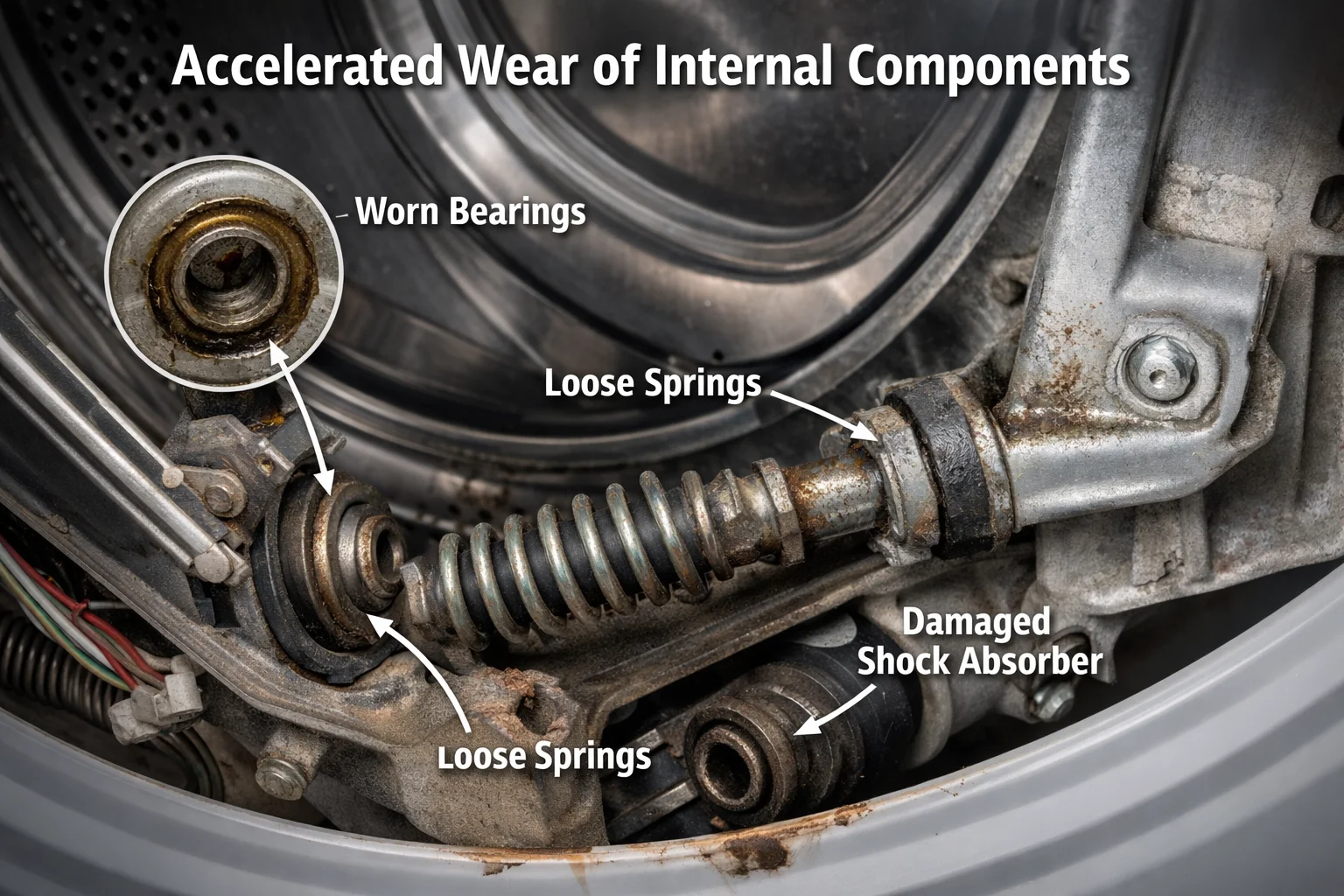
When shock absorbers lose their effectiveness, the impact extends beyond vibration alone. The entire suspension system begins to experience irregular stress. The drum starts moving unpredictably, placing strain on surrounding components such as bearings, suspension springs, and mounting brackets. These parts are not designed to handle continuous uncontrolled motion. As a result, several secondary issues may develop:
- Accelerated wear of internal components
- Reduced spin efficiency and longer drying times
- Increased operational noise from other parts
- Loosening of structural connections within the washer
Clothing may also come out wetter than expected because the machine cannot maintain stable high-speed rotation. The system often compensates by slowing down or interrupting the spin cycle. This is why washing machine shock absorber failure symptoms should not be viewed in isolation. They often signal broader mechanical stress within the appliance.
You May Also Like
-
Washing Machine Making Loud Noise When Spinning: Causes and Fixes
Learn what causes loud banging or thumping sounds during spin cycles and how internal components like shock absorbers or bearings may be involved.
What Shock Absorbers Cannot Do and Common Misunderstandings
It is a common misconception that shock absorbers are responsible for eliminating all vibration. In reality, they are designed to control movement, not remove it entirely.
A washing machine will always produce some level of vibration, particularly during high-speed spinning. Even a properly functioning unit is not completely motionless. Shock absorbers also cannot resolve issues such as:
- Severely uneven flooring
- Improper load distribution inside the drum
- Structural damage to the washer frame
Another misunderstanding is the expectation that replacing shock absorbers will fully restore a machine to like-new condition. While new components improve stability, they cannot reverse wear in other parts that may already be compromised. Understanding these limitations helps set realistic expectations and supports more accurate troubleshooting.
Two Everyday Situations That Reveal the Issue
Consider a typical evening laundry cycle. The washer starts normally, but during the spin phase, a heavy thudding sound begins at regular intervals. You pause the cycle, adjust the load, and restart it. The noise returns, slightly louder than before.
In another scenario, you notice that your washing machine has gradually shifted a few inches from its original position over several days. You reposition it, assuming it was accidentally moved. After a few more cycles, it shifts again. Both situations reflect the same underlying problem: uncontrolled internal drum movement due to weakened damping. These are not isolated incidents but common ways washing machine shock absorber failure symptoms present in everyday use.
You May Also Like
-
Washing Machine Not Spinning Properly: Causes and Easy Fixes
Discover why your washer fails to spin correctly and how issues like imbalance, worn parts, or shock absorber problems can affect overall performance.
Safety and Practical Considerations
Operating a washer with significant instability introduces both mechanical and safety risks. Excessive movement can affect more than just performance. A machine that shifts during operation may:
- Place strain on water hoses and electrical connections
- Damage nearby walls, flooring, or cabinetry
- Increase the likelihood of internal component failure
If left unaddressed, minor vibration can escalate into structural damage. The longer the issue persists, the greater the risk to the appliance and surrounding area. Practical steps to reduce immediate risk include:
- Reducing load size temporarily
- Ensuring the washer is properly leveled
- Avoiding high-speed spin cycles until repairs are made
While some inspections can be done at home, certain repairs require technical expertise. In those cases, professional service is often the safest approach.
Important Notice
When Should You Take Action?
If your washing machine shows repeated vibration, loud banging noises, or imbalance errors, it is a clear sign that something is wrong internally and should not be ignored.
Delaying repairs can lead to serious damage to key components such as bearings, suspension systems, and the drum assembly—resulting in more expensive repairs later.
A Measured View on Repair and Replacement
When dealing with washing machine shock absorber failure symptoms, responses often fall into two extremes: ignoring the issue or assuming the entire appliance must be replaced. In reality, most situations fall somewhere in between. Replacing worn shock absorbers is typically a straightforward repair that restores stability. It is one of the more predictable maintenance tasks in appliance repair.
However, it is also important to consider the machine’s overall condition. If multiple components have worn out, replacing a single part may not provide a long-term solution. Not every unusual vibration or noise indicates immediate failure. Some variation is normal, particularly with uneven loads. The key is identifying patterns that worsen over time rather than isolated occurrences.
Understanding That Knowledge Is Still Evolving
Washing machine design continues to evolve, and with it, the understanding of suspension and damping systems. Modern appliances incorporate different materials, sensor technologies, and structural designs. Because of these variations, washing machine shock absorber failure symptoms may present differently across models and brands. What appears as a clear indicator in one machine may manifest more subtly in another.
Technicians and manufacturers continue refining these systems, leading to updated diagnostic approaches and repair techniques. Staying informed about these developments helps ensure more accurate problem identification.
You May Also Like
-
Washing Machine Stuck on Sensing Cycle: Causes and Fixes
If your washer keeps pausing or gets stuck during cycles, this guide explains common causes and how control or balance issues can affect normal operation.
A Quiet Perspective on Maintenance and Awareness
Household appliances often operate unnoticed until something changes. Washing machines, in particular, tend to blend into daily routines without much attention. Recognizing small shifts in performance—such as sound, vibration, or balance—creates an opportunity to address issues early. This level of awareness does not require technical knowledge, only consistent observation.
Over time, these small observations form a habit of preventive care. In many cases, that awareness determines whether a problem remains minor or develops into a more complex repair situation. Sometimes, the machine is simply indicating, in its own subtle way, that its internal balance is no longer what it used to be
Still Having Washer Problems?
Explore more expert troubleshooting guides to fix your washing machine quickly and easily.
Frequently Asked Questions
What are the most common washing machine shock absorber failure symptoms?
The most common symptoms include excessive vibration, loud banging or thumping noises during spin cycles, the washer moving or “walking,” and frequent unbalanced load errors. You may also notice the drum bouncing excessively or clothes coming out wetter than usual
Can I continue using a washing machine with faulty shock absorbers?
It is not recommended. Continued use can put extra stress on internal components like bearings and suspension parts, potentially leading to more serious and costly damage over time.
How do I test if my washing machine shock absorbers are bad?
A simple method is the bounce test. Press down firmly on the drum and release it. If it bounces multiple times instead of returning smoothly, the shock absorbers are likely worn and need replacement.
How long do washing machine shock absorbers typically last?
Shock absorbers usually last between 5 to 10 years, depending on usage, load size, and maintenance habits. Frequent overloading or heavy cycles can shorten their lifespan


1 comment
[…] Shock Absorber Failure Signs […]