Washing Machine Ineffective Wash Cycle
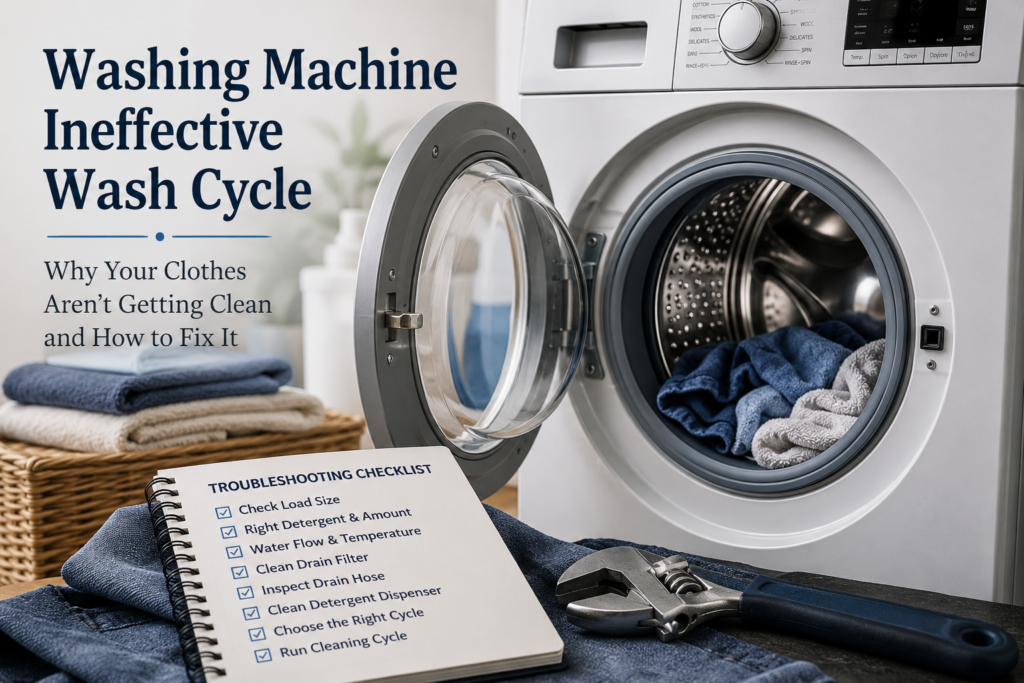
If your washing machine runs a full cycle but clothes still come out dirty, soapy, or smelling stale, you’re dealing with a washing machine ineffective wash cycle. and it’s far more common than most people realize. The most frequent causes are overloading the drum, using too much detergent, restricted water flow, or a clogged drain that quietly recycles dirty water back through your laundry. Before assuming something is seriously wrong, start by checking your load size, detergent amount, and drain filter
Quick Key Takeaways
- Overloading the washer prevents proper agitation, rinsing, and detergent circulation.
- Excess detergent often causes residue buildup that makes clothes feel dirty or stiff after washing.
- Restricted drainage can recycle dirty water back through the laundry during rinse cycles.
- Weak water flow or low water temperature can quietly reduce overall cleaning performance.
- Regular washer cleaning and proper load sizing prevent many ineffective wash cycle problems before they start.
Table of Contents
Why Your Washing Machine Stops Cleaning Properly
There’s a particular frustration that comes with pulling laundry out of the washer only to realize it’s not actually clean. The machine seemed to do everything right .water filled, the drum tumbled, the spin cycle finished .but the clothes tell a different story. Stains are still there, fabrics feel stiff or greasy, and sometimes there’s a faint sour smell that wasn’t there before washing.
What makes this problem tricky is that it rarely announces itself dramatically. The washer doesn’t stop mid-cycle or flash an error code. It just quietly underperforms, cycle after cycle, while you keep blaming your detergent or water quality. when the real issue has often been building up for weeks. Every effective wash cycle depends on four things working together:
- Water temperature — warm or hot water breaks down oils, grease, and heavy soils
- Water volume — the drum needs enough water to properly dilute detergent and rinse clothing
- Mechanical agitation — drum movement physically loosens dirt from fabric fibers
- Clean drainage and rinsing — dirty water must fully exit before clean rinse water enters
When even one of these breaks down, cleaning performance suffers noticeably. When two or three are compromised at the same time, the results feel consistently poor no matter what you try

Overloading: The Most Underestimated Cause
If there’s a single issue behind more ineffective wash cycles than anything else, it’s overloading . and it’s the one most people consistently underestimate. When you pack the drum as tightly as it will physically hold, the machine accepts it without complaint. But what happens inside during the cycle is far from a proper wash.
Clothes compressed together can’t move freely through the water. Detergent never fully reaches the fabric. Agitation becomes weak and uneven. Rinsing is incomplete because water can’t circulate through the dense mass of laundry. The machine runs its full cycle time. and delivers a fraction of its actual cleaning power.
Front-load washers are especially affected. Their cleaning action depends on clothes lifting and dropping through the water as the drum rotates. Overfill the drum and there’s no lift. just a compressed bundle rotating slowly in place while water splashes around it ineffectively. A few practical rules that make a real difference:
- Fill the drum no more than three-quarters full. clothes should move freely, not sit packed
- Heavy items like comforters, towels, and jeans should be washed in smaller, separate loads
- If you can’t easily push a hand into the top of the load, it’s too full
A single king-size comforter in a standard washer is already at the limit. Add a few bath towels alongside it and you’ve got a machine that runs a complete cycle and leaves everything barely cleaner than before . An overloaded drum is one of the biggest reasons a washing machine ineffective wash cycle develops over time.
The Detergent Problem Most People Get Backwards
Excess detergent is one of the most common and least suspected causes of poor wash results. Too much soap creates excessive suds that trap dirt inside the foam rather than flushing it away. High-efficiency front-loaders use far less water than older machines, so those extra suds have nowhere to go. they recirculate through the cycle, depositing a sticky film on fabrics and building up inside the drum over time. Signs you’ve been using too much detergent:
- Clothes feel stiff or slightly tacky after drying
- Dark fabrics develop a faint whitish haze
- The washer drum smells musty even after running cycles
- Clothes don’t feel fully clean despite a complete wash
If you’re running standard detergent in an HE machine, this problem is almost guaranteed. Regular formulas produce far more suds than the low-foaming HE detergents specifically designed for these washers.
That said, using too little detergent causes its own problems. Without enough cleaning agent, body oils and light soils simply redistribute across the load rather than getting removed. The practical fix is straightforward: measure carefully rather than guessing, use the detergent type matched to your machine, and if you’ve been overdosing for a while, run two or three empty hot-water cycles to flush accumulated soap residue from the drum and dispenser housing
Water Flow and Temperature: Two Quiet Performance Killers
A washing machine needs adequate water pressure and volume to clean effectively. If water fills too slowly, the machine may begin the wash cycle before reaching the correct water level. which means less water contacting your clothes, weaker detergent dilution, and reduced cleaning throughout the entire cycle.
Check the basics first. Make sure both hot and cold supply valves behind the machine are fully open. Inspect the inlet hoses for kinking or crushing against the wall. Then remove and rinse the inlet filter screens where the hoses connect to the machine. mineral buildup on these small screens is extremely common and quietly reduces water flow without any obvious external sign.
Water temperature deserves equal attention. Hot and warm water break down body oils, grease, and heavier soils in ways cold water simply can’t replicate. If your washer’s heating element is failing, warm cycles may effectively be running cold. and you’d never know without feeling the door glass partway through the cycle. Consistently poor results on warm or hot settings, especially with greasy or heavily soiled loads, is a clear sign worth investigating further.
Hard water adds another layer to this problem. High mineral content reduces detergent effectiveness, leaves mineral deposits on fabric fibers, and gradually builds scale inside the drum and dispenser. If you live in a hard water area and clothes consistently look dingy or feel scratchy regardless of what else you adjust, hard water-specific detergents, descaling additives, and regular cleaning cycles are worth trying before assuming the machine is faulty . Restricted water flow is another major contributor to a washing machine ineffective wash cycle.
Important Safety Note Before Checking Filters or Hoses
Before removing a drain filter, disconnecting hoses, or inspecting internal washer components, always unplug the machine from the power outlet first. Drain filters can release a surprising amount of hot or dirty water suddenly, so keep towels and a shallow container nearby. If you notice burning smells, exposed wiring, sparks, or signs of electrical damage, stop troubleshooting immediately and contact a qualified appliance technician.
Clogged Drain Filter: A Small Component With a Big Impact

One of the most overlooked causes of an ineffective wash cycle is a partially clogged drain filter. When it’s blocked, dirty water can’t exit properly during the rinse stage. so instead of fresh rinse water cleaning your clothes, the machine recirculates the same dirty water back through them. The result is laundry that comes out smelling stale, feeling filmy, or coated in detergent residue.
On most front-load washers, the drain filter sits behind a small access panel at the bottom front of the machine. Cleaning it takes about five minutes and requires no tools beyond a shallow pan and a towel.
How to clean the drain filter:
- Place a towel and shallow pan below the access panel to catch water
- Unscrew the filter cap slowly to control the water flow
- Pull the filter out and rinse it thoroughly under running water
- Check the filter housing for any trapped debris
- Reinsert, tighten the cap, and run a short cycle to confirm drainage
If it hasn’t been cleaned in months, what comes out can be genuinely alarming .matted lint, coins, hair ties, and compacted debris that’s been quietly restricting drainage the entire time.
While you’re there, check the drain hose as well. It should have no sharp kinks, should sit at the correct height (typically 24 to 48 inches from the floor depending on the machine), and shouldn’t be pushed too deeply into the standpipe. A hose inserted too far can create a siphon effect that pulls rinse water back into the drum at the wrong point in the cycle
Cycle Selection and the Forgotten Detergent Dispenser

Choosing the wrong wash cycle quietly contributes to poor results more often than most people expect. Quick wash cycles are designed for lightly worn items only .running them on heavily soiled work clothes, gym gear, or children’s play clothes almost guarantees incomplete cleaning because the cycle doesn’t run long enough or agitate strongly enough to remove embedded dirt and oils.
Eco cycles present a similar limitation. They reduce water usage significantly, which is beneficial under normal conditions, but they can struggle with anything beyond moderately soiled loads. Matching the cycle to what’s actually in the drum is a small adjustment that makes a consistent, meaningful difference in cleaning results.
The detergent dispenser is another component that gets overlooked until something fails. Detergent residue. especially from powder or concentrated liquid formulas. can harden inside the drawer and physically block soap from entering the drum. If you notice detergent or fabric softener still sitting in the compartment at the end of a cycle, it never reached your clothes. Remove the drawer, soak it in warm water, and clean the housing cavity behind it with a small brush. The fabric softener compartment is especially prone to a thick, waxy buildup that eventually blocks flow entirely. Making this part of a monthly routine prevents a surprisingly common and easily missed cause of poor wash performance
When the Problem Is Mechanical or Electronic
If you’ve worked through all the basics. load size, detergent, water supply, drainage, dispenser, and cycle selection. and the cleaning still isn’t improving, the issue may be mechanical or electronic rather than behavioral.
Worn Agitator Components
On older top-load washers, small plastic components inside the agitator called agitator dogs can wear out gradually over time. When they fail, the agitator spins freely in one direction rather than working laundry back and forth properly. You can check for this by spinning the agitator by hand. if it rotates easily in both directions with no resistance, something’s worn. A replacement kit is inexpensive and a manageable DIY repair for most homeowners.
Drive Belt and Drum Issues
A slipping drive belt, worn drum bearing, or weakening motor can all reduce the mechanical agitation your clothes need. If the drum seems to move sluggishly, sounds quieter than usual, or produces grinding or squealing during the cycle, these are signs worth investigating. Drive belt inspection requires removing a rear or front panel depending on the model. manageable for confident DIYers. but motor and bearing repairs are generally best handled by a qualified technician.
Sensor and Control Board Failures
Modern washers use sensors to manage water level, cycle timing, temperature, and spin speed. When a sensor malfunctions, the machine may shorten cycles, underfill water, or skip wash stages entirely. often without throwing a visible error code. If your machine’s behavior has become inconsistent (cycles ending too early, water levels varying, wash quality changing from load to load), having a technician run an internal diagnostic is the most efficient way to identify the root cause
Don’t Forget: The Washing Machine Needs Cleaning Too
A dirty washer is one of the most consistently overlooked reasons for poor wash results. Mold and mildew inside the drum and door gasket, detergent scale along the drum walls, and bacteria in the drain system don’t stay isolated they transfer back onto laundry during the wash cycle. Front-loaders are particularly vulnerable because residual moisture stays trapped inside the rubber door gasket after every cycle, creating ideal conditions for mold growth.
Running a monthly maintenance cycle keeps this problem under control. Use a commercial washer cleaner, a cup of white vinegar, or a combination of baking soda and hot water .run it on an empty hot cycle to flush the drum, dispenser, and drain system. Wipe down the door gasket after every wash and leave the door slightly open between cycles to allow moisture to escape. These small habits prevent the kind of gradual internal buildup that silently degrades cleaning performance over months without any single obvious cause you can point to . In many cases, a washing machine ineffective wash cycle is simply caused by long-term detergent and mold buildup inside the washer.
When to Call a Technician
Most ineffective wash cycle problems are solvable without professional help. But some situations genuinely call for an expert. and recognizing them early usually means a simpler, less expensive repair. Call a technician if you notice any of the following:
- The drum barely moves or stops consistently mid-cycle
- Water fails to heat up despite selecting a warm or hot cycle
- A burning smell occurs during operation stop the machine immediately
- Loud grinding, banging, or squealing has developed during washing or spinning
- Error codes reappear even after resetting the machine
- Water levels remain incorrect after verifying the supply connections
- The machine leaks during the wash or rinse stage
These are signs of mechanical or electrical problems that go beyond routine troubleshooting and genuinely need professional diagnosis
Simple Habits That Help Prevent Poor Wash Performance
Most ineffective wash cycle problems develop gradually over time rather than appearing suddenly. A few simple maintenance habits can dramatically improve cleaning performance and help your washer last longer.
Avoid Constant Overloading
Leaving enough space for clothes to move freely improves agitation, rinsing, and spin performance.
Clean the Washer Monthly
Regular maintenance cycles help remove detergent buildup, mold, mineral deposits, and trapped residue.
Measure Detergent Carefully
Using more detergent than necessary often creates worse cleaning results instead of better ones.
Leave the Door Slightly Open
Allowing airflow inside the drum helps prevent moisture buildup and mold growth between cycles.
Quick Troubleshooting Checklist
Before calling anyone or buying any parts, run through this checklist systematically. It resolves the majority of ineffective wash cycle complaints without any tools or replacement parts:
- Is the drum filled no more than three-quarters full with clothes moving freely?
- Are you using the correct detergent type and the right measured amount?
- Are both hot and cold water supply valves behind the machine fully open?
- Have the inlet hose filter screens been cleaned recently?
- Is the drain filter clear of lint, debris, and buildup?
- Is the drain hose free from kinks and correctly positioned at the right height?
- Is the detergent dispenser drawer clean and unblocked?
- Are you selecting a wash cycle appropriate for the soil level of the load?
- When did you last run an empty drum cleaning cycle?
Work through this list before drawing any conclusions about mechanical failure. In most cases, one or two of these items will point directly to the problem
A washing machine ineffective wash cycle is rarely a sign that the appliance is failing. In the vast majority of cases, it’s a combination of everyday usage habits and deferred maintenance that has slowly drifted off track. Address those, clean what needs cleaning, and match your settings to your actual laundry. and most washers will go straight back to performing exactly as they should
Frequently Asked Questions
Why is my washing machine completing a full cycle but clothes are still dirty?
This usually happens because of one or more common issues working together — an overloaded drum, too much detergent creating suds that trap dirt, a clogged drain filter recirculating dirty water, or the wrong cycle selected for the soil level of your load. Start by reducing your load size, measuring detergent carefully, and cleaning the drain filter. In most cases, one of these three fixes resolves the problem without any professional help needed.
How do I fix a washing machine that isn’t cleaning clothes properly?
Begin with the simplest checks first. Make sure the drum isn’t overfilled, you’re using the correct detergent type and amount for your machine, both water supply valves are fully open, and the drain filter is clean and unblocked. Also inspect the drain hose for kinks and clean the detergent dispenser drawer. Run a monthly empty hot-water cleaning cycle to prevent internal mold and soap buildup from affecting wash performance over time.
Can too much detergent cause an ineffective wash cycle?
Yes — and it’s one of the most common causes people overlook. Excess detergent creates heavy suds that actually trap dirt inside the foam rather than rinsing it away. This leaves a sticky residue on clothes and builds up inside the drum over time. If your clothes feel stiff, look dull, or carry a faint musty smell after washing, reduce your detergent amount, switch to an HE-rated detergent if you own a high-efficiency washer, and run a few empty hot cycles to flush out accumulated soap buildup.
When should I call a technician for a washing machine that isn’t cleaning properly?
If you’ve worked through the basic troubleshooting steps — load size, detergent, water supply, drain filter, dispenser, and cycle selection — and cleaning performance still hasn’t improved, it’s time to call a professional. Also contact a technician immediately if you notice the drum barely moving during a cycle, water not heating on warm or hot settings, a burning smell during operation, persistent error codes, or the machine leaking during the wash or rinse stage. Catching mechanical problems early almost always means a less complicated and less costly repair.


Comments