Dryer Cycle Selector Not Working? 7 Easy Fixes That Actually Work
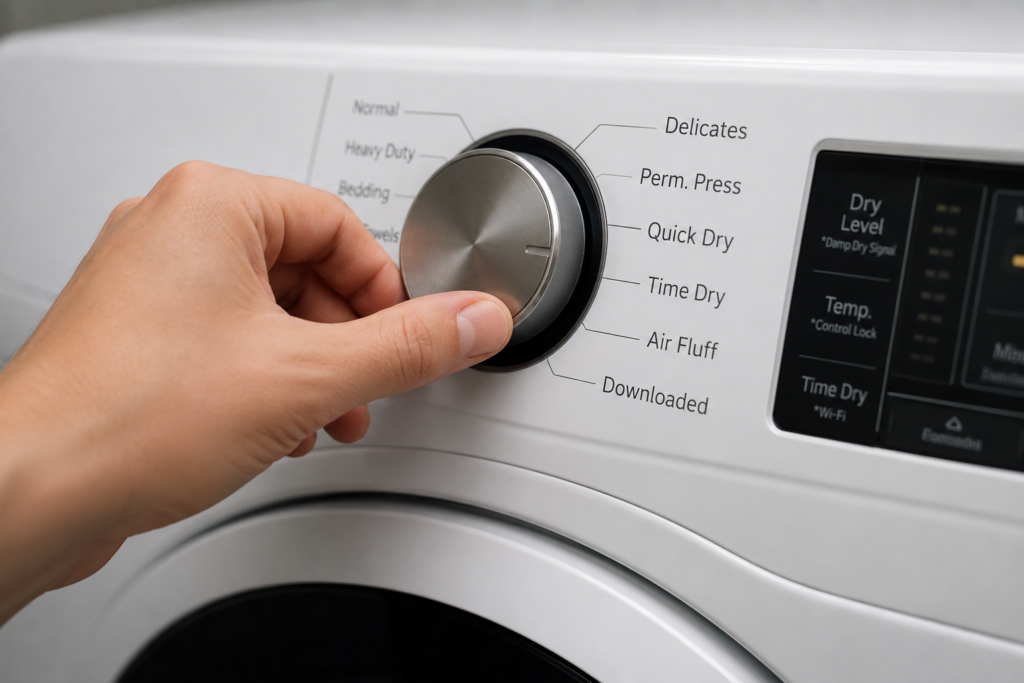
When your dryer cycle selector not working problem starts preventing the machine from changing cycles correctly, the issue is usually related to a damaged selector knob, failing timer assembly, or an electronic control problem. Before assuming the worst, start by checking whether the knob itself is physically damaged or whether a control lock feature has quietly been activated without your knowledge
A dryer cycle selector not working issue may also cause the dryer to freeze on one setting, ignore cycle selections, or fail to start completely. In many cases, homeowners replace expensive parts too early before checking simple causes like a cracked knob, loose wiring connection, or locked control panel.
Quick Troubleshooting Guide
- Selector knob spins freely → Check for a cracked inner knob insert
- Dryer stuck on one cycle → Possible selector switch or timer failure
- Controls completely frozen → Disable control lock and reset the dryer
- Display flickering or resetting → Inspect wiring and control board connections
- Dryer will not start after cycle selection → Check selector communication and timer continuity
Table of Contents
What the Cycle Selector Actually Does (And Why It Matters)
Most people think of the cycle selector as just a dial you turn before pressing start. In reality, it’s doing something more important. Whether your dryer uses a mechanical timer knob, a rotary switch, or a digital touch panel, the selector tells the control system which heat level, drum speed, and run time the machine should use. When it works correctly, you barely notice it. When it fails, the dryer either refuses to start, locks onto one setting permanently, or behaves completely unpredictably.
How the selector communicates depends on your dryer’s design. Older mechanical dryers route the selector directly through a physical timer that controls power to the heating element and motor. Newer electronic models send a signal from the selector through a control board, which interprets the input and runs the appropriate cycle. Both systems can fail. but they fail in very different ways, and understanding that difference is what makes troubleshooting faster and more accurate
The Most Overlooked Cause: A Cracked or Stripped Knob

In most service calls involving a dryer cycle selector not working, the problem turns out to be surprisingly simple. The knob itself is cracked or stripped on the inside. The outer shell looks completely fine, but the inner plastic fitting that grips the selector shaft has broken loose. When you turn the knob, it spins freely without actually rotating the shaft underneath. The dryer sits there waiting for input it never receives.
This is especially common in dryers that have been in use for five or more years. particularly in households where the dial gets turned firmly or quickly on a regular basis. A replacement knob typically costs between $10 and $35 depending on the brand, and installation takes about two minutes.
Before pulling apart your control panel or testing any electrical components, check the knob first. Pull it straight off the shaft and look inside at the plastic insert. If it’s cracked, split, or the metal insert has slipped out, you’ve found your problem
Common Symptoms of a Dryer Cycle Selector Not Working
Not every selector problem looks the same, and the way your dryer is misbehaving can tell you a lot about what’s actually failing. Here’s what different symptoms typically indicate:
- Dryer runs but stays on the same cycle regardless of what you select. the inner shaft connection is likely broken, either inside the knob or at the selector switch beneath it.
- Dryer won’t start after selecting a cycle. check wiring connections at the control panel before anything else.
- Display is flickering, freezing, or showing error codes. the control board or its power supply is the more likely culprit.
- Selector feels completely frozen with no response on any setting. check whether the control lock is active before spending money on parts.
- Knob feels stiff, grinds slightly, or resists turning. lint, dust, or moisture buildup inside the control area is a common and overlooked cause.
Important: A burning smell near the control panel is a warning that demands immediate action. Disconnect power right away and inspect the wiring and switch contacts for signs of arcing or melted plastic. Don’t keep running the dryer electrical damage in the control area can escalate quickly.
Don’t Overlook the Control Lock Feature
One symptom that trips up a lot of homeowners is a selector that appears completely frozen. no response to any input whatsoever. Before spending any money or opening anything up, check whether the control lock feature is active. Many modern dryers include a child lock or control lock that silently disables all inputs. It’s easy to trigger accidentally, and it looks exactly like a serious malfunction when it isn’t.
Look for a small lock icon on the display. To disable it, press and hold the designated lock button for three to five seconds. the exact combination varies by model, so check your owner’s manual if you’re not sure which button it is. This one check has saved many homeowners an unnecessary repair call
Mechanical vs. Electronic Dryers: Why the Fix Is Different
Once you’ve ruled out the knob and the control lock, the troubleshooting path splits based on whether your dryer is mechanical or electronic. Getting this distinction right saves a lot of time.
Mechanical Dryers and the Timer Assembly
On older dryers. particularly Whirlpool, Maytag, and Kenmore models. the cycle selector is physically linked to a timer assembly. This timer uses a small motor and a set of electrical contacts to advance through the cycle and control when heating and motor functions activate. When the timer motor fails or the internal contacts burn out, the dryer may get stuck on a single cycle, fail to advance, or stop mid-cycle without finishing the job.
Testing the timer requires a multimeter. After disconnecting power, you access the control panel, disconnect the wiring from the timer terminals, and check for continuity through the contacts at each position. A reading that falls outside the expected ohm range. typically between 2,000 and 3,000 ohms depending on your model. points to a defective timer that needs full replacement. The motor and contact assembly come as one unit, so there’s no rebuilding individual components here.
Electronic Dryers and the Control Board

Modern dryers from Samsung, LG, GE, and similar brands process cycle selection through an electronic control board. When this board malfunctions, the symptoms can look like almost anything. frozen touch panels, self-resetting cycles, unexplained error codes, or a selector that produces no response at all.
Before assuming the board is dead, try a full power reset. Unplug the dryer completely, wait at least five full minutes, then restore power and test the selector again. Temporary electrical glitches. especially those caused by power surges or brief outages. can freeze the board’s firmware in a way that a simple hard reset clears immediately.
If the reset doesn’t help, inspect the wiring harness that connects the selector panel to the board. A single loose connector or slightly corroded terminal can interrupt communication entirely and perfectly mimic a board failure. Always check wiring before ordering a new board
You May Also Like
If your dryer selector is not responding properly, these related troubleshooting guides may help you diagnose startup problems, control issues, and common dryer failures more accurately.
- Dryer Not Turning On But Has Power: Common Causes and Fixes
- Dryer Not Starting When Pressing Start Button? What to Check First
- Washing Machine Selector Not Working: 9 Easy Fixes That Actually Work
- Washing Machine Display Not Working: Causes and Troubleshooting Guide
- How to Reset a Washing Machine Step by Step
7-Step Troubleshooting Guide for a Dryer Cycle Selector Not Working

Most technicians approach a dryer cycle selector not working issue by starting with the simplest possible causes first before moving toward electrical testing, timer inspection, or control board replacement.
- Check the control lock first. Look for a lock icon on the display and disable it if active.
- Perform a power reset. Unplug the dryer for five full minutes, then restore power and test.
- Inspect the selector knob. Pull it off the shaft and check the inner plastic insert for cracks or a missing metal insert.
- Test across all cycles. If even one cycle responds, that narrows the problem significantly.
- Inspect wiring connections at the control panel for looseness, corrosion, or heat damage.
- Test the timer with a multimeter if your dryer is mechanical and continuity reads out of range.
- Consider the control board only after all other causes have been ruled out.
This sequence moves from free and simple to progressively more involved. which is exactly how a technician approaches it in the field
Dirt and Moisture: The Cause Nobody Talks About
One cause that doesn’t get nearly enough attention is contamination inside the control area. Lint, detergent residue, humidity, and fine dust can work their way into the selector mechanism over time, causing the dial to stick, respond sluggishly, or produce a grinding sensation when turned. This is more common in poorly ventilated laundry rooms and in households that use powder detergent, which generates particles that drift into control panels.
If your selector knob feels physically difficult to turn, disconnect power and carefully remove the knob. Use short bursts of compressed air to clear lint and dust from the surrounding area. Avoid spraying any liquid cleaner directly into the control panel. moisture inside electrical contacts causes more damage than it prevents. A dry microfiber cloth for the surface and compressed air for the interior is the right approach
Expert Tip
If the selector issue happens randomly during humid weather or after long drying cycles, heat and moisture buildup inside the control area may be affecting the selector contacts temporarily. Many dryers get misdiagnosed with a bad control board when the real issue is poor airflow or contamination around the selector assembly.
Repair Costs: Is It Worth Fixing?
The answer depends heavily on what’s failing and how old your dryer is.
| Component | Typical Repair Cost |
|---|---|
| Replacement knob | $10 – $35 |
| Selector switch | $40 – $120 |
| Dryer timer | $80 – $200 |
| Control board | $150 – $350 |
| Professional labor | $75 – $150 per visit |
A new knob or selector switch is almost always worth fixing. the parts are inexpensive and the repair is quick. Timer replacements make sense if the dryer is under eight years old and otherwise running well. Control board replacements are where the math gets harder. On a dryer that’s ten or more years old, spending $250 to $350 on a board plus labor often doesn’t make financial sense when a comparable new dryer costs $400 to $600. If the dryer is newer or a higher-end model, repair is usually the smarter call.
If the dryer is also showing signs of other wear overheating issues, drum noise, inconsistent drying times. factor those into the decision. One failing component is a repair. Multiple failing components in an aging machine is often a replacement
How to Prevent Selector Problems Going Forward
Most cycle selector issues are preventable with consistent habits:
- Turn the dial smoothly and deliberately. Flicking it quickly or forcing it past resistance is the fastest way to crack the inner fitting.
- Clean the control panel area monthly with a dry cloth to prevent lint and dust accumulation.
- Keep the laundry room ventilated to reduce humidity around electronic components.
- Clean the lint trap after every load and inspect the exhaust vent periodically — poor airflow causes excess heat that accelerates wear on control components.
- Use a surge protector for electronic dryers. Power fluctuations are a leading cause of control board failures, and a quality surge protector adds meaningful protection for minimal cost.
When to Call a Technician
DIY troubleshooting handles most selector problems without issue. But some situations genuinely call for professional help:
- You’ve found burnt wiring or melted terminals near the control panel
- The control board needs replacement and you’re not comfortable working with appliance electronics
- The dryer is a gas model and disassembly involves components near the gas valve or igniter
- You’ve worked through every troubleshooting step and still can’t identify the cause
A qualified appliance technician can diagnose the problem accurately, source the correct part, and complete the repair safely. often in a single visit
A dryer cycle selector problem is genuinely fixable in most cases, and it rarely requires replacing the machine. Start with the simplest checks, work methodically through the likely causes, and you’ll usually identify the problem before it costs you much at all. The key is not jumping straight to the most expensive explanation when the answer is often something as simple as a cracked knob or an accidentally activated control lock . Fortunately, most dryer cycle selector not working problems can be repaired without replacing the entire appliance, especially when the issue is diagnosed early and the damaged component is identified correctly.
Common Mistakes to Avoid
- Forcing the selector knob when it feels stiff
- Replacing the control board before checking wiring and the knob itself
- Spraying liquid cleaner directly into the control panel
- Ignoring burning smells near the selector area
- Assuming the timer is defective without proper testing
Frequently Asked Questions
Why is my dryer cycle selector not working after a power outage?
Power surges and sudden outages can freeze or corrupt the firmware on your dryer’s electronic control board, making the cycle selector completely unresponsive even though nothing is physically broken. The first thing to try is a full hard reset — unplug the dryer from the wall outlet, wait a full five to ten minutes, then restore power and test the selector again. This clears temporary electronic glitches in most cases. If the selector still doesn’t respond after a reset, the power surge may have caused actual damage to the control board itself, which would require inspection and likely replacement. Checking your home’s breaker panel is also worth doing, since a partially tripped breaker can cause strange electrical behavior in appliances without completely cutting power.
Can I still use my dryer if the cycle selector is stuck on one setting?
Technically yes, but it depends on which setting it’s stuck on and what you’re drying. If the selector is locked onto a high-heat cycle like Heavy Duty, running delicate fabrics through it repeatedly will cause shrinkage and fabric damage over time. If it’s stuck on Air Fluff with no heat, your clothes simply won’t dry properly. Beyond fabric concerns, a stuck selector often signals an underlying electrical problem — a failing timer, worn switch contacts, or a control board issue — that can worsen with continued use. Running the dryer while ignoring a known control problem isn’t dangerous in every case, but it’s not a situation you want to leave unaddressed for long. Getting the selector diagnosed and repaired sooner rather than later protects both your clothes and the appliance itself
How do I know if my dryer’s selector switch needs to be replaced or just cleaned?
The easiest way to tell the difference is by how the selector behaves across different cycles. If the knob turns smoothly but the dryer only responds to certain settings and ignores others, that’s a strong sign the internal contacts inside the selector switch are worn or burned out — cleaning won’t fix that. On the other hand, if the knob feels physically stiff, grinds slightly when turned, or responds inconsistently in a way that comes and goes, contamination from lint, dust, or moisture is a more likely cause and cleaning is a reasonable first step. Remove the knob, use compressed air to clear out the surrounding area, and test again. If the problem persists or the dryer continues ignoring specific cycle positions after cleaning, the switch itself has likely failed and replacement is the correct fix.
Is a dryer cycle selector problem covered under a home warranty or appliance warranty?
It depends on the type of warranty and what caused the failure. If your dryer is still within the manufacturer’s warranty period — typically one year for most brands — a defective cycle selector, control board, or timer that fails under normal use is generally covered at no cost. You’ll need to contact the manufacturer directly and schedule a service appointment through their authorized repair network. Home warranty plans vary significantly by provider and policy. Most cover mechanical and electrical failures from normal wear, which would include a failed selector switch or timer. However, damage caused by power surges, improper installation, or physical misuse is commonly excluded. Review your specific policy terms or call your warranty provider before scheduling any paid repair, since a covered repair could save you anywhere from $80 to $350 depending on which component has failed.
Appliance Troubleshooting Expert
Muhammad Khalid
Founder of FixAppLab • Appliance Troubleshooting Writer • Home Appliance Research Publisher
Muhammad Khalid is the founder and publisher of FixAppLab , a home appliance troubleshooting platform focused on helping homeowners diagnose and understand real appliance problems in everyday situations. His work covers practical troubleshooting guides for dryers, refrigerators, washing machines, and other major household appliances, with a strong focus on explaining why problems happen, how appliances behave during failures, and what users should realistically check before calling for repairs.
Explore appliance troubleshooting categories including dryer problems , refrigerator problems , and washing machine troubleshooting . Readers can also learn more about the website on the About page , browse the latest appliance articles in the blog section , or contact FixAppLab directly through the contact page .
Connect With FixAppLab
Facebook: facebook.com/fixapplabofficial
YouTube: youtube.com/@fixapplab
Instagram: instagram.com/fixapplab
TikTok: tiktok.com/@fixapplab
Pinterest: FixAppLab Pinterest
Need help or want to contact FixAppLab directly?
Email:
mkhalidjutt302@gmail.com
Phone:
+92 345 1525769


Comments