12 Refrigerator Control Board Problems and Troubleshooting Tips
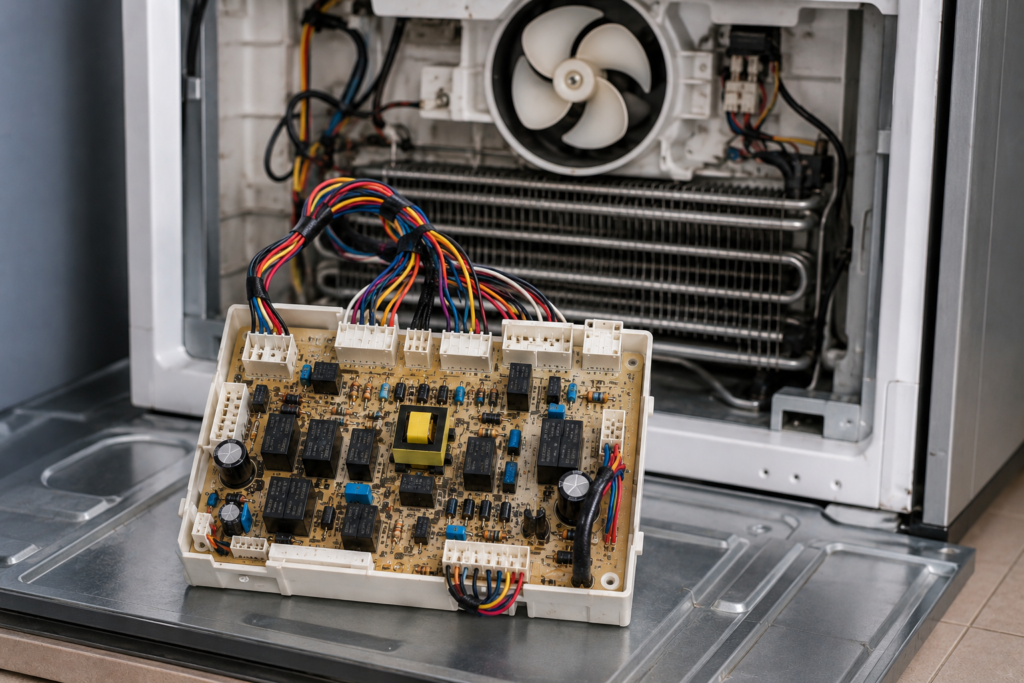
If your refrigerator is acting up. running nonstop, refusing to cool properly, or flashing error codes you can’t clear. the control board is often the real culprit. Refrigerator control board problems are among the most misdiagnosed issues in appliance repair, frequently mistaken for compressor failure, a bad thermostat, or defrost system faults. Before you spend money on a technician or start shopping for a new appliance, understanding how the control board works. and what it looks like when it fails. can save you hundreds of dollars
Quick Key Takeaways
- The control board manages the compressor, fans, sensors, and defrost system.
- Cooling problems, recurring error codes, and fan failures can all indicate control board issues.
- Always test thermistors, heaters, fans, and wiring before replacing the board.
- Many control board symptoms are often mistaken for compressor or thermostat failures.
- A visual inspection can reveal burnt components, damaged relays, or failed capacitors.
- Power surges are one of the most common causes of refrigerator control board failure.
Table of Contents
What the Control Board Actually Does

The control board is the brain of your refrigerator. Every major system in the appliance. the compressor, evaporator fan, condenser fan, defrost heater, ice maker, and temperature sensors .runs through it. When you adjust the temperature setting on the panel, the board interprets that signal and sends the correct instructions to the right components. It monitors sensor data continuously, regulates compressor cycling, and initiates defrost cycles at timed intervals to prevent ice buildup on the evaporator coils.
Most modern refrigerators use two boards working together: the main control board, which governs primary operating functions, and the user interface board, which manages everything you touch on the exterior panel. buttons, touchscreens, and digital displays. Either one can fail independently, and because their symptoms overlap so heavily, accurate diagnosis requires a methodical approach rather than guesswork.
One important thing to understand: refrigerator control board problems don’t always announce themselves with a sudden, dramatic failure. Many develop gradually .a slight temperature inconsistency that slowly worsens over weeks, an error code that clears itself and keeps returning, or a fan that occasionally fails to start. Catching these early warning signs makes the difference between a straightforward board swap and an expensive misdiagnosis.
Common Signs of a Bad Refrigerator Control Board
A failing refrigerator control board can cause several different symptoms because it communicates with many of the appliance’s major components. However, these symptoms do not automatically prove that the control board is defective. Problems with fans, sensors, wiring, the defrost system, or the compressor can produce similar behavior.
The most useful approach is to look for a pattern rather than relying on one symptom. If several unrelated refrigerator functions begin behaving strangely at the same time, the control system becomes more important to investigate.
Signs worth checking include:
- The refrigerator runs inconsistently or stops cooling without an obvious mechanical cause.
- Fans fail to start even though the fan motors and wiring appear to be in good condition.
- Defrost operation becomes irregular and frost repeatedly builds up on the evaporator.
- Temperature readings or settings behave unexpectedly or change without a clear reason.
- Error codes repeatedly return after the refrigerator has been properly reset.
- Several refrigerator functions appear to fail or behave abnormally at the same time.
- The control board shows visible damage such as burn marks, overheated areas, or damaged components.
These signs should be treated as clues rather than a final diagnosis. Before replacing a refrigerator control board, check the simpler possibilities first, including temperature sensors, fans, wiring connections, defrost components, and power supply problems. This can prevent replacing an expensive board when another component is actually responsible.
How to Tell if the Control Board Is Actually at Fault
Refrigerator control board problems can look very similar to failures in other components. A refrigerator that is not cooling, for example, could have a problem with the compressor, condenser fan, evaporator fan, temperature sensor, start device, or control system. Replacing the board without checking these possibilities first can lead to an unnecessary repair.
The best way to narrow down the problem is to follow the symptoms and check the simplest possibilities first. A control board becomes more suspicious when the components it controls test normally but the expected output or operation is still missing.
A practical diagnostic sequence
- Confirm the refrigerator has a stable power supply. Check that the appliance is receiving power and that the circuit breaker has not tripped.
- Look for simple operating issues. Check the temperature settings and make sure the refrigerator has not entered a special mode that disables normal cooling.
- Inspect visible wiring and connectors. Loose plugs, corrosion, damaged insulation, or overheated connectors can interrupt communication between the control board and other components.
- Check the affected component. If a fan, sensor, heater, or other component is not working, determine whether the component itself has failed before blaming the control board.
- Consider the control board only after simpler causes are ruled out. If the wiring and connected components are functioning correctly but the required control signal is missing, professional testing of the board may be necessary.
Important: A visual inspection alone cannot prove that a control board has failed. Some board faults require voltage, resistance, or output-signal testing with the correct service information and equipment. If you are not trained to perform electrical testing safely, it is better to have a qualified appliance technician diagnose the board.
What Causes Refrigerator Control Board Problems?
Refrigerator control boards can fail for several reasons, and the cause is not always related to the board itself. Electrical stress, moisture, heat, component aging, and problems elsewhere in the refrigerator can all contribute to control-system failures.
Identifying what may have caused the failure is important because installing a replacement board without correcting an underlying electrical or component problem can lead to another failure.
Common causes include:
- Power surges: Sudden voltage changes can damage sensitive electronic components, relays, and circuit-board traces.
- Component aging: Capacitors, relays, solder joints, and other electronic components can deteriorate after years of normal operation.
- Moisture and corrosion: Water or condensation near electronic connections can gradually corrode contacts and create electrical problems.
- Overheating: Excessive heat around the refrigerator or poor ventilation can increase stress on electronic components.
- Shorted components: A failing fan, heater, compressor circuit, or wiring fault can sometimes place abnormal electrical load on the control system.
- Software or communication faults: On some smart refrigerators, firmware or communication problems can produce symptoms that resemble a hardware failure.
Good to know: If a refrigerator control board fails shortly after replacement, the original cause should be investigated instead of simply installing another board. A downstream component or wiring fault may be responsible for damaging the replacement.
Quick Signs of a Refrigerator Control Board Problem
A faulty control board can affect several refrigerator functions at the same time. However, these symptoms can also be caused by individual components, so a symptom alone does not confirm that the control board has failed.
- The refrigerator runs continuously or does not start when cooling is required.
- The compressor or refrigerator fans do not receive the expected operating signal.
- Defrost problems return even after the heater and temperature sensor have been checked.
- Temperature readings or digital controls behave inconsistently.
- The same error code repeatedly returns after a proper reset.
- Visual inspection reveals burnt components, damaged relays, or scorched areas on the board.
Common Symptoms of Refrigerator Control Board Problems.
Related Refrigerator Troubleshooting Guides
If you are troubleshooting refrigerator control board problems, cooling failures, compressor issues, fan problems, or temperature fluctuations, these related guides can help you narrow down the cause and choose the right troubleshooting steps.

For official firmware updates and support information, visit the manufacturer’s website:

About the Author
Muhammad Khalid
Founder of FixAppLab | Appliance Troubleshooting Writer
Muhammad Khalid is the founder of FixAppLab, a website dedicated to helping homeowners diagnose and solve common appliance problems. He writes practical troubleshooting guides covering refrigerators, washing machines, dryers, and other household appliances.
His content focuses on real-world appliance issues, including cooling failures, compressor problems, temperature fluctuations, control board faults, drainage issues, and preventive maintenance tips. The goal is to provide clear, easy-to-follow information that helps readers identify problems and make informed repair decisions.
Explore More From FixAppLab


1 comment
[…] Refrigerator Control Board Problems – Symptoms & What to Check […]